
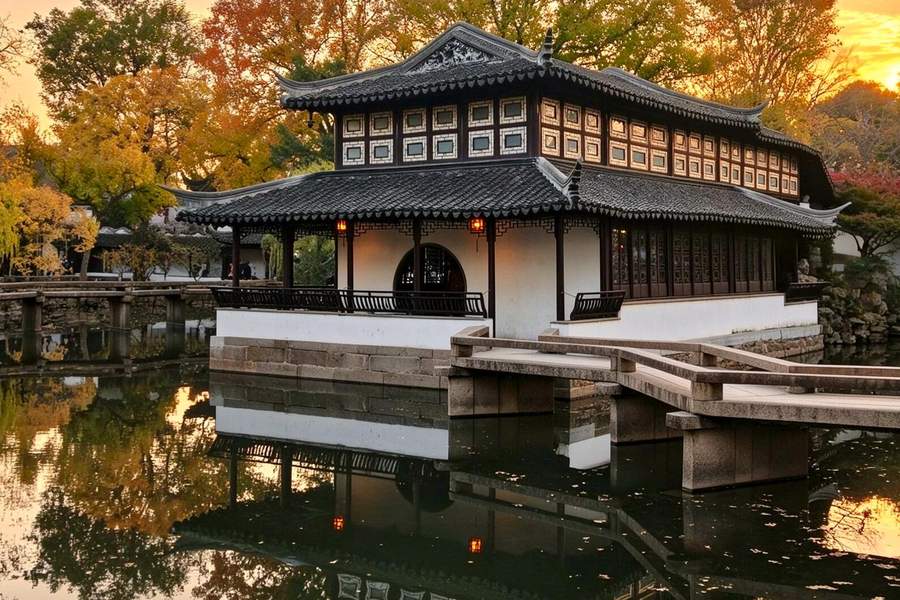
My first trip to Suzhou was a mistake I made in full daylight, in front of witnesses. I came from Shanghai for the day, armed with a list of four gardens, a museum and two canal streets, and I tried to tick them all off before dinner. By the third garden I could no longer tell one rockery from another, my feet hurt, and I was standing in front of a famous pavilion thinking about the train home. Suzhou punished me the way it punishes everyone who treats it like a checklist: it gave me everything I asked for and none of what I came for.
I came back a year later and did almost nothing. I sat in one garden for two hours. I walked one canal street twice, slowly, once in the morning and once after dark. I ate noodles at a counter where nobody spoke English and nobody needed to. That was the trip that worked, and it is the trip this guide is built around. Suzhou is not a city to conquer. It is a city to slow down for.
A city built on water
Suzhou is older than most of the places people fly to China to see. It was founded around 514 BC as the capital of the state of Wu (吴), and it has been a place of gardens, silk and poetry ever since. The Grand Canal (大运河) — the longest canal in the world, dug in sections over centuries — runs right through it, which is why Suzhou became one of the richest cities in imperial China. By the Song dynasty (宋朝), when the capital had moved south, Suzhou was already famous for its gardens, its scholars and its food. The old saying goes: “Above is heaven, below are Suzhou and Hangzhou.” It is not an exaggeration so much as a warning — the city has spent two and a half thousand years being beautiful, and it is not in a hurry.
What you see today is really two cities in one. Suzhou sits in Jiangsu province, on the flat Yangtze Delta where the Grand Canal meets the Yangtze. The old town, Gusu (姑苏), is a grid of canals and whitewashed lanes inside the old city walls, and it is where almost everything in this guide happens. Around it sits the new Suzhou — glass towers, the industrial park, Jinji Lake (金鸡湖) — which is where most of the city’s money is made and where you do not need to spend your time. The old town is the point. It is also, by Chinese standards, small and flat and easy to walk, which is why the worst mistake you can make here is rushing it.
Suzhou’s gardens are the reason most people come, and they deserve their reputation. Nine of them are on UNESCO’s World Heritage list, and they are unlike anything else in China: not the grand imperial gardens of Beijing, but small, private, intensely designed spaces where a retired official would spend his fortune building a miniature landscape — a pond for a lake, a rock for a mountain, a window that frames a tree like a painting. The classical gardens of China are a whole art form of their own, and Suzhou is where that art reached its peak. But the gardens are only half the story. The other half is the canals: the old streets that run alongside the water, the stone bridges, the boats, the teahouses where people still sit for hours listening to Pingtan (评弹), the sung storytelling that has echoed down these lanes for centuries.
If you have already been to Hangzhou, Suzhou will feel like its quieter, more inward-looking sister. Hangzhou has the big lake and the big views; Suzhou has the small lanes and the small gardens, and it rewards the traveller who is willing to look closely. If you have not been to either, start with Suzhou. It is the gentler introduction to old China — and, I would argue, the more rewarding one.
At a Glance
- How long: Three days is the sweet spot. Two days if you are disciplined and skip the water towns; one day from Shanghai is possible but it is exactly the mistake I made first time, and I do not recommend it.
- Where to stay: Gusu old town, on a side street near Guanqian Street (观前街) or Pingjiang Road (平江路). Not on the main street itself — noisy and overpriced — and not near Suzhou North Station or the industrial park. Being near a metro station matters more than being near any single sight.
- Shape of the trip: Day One, the north-east cluster: gardens, museum and Pingjiang Road. Day Two, the west side: Lingering Garden, Tiger Hill and Shantang Street after dark. Day Three, pick one water town — Zhouzhuang (周庄) or Tongli (同里).
- Book ahead: The Suzhou Museum (苏州博物馆) and the big gardens are all reservation-only, and the museum’s slots go fast. Book a week ahead, and book the gardens at the same time so you do not end up with a museum slot and no garden to pair it with.
- Getting around: The metro is your default — Lines 1, 2, 4 and 6 cover everything in this guide. Walk everywhere in the old town. Use a ride-hailing app if you need a car; do not take a street taxi in the old town, where the narrow roads turn a kilometre into a half-hour crawl.
- When to go: Spring and autumn. Late autumn is the prettiest — ginkgo and maple turning gold and red — but it is also the busiest. Summer is hot and humid, winter is grey and cold, and the gardens are at their quietest then, which counts for something.
- My verdict: Suzhou is the most beautiful city in China for travellers who like to look closely rather than tick boxes. If you want spectacle, go to Xi’an. If you want to understand why China fell in love with gardens, come here — and come slowly.
Day One: Gardens, a Museum and an Old Street
Start at the Humble Administrator’s Garden (拙政园), the largest and most famous of Suzhou’s gardens, and go at opening time. This matters more than it sounds. The garden is beautiful at any hour, but it is a different place before the tour groups arrive — quiet, empty, the water still. I have been in twice, once at opening and once in the afternoon, and they felt like two different gardens.
The Humble Administrator’s Garden is the biggest of the classical gardens, and the middle section is the essence of it: the Far Fragrance Hall (远香堂), the 36 Mandarin Ducks Hall (卅六鸳鸯馆), and the borrowed view of Beisi Pagoda (北寺塔) rising over the rooftops beyond the wall. Walk it counter-clockwise, from the west garden into the middle, and save the east garden for last — it is mostly lawns, and it is the part you can skip if your feet give out. Give it two hours and do not try to see everything. The garden is designed to be looked at slowly, one framed view at a time, and the people who enjoy it most are the ones who sit down.
One practical note: the garden is reservation-only, with no on-site ticket sales, so book a few days ahead through the official channel. Do not buy a ticket from a tout at the gate — the “discount” or “queue-jump” tickets are scams, and the garden also sells extra paid shows inside that are not worth it. Bring your own water and food; the garden’s own stalls are overpriced and the best lunch in this part of town is a bowl of noodles on a side street, not inside a garden.
From the garden, it is a two-minute walk to the Suzhou Museum, and the two belong together. The museum is the work of I.M. Pei (贝聿铭), the Suzhou-born architect who designed the Louvre pyramid, and it is as much the attraction as anything inside it. Pei built a modern building out of the old Suzhou vocabulary — white walls, dark rooflines, rock, water and framed views — and the courtyard, with its rockery and still pond, is one of the most photographed spots in the city. Inside, look for the True Pearl Relic Pagoda (真珠舍利宝幢), a Song-dynasty treasure, and the celadon lotus bowl, a Five Dynasties piece so delicate it looks as if it might float.
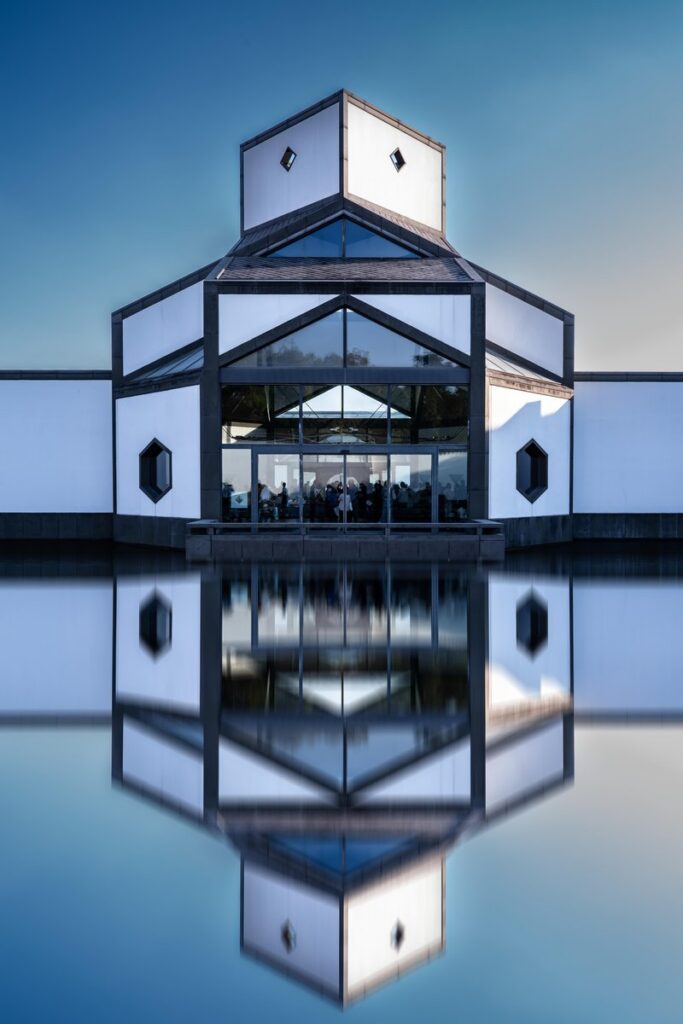
The museum is free, but that does not mean you can walk in. Every visitor needs a real-name timed reservation, made a week ahead through the official WeChat mini-program, and this is where foreign visitors get caught out. The booking form defaults to a Chinese identity card — you have to switch the document type to Passport and enter your passport number exactly, then bring the same passport with you to the gate. The mini-program has an English toggle, which helps, but it may also ask for a mobile number verification that expects a Chinese number. If you get stuck at that step, ask your hotel to help you book; they do this for guests all the time. One more trap: there are two Suzhou Museums. The main building, by the garden, is the one you want. The West Wing (西馆), across town in the new district, is a separate modern building that needs no reservation at all — which sounds convenient, but it is not the I.M. Pei building and it is not in the old town. Do not confuse the two. The museum has a weekly closing day, so check before you go.
By the late afternoon, walk to Pingjiang Road, the old canal street that runs a mile and a half through the north-east of the old town. Pingjiang Road is free, and the best way to see it is to walk it from north to south, slowly, and to turn off into the side lanes whenever one looks interesting. The main street itself is pretty but crowded, and most of the shops on it are not what they pretend to be — the “old shops” are mostly new, the silk is mostly not silk, and the food on the main drag is mostly for tourists. The real old Suzhou is in the side lanes: the washing stones at the water’s edge, the grandmothers chatting on doorsteps, the tiny shrines and the cats. Go early in the morning or in the evening; midday is the worst time, when the street is at its most crowded and the light is at its flattest.
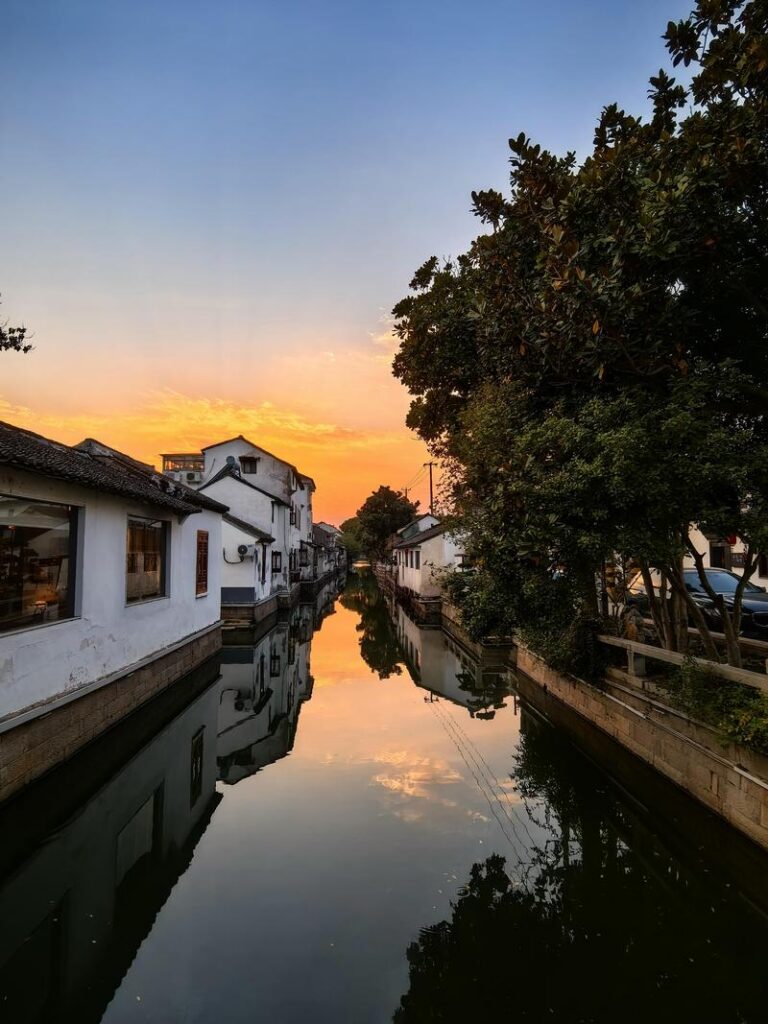
If you stop anywhere on Pingjiang Road, stop for Pingtan. The teahouses along the street host performances of this sung storytelling — a singer with a three-stringed lute, telling a story in the Suzhou dialect — and you do not need to understand a word of it to enjoy it. Sit, order tea, and listen for a while. It is the sound of old Suzhou, and it is disappearing. The hand-rowed boats on the canal are also worth it here; they are better value than the boats on Shantang Street, and the rowers will point out the houses and bridges as you drift along. Eat dinner off the main street, one or two lanes back, wherever you see a local queue.
Day Two: The West Side — Rock, Pagoda and Lanterns
Day Two starts at the Lingering Garden (留园), and if you only visit one garden in Suzhou, the Humble Administrator’s Garden is the one most people pick — but the Lingering Garden is the one I love more. It is smaller and quieter, and it is the most architectural of the gardens: a place of corridors and pavilions and one-step-one-scene views, where every turn opens a new composition. The centrepiece is the Crown Cloud Peak (冠云峰), the tallest Taihu rock (太湖石) in any Suzhou garden, a six-and-a-half-metre slab of pitted limestone that looks like a mountain that has been shrunk. The garden’s corridor runs for the better part of a kilometre, and the Five Peaks Fairy Pavilion (五峰仙馆) at its end is one of the most beautiful rooms in China.
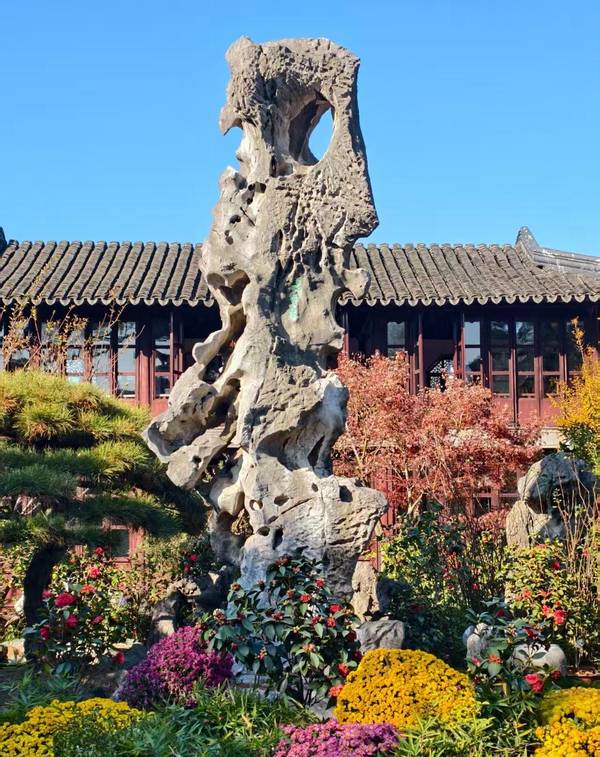
The Lingering Garden is quieter than the Humble Administrator’s Garden, but it is not empty, and it is still best at opening time. There are free guided tours, and first-timers should take one — otherwise you will, as one Chinese blogger put it, walk through in a daze and miss half of what you are looking at. Give it two hours. And remember the rule I learned the hard way: never do two or three gardens in one day. They blur into each other, and you end up remembering none of them. One garden a day, properly, is the pace Suzhou rewards.
From the Lingering Garden it is a short walk to Tiger Hill (虎丘), and the two pair naturally. Tiger Hill is Suzhou’s oldest sight — two and a half thousand years old, a hill that the poet Su Dongpo (苏东坡) called the finest in the region — and it is the one place in Suzhou where you climb something. Enter through the north gate, which is nearest the pagoda, and leave through the south gate, which drops you towards Shantang Street. The Leaning Pagoda (虎丘塔), a thousand-year-old brick tower that leans further than Pisa’s, is the landmark; you cannot climb it — it has been closed for years, and anyone who promises you a climb is lying — but you do not need to. The pagoda is best seen from below, framed by the trees, and the real pleasure of Tiger Hill is the back hill, the quiet part of the park that most visitors never reach. The Sword Pond (剑池) and the Thousand-Person Rock (千人石) are the sights everyone photographs; the back hill, with its bamboo and its empty paths, is the part you will remember.
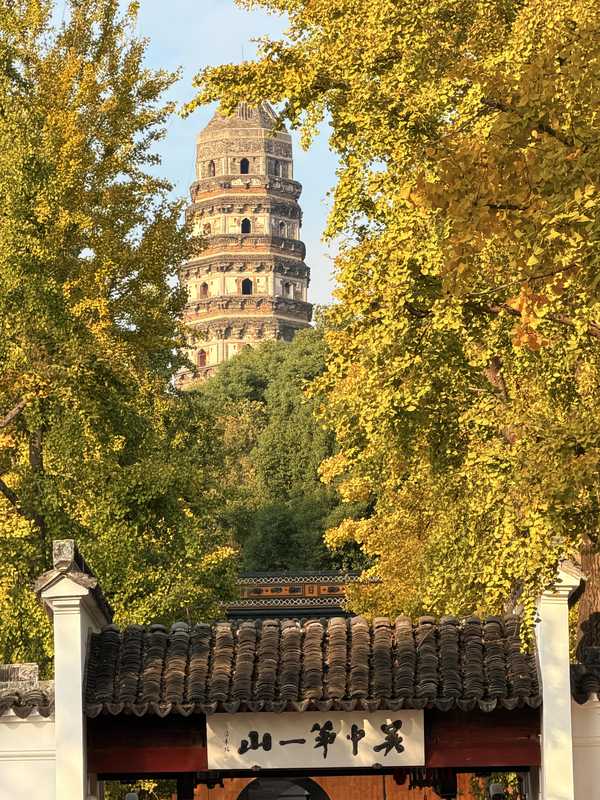
Skip the diversions. The tiger show at the south gate is a waste of time, the “Tiger Hill swords” in the souvenir stalls are factory-made, the paid sightseeing car is unnecessary on a hill this size, and the combined Tiger Hill-plus-Shantang boat ticket sold at the gate is marked up — buy your boat ticket at the wharf itself, if you buy one at all.
Hanshan Temple (寒山寺) sits on the way between Tiger Hill and Shantang Street, and it is the most famous temple in Suzhou for the worst reason: a poem. The Tang-dynasty poet Zhang Ji (张继) wrote “Night Mooring by Maple Bridge” (枫桥夜泊) here, and the temple has been trading on it ever since. It is small, it is commercial, and the bell that the poem made famous is not something you can simply walk up and ring — the famous midnight ringing is a separate ticketed event, and on an ordinary day the bell is behind a rope. I include it here because you will walk past it, and the Puming Pagoda (普明宝塔), seen through the rooftops, is genuinely photogenic. Go in, look around, leave within the hour, and do not plan your day around it. The better temple is Xiyuan Temple (西园寺), nearby and near the Lingering Garden, which is quiet, working and largely free of the crowds.
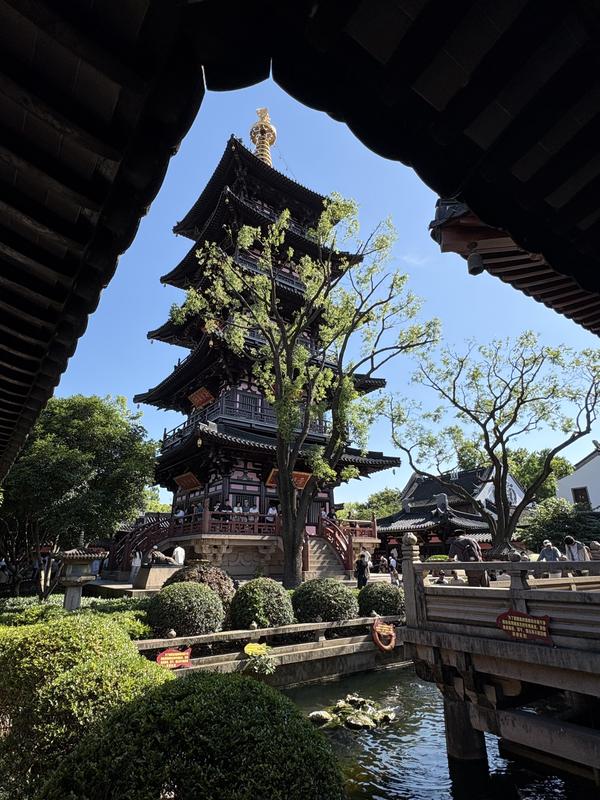
The evening belongs to Shantang Street (山塘街), and only to the evening. The old saying is that Shantang Street at night is the correct way to see it, and it is true: the lanterns come on, the stone bridges light up, and the whole street turns into the postcard. Walk from Xinmin Bridge (新民桥) towards Tonggui Bridge (通贵桥), and navigate to “Xinmin Bridge” or “Qili Shantang” (七里山塘) rather than “Shantang Street” — the wrong starting point is three kilometres away, and it is a mistake people make constantly.
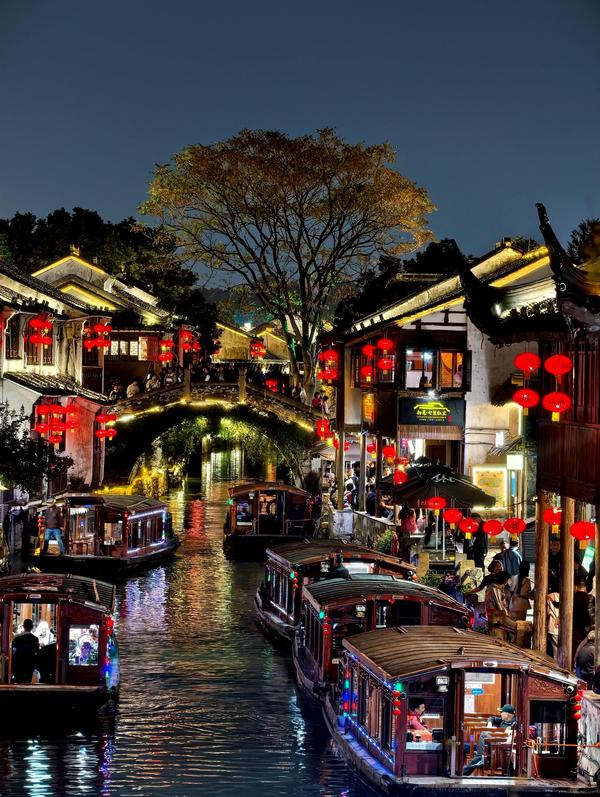
The boat is where Shantang Street catches people out, so listen carefully. There are two boats, and they are not the same. The Tourist Service Centre boat, the one that leaves from the big visitor centre, runs the inner river with sealed windows and a looped video, and you will see almost nothing. Avoid it. The boat worth taking is the Grand Canal line from Baijuyi Wharf (白居易码头), with Pingtan and tea on board, or the hand-rowed boat at dusk — and before you board any boat, ask two questions: is this the Grand Canal line or the inner river line, and do the windows open? Buy only at the official wharf, never from a hawker. If the boats do not appeal, the walk is the thing: the lanterns, the reflections, the smell of food from the stalls, and the bridges, which are at their best after dark.
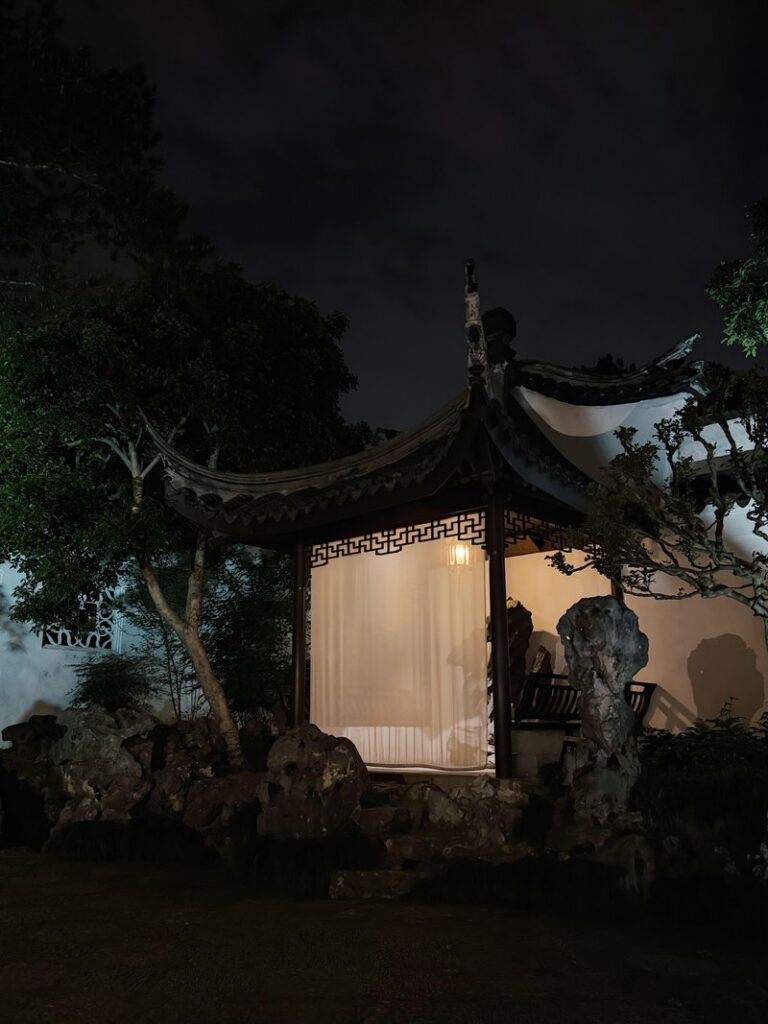
If Shantang’s crowds put you off — and on a weekend evening they might — there is a quieter way to spend the night. The Master of the Nets Garden (网师园) opens in the evening, with lanterns and music and performances in the pavilions, and it is the most atmospheric thing in Suzhou after dark. It is small, it is calm, and it is the opposite of a crowded canal street. Pick one or the other; do not try to do both in one night.
Day Three: Pick a Water Town
Suzhou’s old town is a water town in itself, but the famous water towns are outside the city, and a day trip to one of them is the best use of your third day. You have two real choices, and they are genuinely different — so choose on the basis of what you actually want, not on the basis of which one is more famous.
Zhouzhuang is the famous one, the most visited water town in China, and the one with the iconic photograph: the Twin Bridges (双桥), two stone bridges meeting at right angles over the river. Half a day is enough for the daytime core — the old archway, the Twin Bridges, the Shen Hall (沈厅) and the Zhang Hall (张厅), the two merchant houses that are the must-see interiors — but the town only really earns its reputation after dark, when the lanterns come on and the night show, Only This Zhouzhuang (只此周庄), plays out on the water with its famous fish lanterns. The show is the reason to stay overnight, and if you go, watch the show first and stroll the town afterwards, when the streets are at their quietest.
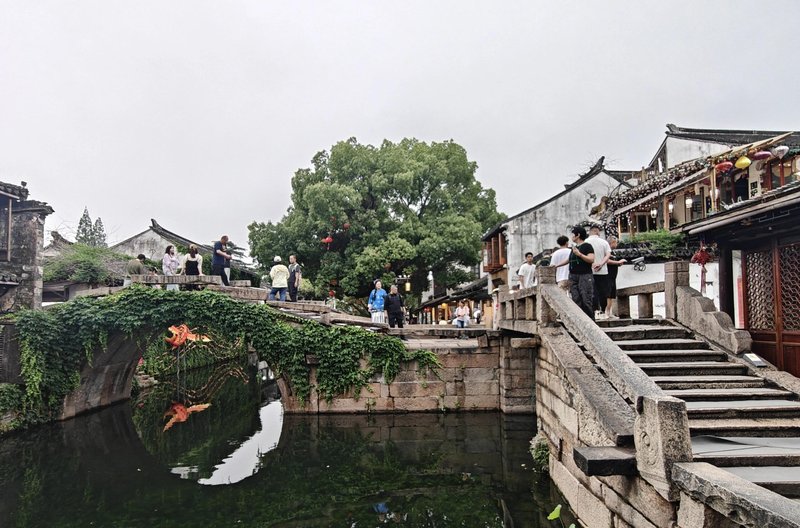
Zhouzhuang has rules, and they are all worth following. Take the official direct bus from the north square of Suzhou Station — it is the simplest way there, and it takes about an hour and a half. Do not take a tout’s private car or three-wheeler at the gate. Enter through the old archway gate, not the visitor centre on Aidu Road (爱渡路), which is a kilometre away and whose shuttle is a trap. See the Twin Bridges before the tour groups arrive, and go into the Shen Hall and Zhang Hall in the morning, because they close in the late afternoon. Take only the official pier boats, and share a boat with other passengers — never a roadside “private boat”. Eat in the alleys, not on the main street, where the food is overpriced. Do not follow the “wild guides” who approach you at the gate; they are paid to deliver you to silk and jade shops. And go on a weekday. On a public holiday, Zhouzhuang takes more than ten thousand visitors a day, and the town that is famous for its quiet becomes a queue.
Tongli is the quiet alternative, and it is the one I would pick if I were going back tomorrow. It is a Song-dynasty town of fifteen rivers and forty-nine bridges, and people still live in it — washing, cooking, chatting on doorsteps — which is the thing Zhouzhuang has mostly lost. It is also much easier to reach: the metro runs most of the way there, and a short bus ride from the station drops you at the north gate. The soul of Tongli is the Tuisi Garden (退思园), a UNESCO-listed garden built on the water, which is the single best garden in any of the water towns and worth the trip on its own. Walk the Three Bridges (三桥) — Taiping (太平), Jili (吉利) and Changqing (长庆) — which locals walk for luck, and take the official boat if you take one at all; the per-person quotes you will hear at the roadside are black boats.
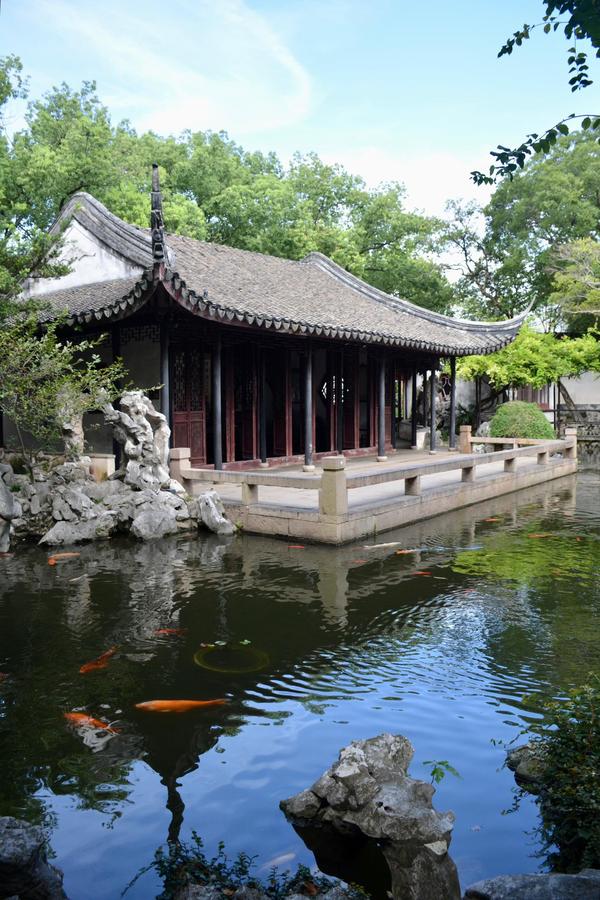
So which one? If you want the iconic photograph, the night scene and the show, go to Zhouzhuang. If you hate crowds, if you are travelling with children or older parents, if you love gardens, or if you simply want the easier journey, go to Tongli. And if you have the energy, both fit in one day — Tongli in the morning, Zhouzhuang in the afternoon, with a short taxi ride between them. There is also a third option, for travellers who have already seen a water town and want something quieter: Mudu (木渎), a garden town on the metro line with a free main gate, where the Yan Family Garden (严家花园) rivals the city gardens and the autumn maples of Tianping Mountain (天平山) are the best in the region. It is the water town for people who have already done the famous ones.
What to Eat
Suzhou food is the hardest food in China to describe to a foreigner, because the first thing you have to say about it is a warning: it is sweet. Not dessert-sweet, but sweet in the savoury dishes — sweet in the braised pork, sweet in the sauces, sweet in the snacks — in a way that surprises people who arrive expecting the heat of Chengdu or the salt of the north. Chengdu taught me to love heat; Suzhou taught me to love sweet, and it took me a day to adjust. If you do not like sweet food, order carefully and ask for less sugar. If you do, you are in for one of the great food cities in China.
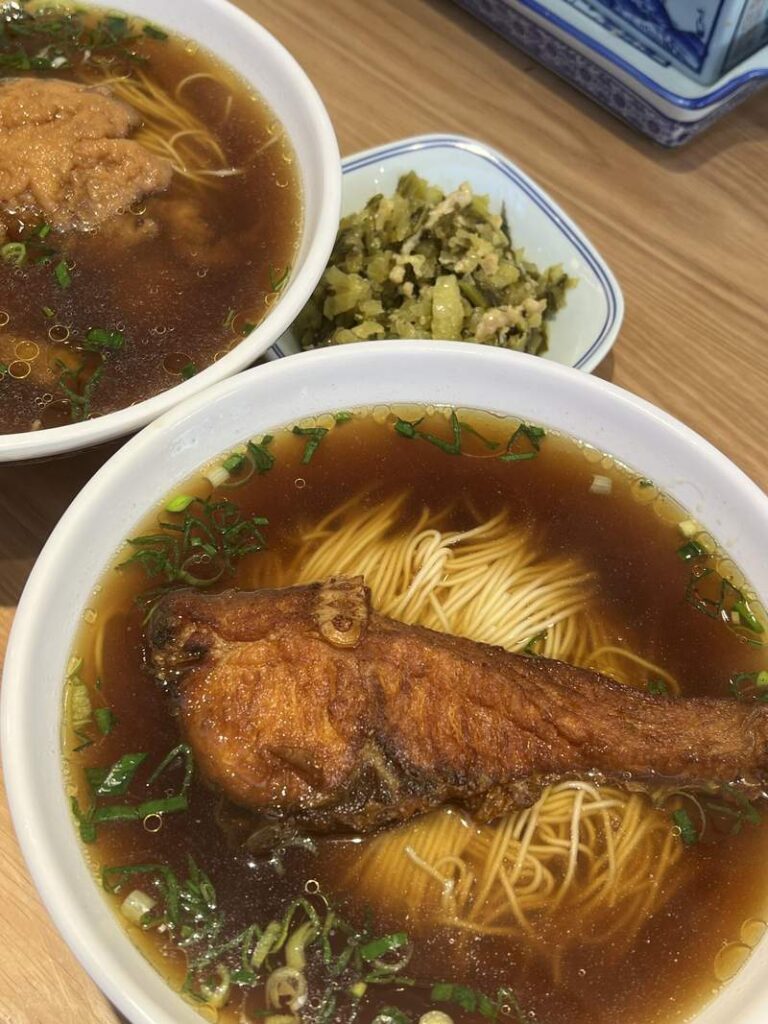
Start with the noodles. Suzhou-style soup noodles (苏式汤面) are the city’s defining dish: fine noodles in a clear, slightly sweet broth, with the topping — the jiaotou (浇头) — served separately on top. It is breakfast food, and the best shops sell out and close by the early afternoon, so go in the morning. The names to look for are Tongdexing (同得兴), in Jiayu Fang (葭沣坊), and Weijin Ao Noodles (伟记奥面馆) near Pingjiang Road; Xucheng Aozao (胥城奥灶面) and Zhuxinnian (朱新年) on Shantang Street are also good, and the last of those does the city’s best fresh-meat xiaolong (鲜肉小笼) too. Do not be put off by the queues — in Suzhou, a queue outside a noodle shop is the most reliable review you will ever get.
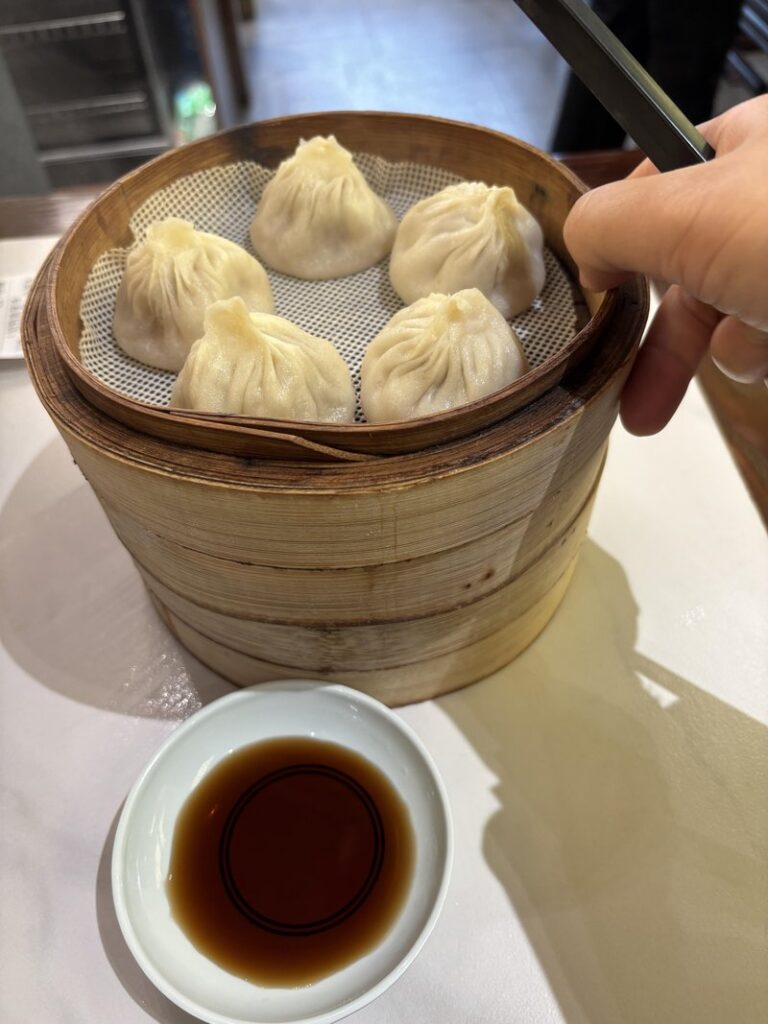
The xiaolong deserve their own paragraph, because they are not the xiaolong you know from Shanghai. Suzhou’s are smaller, thinner-skinned and sweeter, and they are eaten with vinegar and ginger, not with a spoon and a straw. Go to Zhuxinnian in the morning, before they sell out, and eat them standing at the counter like everyone else. While you are in the snack mood, try the crab-shell pastry (蟹壳黄) from Pan Jilong (潘记隆) and the sugar porridge (糖粥) from Pan Yulin (潘玉麟糖粥) on Pishi Street (皮市街) — both are the kind of small, specific, perfect things that Suzhou does better than anywhere else. The one snack to skip is the bamboo-tube milk tea sold on the main streets; it is a tourist trap, and it tastes like one.
For a proper meal, Suzhou’s own cuisine is called Su-bang cuisine (苏帮菜), and it is one of the great regional cuisines of China — delicate, precise and sweet, built on the fish of Taihu Lake (太湖) and the vegetables of the Yangtze Delta. The dish to order is squirrel fish (松鼠桂鱼), a whole mandarin fish scored, fried and sauced until it looks like a squirrel’s tail, which is exactly as strange and exactly as good as it sounds. The locals’ restaurant for it is Wuji Xiaoyuanlou (吴记小园楼), on Baita East Road (白塔东路), which also does the best hairy-crab rice cake in the city in autumn; Gusu Jiayan (姑苏家宴), on Pingjiang Road, is the other name people give, though you will queue for it. If you want the vegetarian side of Suzhou, the vegetarian noodles at Xiyuan Temple are worth the queue — long, but fast-moving.
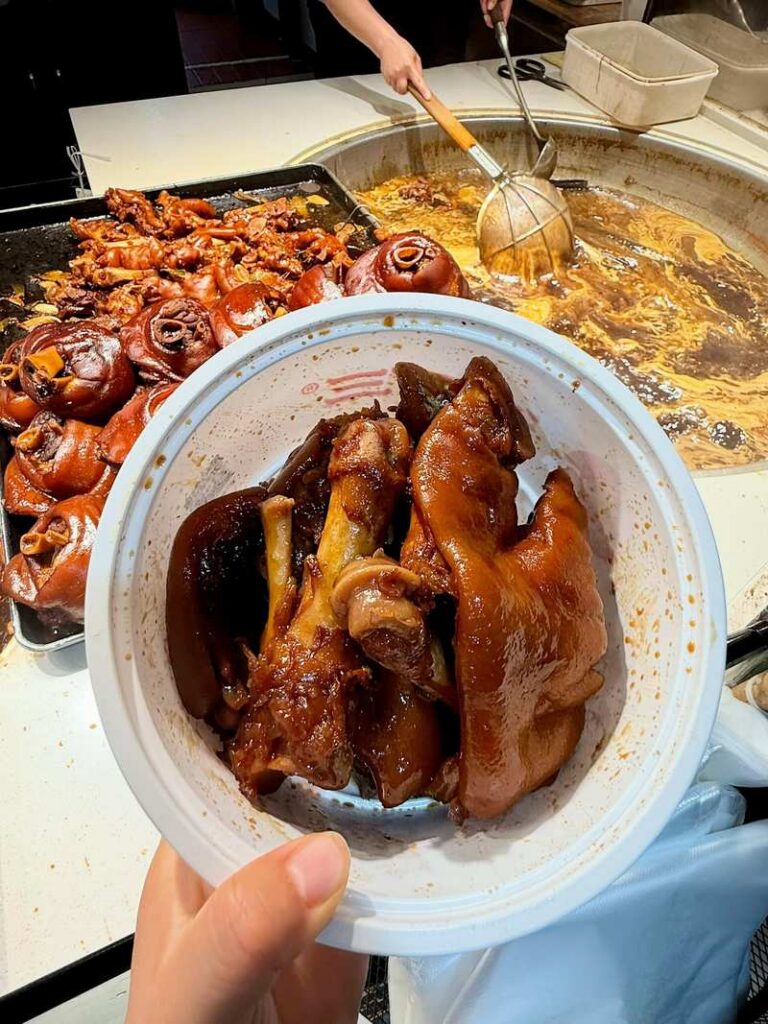
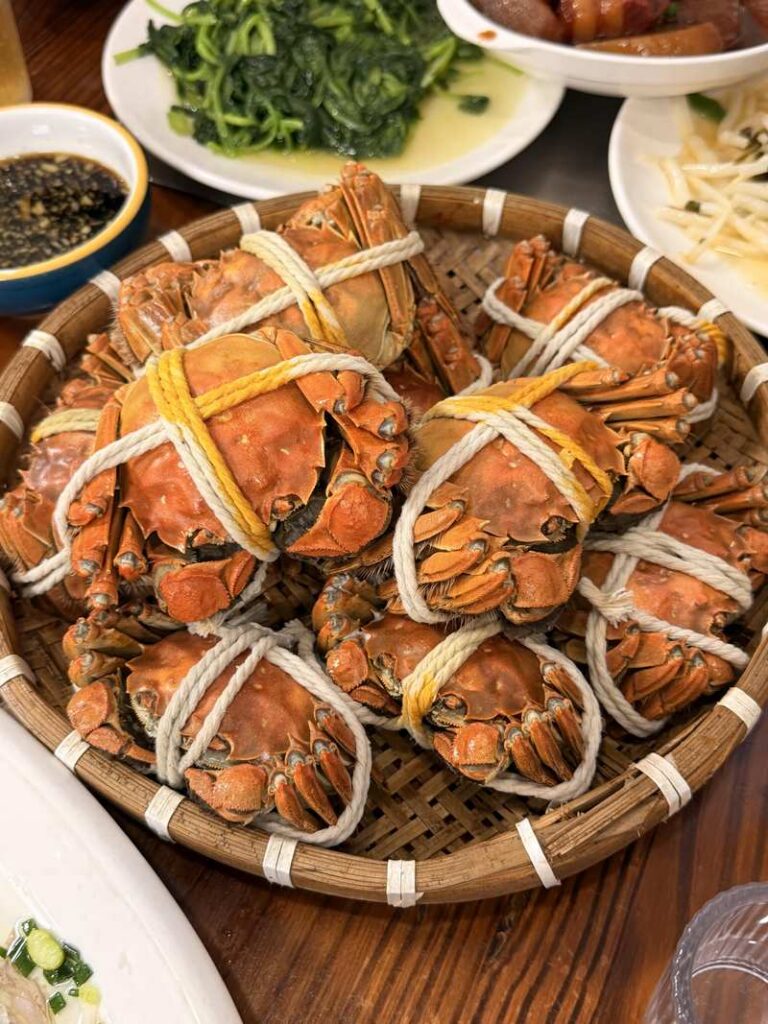
Two things in Suzhou are famous and both come with a warning attached. The first is Wansan pork trotter (万三蹄), named after the Ming-dynasty merchant Shen Wansan (沈万三), a whole pig’s trotter braised until it is glossy and sweet and falling apart. It is very sweet, very fatty and very much an acquired taste — try a small portion once, and do not buy the vacuum-packed souvenir version, which is not the same thing. It is also, strictly speaking, a Zhouzhuang dish, not a Suzhou one, which is why the best place to try it is in Zhouzhuang itself. The second is the hairy crab (大闸蟹) of Yangcheng Lake (阳澄湖), which is in season only in autumn, and which you should eat steamed whole, with ginger and vinegar, and nothing else. The local rule is “females in the ninth month, males in the tenth” (九雌十雄) — females are best in early autumn, males later — and at the end of the season it is the males you want. Do not eat the crab-roe noodles. Every blogger in Suzhou will tell you the same thing: Suzhou has no traditional crab-roe noodle dish, the roe is frozen paste, and the noodles are the number-one tourist trap in the city. Eat the crab itself, not the noodle. And never buy a crab gift card — the cards are the biggest scam in the crab trade, often impossible to redeem — and never buy crabs from a roadside tent or a stall on a tourist street.
Finally, the tea. Biluochun (碧螺春), the green tea grown on Dongting Mountain (洞庭山) in Taihu Lake, is one of the most famous teas in China, and it is also one of the most faked. The scam is well documented: scenic-area tea shops buy ordinary leaves cheaply and sell them at many times the price, and the only defence is to buy from a known brand shop or not to buy leaves at all. The low-risk way to taste Biluochun is the Biluochun ice cream at Sanwanchang (三万昌), which is a legitimate shop and a genuinely good ice cream. If you want to understand Chinese tea culture properly, start there — with a cone, not a purchase.
A few general rules, learned the expensive way. Do not eat on the main streets — Pingjiang Road, Shantang Street and Guanqian Street are where the tourist food is, and the good food is always one or two streets back, where the queues are local. Do not trust the word “old shop” (老字号) on a sign; in Suzhou it is a marketing term, not a guarantee. Do not buy food sold by weight on a tourist street, whether it is osmanthus cake or fruit salad — the price will not be the one you think it is. And do not eat Suzhou hotpot in a scenic area; it is not a Suzhou dish, and it is not good.
Booking, Honestly
Suzhou is not the hardest city in China to book, but it is the city where a small booking mistake costs you the most, because the thing you failed to book is the thing you came to see. Three things need booking, and one thing needs choosing carefully.
The museum first. The Suzhou Museum’s main building is free, reservation-only, and the slots go fast — book a week ahead through the official WeChat mini-program, switch the document type to Passport, and bring the same passport to the gate. If the mini-program asks for a mobile number you do not have, ask your hotel to help. Book the Humble Administrator’s Garden at the same time, through its own official channel, so the two line up on the same day; the garden is reservation-only too, with no on-site sales. The Lingering Garden and Tiger Hill are also reservation-only, and the same rule applies: book ahead, book through the official channel, and do not buy from anyone standing outside the gate.
The thing to choose carefully is your train station. Suzhou has five high-speed stations, and arriving at the wrong one is the most repeated warning in every Suzhou guide written by a local. Suzhou Station (苏州站), in the city centre, is the first choice — it is on the metro, and it is near the gardens, the museum, Pingjiang Road and Shantang Street. Suzhou North Station (苏州北站) is a different place entirely, a long metro ride away; it is an acceptable fallback and nothing more. Suzhou South Station is not to be chosen at all. If you are coming from Shanghai, take the high-speed train from Shanghai Hongqiao; the journey is well under an hour, and you will be in the old town before you have finished your coffee.
Inside the city, the metro is the default and walking is the pleasure. Lines 1, 2, 4 and 6 are the tourist lines, and the Leqiao (乐桥) interchange is the one you will use most, for Guanqian Street. Do not take a street taxi in the old town — the roads are narrow, the traffic is slow, and a kilometre can take half an hour. If you need a car, use a ride-hailing app, and at Suzhou Station, do not hail a car at the exit, where the touts will ask you if you want a ride; use the metro or the proper taxi rank. Shared bikes are the best way to cover short hops in the old town, if you can use them.
Where to stay matters more than it sounds, because the wrong base will cost you an hour a day. Stay in Gusu old town, on a side street near Guanqian Street or Pingjiang Road, near a metro station. Do not stay on the main street itself, which is noisy and overpriced, and do not stay near Suzhou North Station, the industrial park or the new district if this is your first trip to the old town. If you have to choose between a courtyard guesthouse and a hotel at the same price, pick the hotel. The guesthouse is the more romantic choice — a courtyard, a garden view, a sense of old Suzhou — but the rooms are small, the walls are thin, the heating and air conditioning are weak, and finding a lane in the dark with a suitcase is nobody’s idea of a holiday. A hotel registers foreign guests without fuss, holds your luggage and keeps you warm in winter. Book weekends early; Suzhou is a weekend city for Shanghai, and the good hotels go first.
One last warning, and it is the most important one in this guide. Do not buy a cheap one-day tour. The low-price tours that are sold in hotel lobbies and at scenic-area gates promise “no forced shopping” and then deliver you to a silk museum and a pearl museum, where the pressure starts. Go independently, or take the official direct bus to the water towns. Suzhou is an easy city to do on your own — the metro works, the signs are in English, and the gardens are designed to be wandered, not toured.
What I’d Skip
Hanshan Temple, as a destination. Go past it, look at the pagoda, and move on. The poem is better than the temple, and the temple knows it. Xiyuan Temple, nearby, is the better temple, and it is quiet.
Two or three gardens in one day. I did this on my first trip, and I remember none of them properly. One garden a day, slowly, is the pace. If you have only one day, pick the Humble Administrator’s Garden and the museum, and leave the rest for next time. Suzhou rewards the traveller who comes back.
The one-day tour packages. The silk museum, the pearl museum, the “free” lunch that is not free. Suzhou is one of the easiest cities in China to do independently, and the tours exist to sell you things.
Eating on the main streets. Pingjiang Road, Shantang Street and Guanqian Street are where the tourist food is. The good food is one or two streets back. This is true in every city in China, and it is especially true here.
Buying silk, tea or swords on a tourist street. The silk is not silk, the tea is not Biluochun, and the swords are factory-made. If you want silk, go to a proper shop; if you want tea, go to a brand shop; if you want a sword, ask yourself why you want a sword.
Zhouzhuang on a public holiday. The town takes more than ten thousand visitors a day, the bridges become queues, and the quiet that made it famous disappears. Go on a weekday, or go to Tongli instead.
Luzhi (甪直), as a Zhouzhuang replacement. It is a pleasant half-day and its Baosheng Temple (保圣寺) holds Tang-dynasty clay arhats that are a national treasure, but it is thin on sights, and if you have only one water-town day, it is not the one to spend it on.
Summary
Suzhou is the city I recommend most often and visit most reluctantly, because every time I go back I am reminded of how badly I did it the first time. It is not a city of spectacles. It is a city of small things done beautifully: a garden the size of a courtyard, a bowl of noodles eaten standing up, a canal at dusk, a song in a teahouse, a rock that looks like a mountain. The travellers who love Suzhou are the ones who slow down enough to notice those things, and the travellers who do not are the ones who tried to see four gardens before dinner.
Come for three days. Spend the first in the north-east, with the Humble Administrator’s Garden and the museum and Pingjiang Road. Spend the second in the west, with the Lingering Garden and Tiger Hill and Shantang Street after dark. Spend the third in a water town, and choose it on the basis of what you want rather than what is famous. Eat noodles in the morning, xiaolong at the counter, squirrel fish for dinner, and crab in autumn if you are lucky enough to be here then. Book the museum a week ahead, arrive at Suzhou Station, stay on a side street in the old town, and do not buy a one-day tour.
Above is heaven, below are Suzhou and Hangzhou. Heaven can wait. Suzhou is here, and it is not in a hurry — and neither should you be.