
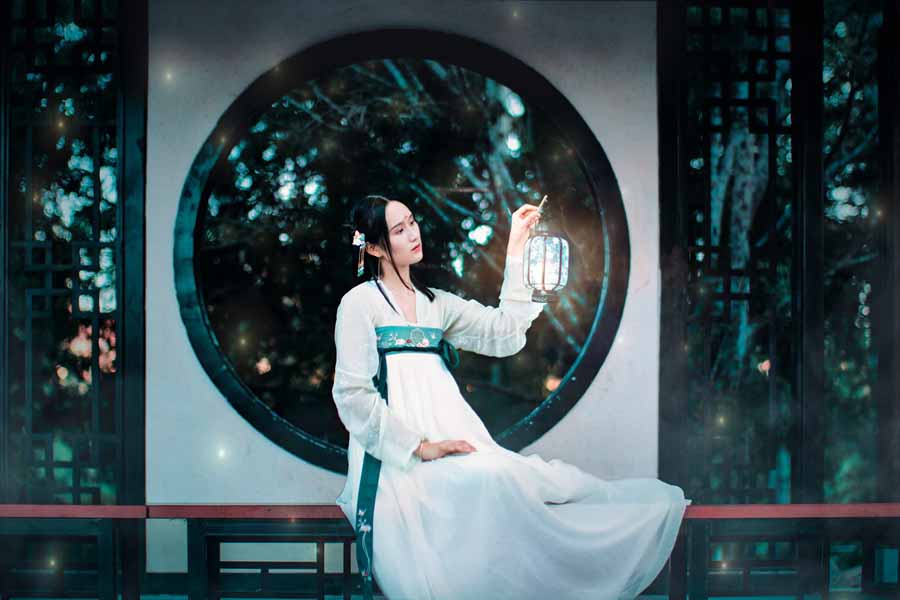
The first time I came to Chengdu, I arrived with a list of sights and a plan to work through it quickly. By the second afternoon I had abandoned the list. I was sitting in a park teahouse with a bowl of tea I had already refilled twice, watching old men play mahjong, and I understood that Chengdu does not reward rushing. It rewards sitting still. I have been back many times since, and my advice has never changed: give it three days, go early for the pandas, and leave your afternoons loose.
Chengdu is often described as the only major city in China to have kept the same name for more than 2,300 years, and it has been a capital for much of that time. It was the capital of Shu Han (蜀汉), one of the three rival states of the Three Kingdoms period, from 221 to 263. The plain around it is known as the Land of Abundance (天府之国), because an ancient irrigation system made it rich farmland two thousand years ago. Chengdu also gave the world its first government-issued paper money: in 1024, under the Song dynasty, an office here issued jiaozi (交子), printed notes that replaced heavy iron coins. Pandas, poetry, paper money and hot pot — few cities pack in that much.
For a first visit, the shape of the trip is simple. Day one starts with the pandas and ends in the old alleys and the bright shopping streets. Day two is the quiet one: a poet’s garden cottage, a park teahouse, and the Three Kingdoms shrine with its lantern-lit street. Day three is a choice between two day trips in opposite directions — pick one and enjoy it rather than attempting both. That is the plan I give friends.
At a Glance
- How many days: Three. Two will cover the pandas and the centre at a rush, but you will miss the teahouse afternoons, which are the point.
- Where to stay: I stay near Chunxi Road (春熙路) or Tianfu Square (天府广场), for the metro and the food, or near People’s Park (人民公园), for the teahouses and the slower streets. Being close to a metro station matters more than anything else.
- The shape of the trip: Day one at the panda base, the old alleys and the shopping streets. Day two at the poet’s cottage, the park teahouses and the Three Kingdoms shrine. Day three out of the city, to the irrigation works or the giant Buddha.
- Book ahead: The panda base and the popular museums need advance booking through the official channels. I sort these out before I arrive. Rules change, so check the official channels for the latest.
- Getting around: I use the metro and taxis. The centre is flat and walkable, and the sights in town cluster in twos and threes.
- When to go: Spring and autumn are the most comfortable. Summer is hot and humid. Winter is grey and damp, but quieter.
- My verdict: Chengdu is the most relaxing first stop in China I know: superb food, history close at hand, and a city that runs at a walking pace.
Day One: Pandas, Old Alleys and Bright Lights
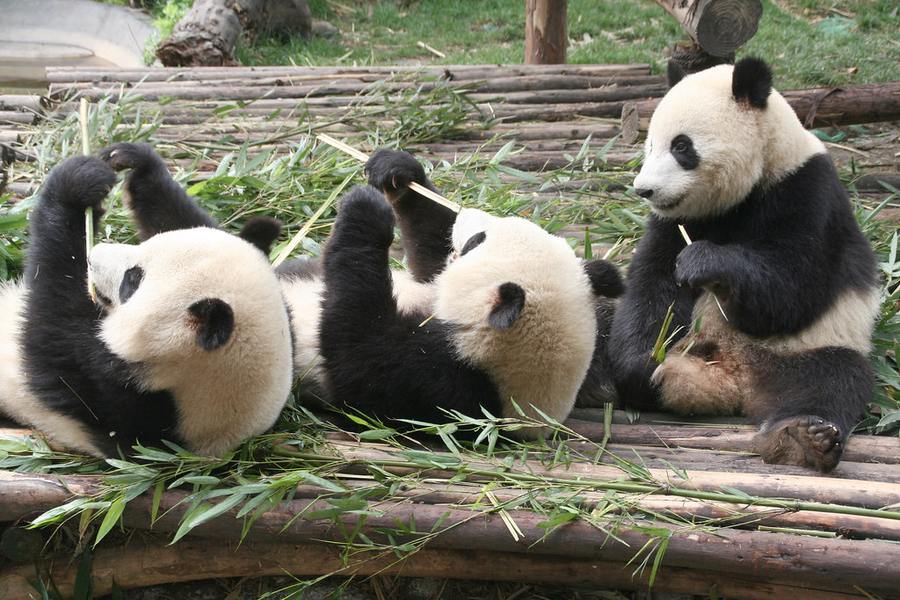
Start with the pandas, and start early. The Chengdu Research Base of Giant Panda Breeding sits on the north edge of the city, and the pandas are at their liveliest in the morning, eating bamboo and tumbling about. By the middle of the day most of them are asleep, and on hot days they retreat indoors where you can barely see them. I take Metro Line 3 to Panda Avenue station and the free shuttle between the gates to the west gate, or a taxi from the centre if I am with friends. Book through the official channels before you go, and check them for the latest rules, because they change.
I go in at the west gate. My rule, learned over several visits, is that the west side holds more pandas, closer together, with fewer people pressing around them. The south gate suits you better if your one aim is the celebrity pandas and you are willing to queue for them. I never queue for Hua Hua (花花), the famous one: I would rather spend the same hour watching a dozen other pandas eat bamboo in peace. Give the base a good half day. The three Moon halls near the west gate are my first stop, then the wooded enclosures beyond, where the keepers will tell you which hall has pandas out if you ask. The red pandas are as charming as the giants and far less crowded. I skip the sightseeing bus inside the base — the halls connect well enough on foot — and walk out through the other gate.
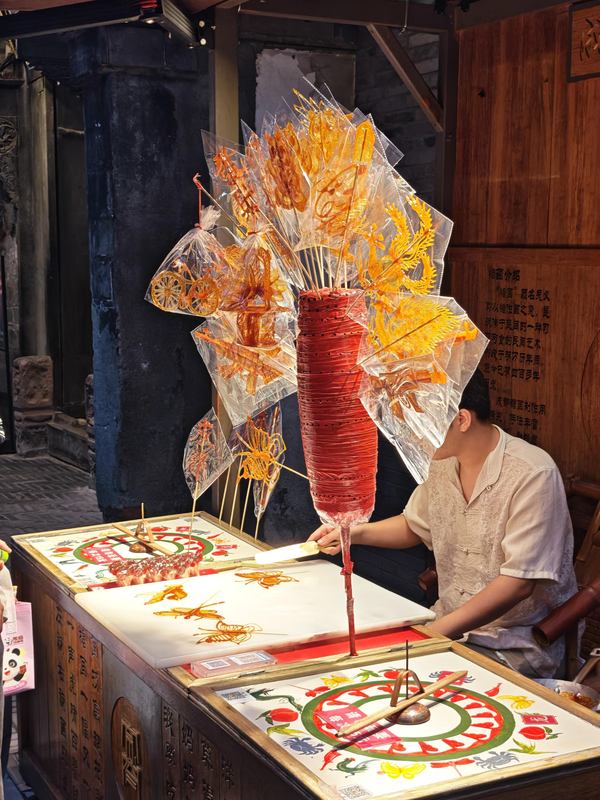
In the afternoon, go to Kuanzhai Alley (宽窄巷子), the Wide and Narrow Alleys. This was the garrison quarter of the Manchu soldiers stationed here in 1718, under the Kangxi Emperor (康熙): troops of the Manchu Eight Banners (八旗) lived in courtyard houses inside a walled quarter called Shaocheng (少城), the Lesser City. Three parallel lanes survive — Wide Alley, Narrow Alley and Well Alley — on the old street plan, though much of what you see is rebuilt, and the district reopened in its present form in 2008. I walk it in one direction, from the east square through Wide Alley and Narrow Alley to Well Alley, and out at the west square. Well Alley is the quietest, and my favourite at dusk. Watch for the sugar-painting vendors, who paint dragons and phoenixes out of hot sugar syrup while you wait.
I am honest with friends about Kuanzhai Alley: it is beautiful, it is crowded, and it is built for visitors. The silver shops and snack stalls repeat themselves, and the restaurants inside charge far more than the same food costs a few minutes away. I still go, for an hour or two in the late afternoon, because the courtyards are genuinely lovely. But I eat outside the alleys. Kuixinglou Street (奎星楼街), a short walk away, is where I go for dinner: hot pot, skewers, small dishes, and plenty of locals eating alongside me. That is the pattern for the whole trip — look inside the famous streets, eat on the ordinary ones.
For the evening, head for the bright lights. Chunxi Road is the big shopping street, and the climbing panda on the IFS building is the photograph everyone takes — a giant panda clambering up the glass, best seen from the street below. Taikoo Li (太古里), next door, is the open-air shopping quarter built in old Sichuan style, and it is at its best in the evening, when the lanes fill up and the lights come on. Tucked inside it is Daci Temple (大慈寺), suddenly quiet after the shopping crowds, all red walls and old trees. I go for the panda photograph and the evening air, not for shopping: Chunxi Road sells the same brands as every other big city, and I did not come to Chengdu for that.
Day Two: The Poet’s Cottage, the Teahouses and the Three Kingdoms Shrine
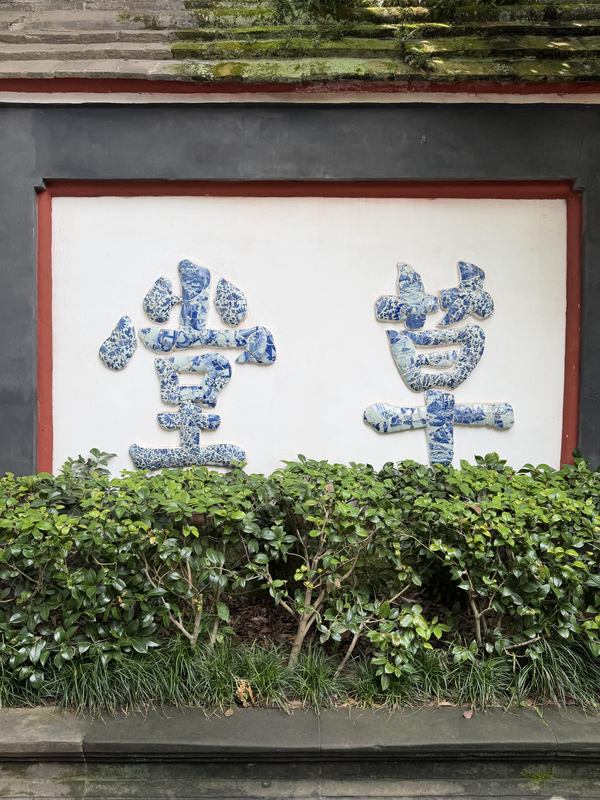
The poet Du Fu (杜甫) arrived in Chengdu in the winter of 759, fleeing the An Lushan Rebellion with his family, and built a thatched hut beside Huanhua Stream (浣花溪) on the western edge of the city. He lived here for nearly four years and wrote more than 240 poems, the finest stretch of his career, including the poem about the autumn wind tearing his roof off. Du Fu Cottage (杜甫草堂) is the memorial garden on that site, and the calmest place in the city. Be clear about what it is: the hut is a reconstruction, built to match the poems, and the halls around it are later buildings. What is real is the setting — bamboo, streams, old trees — and the feeling that a great poet worked here. Du Fu is the Tang dynasty poet the Chinese call the Poet-Sage.
Go in at the main entrance, the west gate, and follow the central axis: the main hall, the poetry hall, the shrine, and then the thatched hut itself. Do not turn left into the hut area first. I made that wrong turn on my first visit and spent an hour wandering before I found the route again. The highlights, in order, are the reconstructed hut, the Flower Path (花径), a red-walled lane under bamboo that photographs beautifully, the bonsai garden, and Daya Hall (大雅堂), the great hall with its mural of scenes from the poems. Give it a slow morning. The garden is full of mosquitoes in warm weather, so I carry repellent. A guide is worth it if you want the poetry explained; if you only want the garden, walk it alone.
There is a small teahouse inside the grounds, on the water, and I always stop there before leaving. Sitting with a bowl of tea beside the stream, after the halls and the poems, is the right way to end the visit. Afterwards, walk out through the east gate into Huanhua Stream Park (浣花溪公园), the free park next door, where locals walk and jog under the trees.
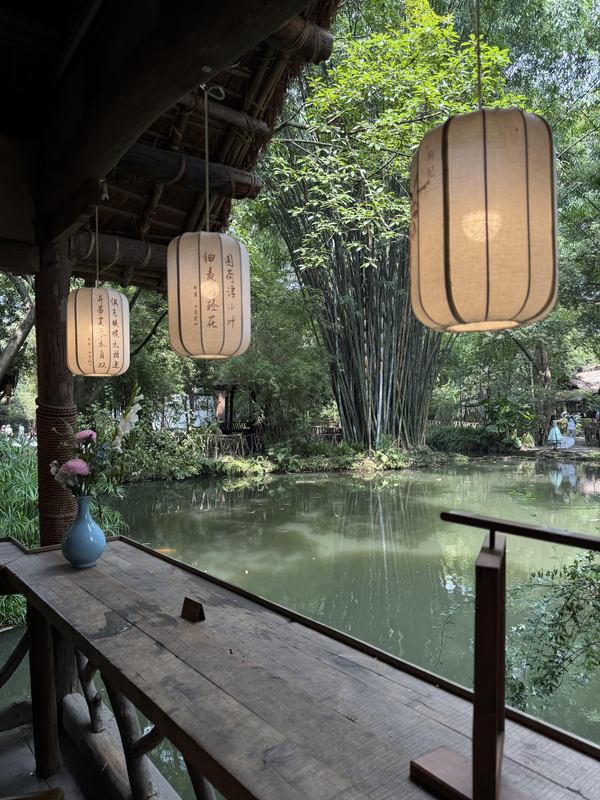
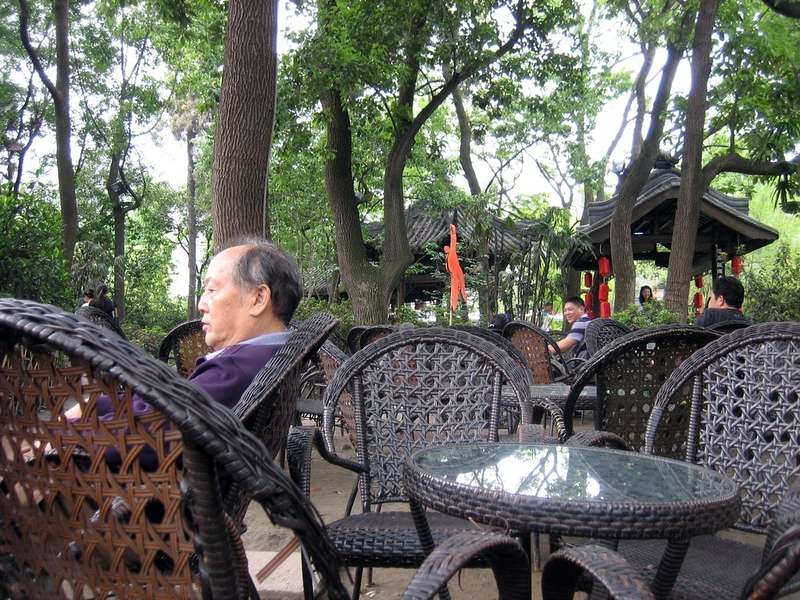
Midday belongs to People’s Park and its teahouses. Heming Teahouse (鹤鸣茶社), by the lake, dates from 1923 and is one of the oldest surviving teahouses in the city. Order gaiwan tea (盖碗茶), tea in a lidded bowl, and the hot water is refilled for free all afternoon — one bowl can last you hours, which is the whole idea. Around you, people play mahjong, chat, nap in the bamboo chairs, and get their ears cleaned: ear cleaning (采耳) is a Chengdu institution, done with fine metal tools that make a light clinking sound. I tried it once and found it oddly relaxing. The park opened in 1911 as Shaocheng Park, on the site of the old garrison quarter, and it holds the monument to the 1911 Railway Protection Movement, the Sichuan protest that helped trigger the revolution that ended the Qing dynasty. Go early in the morning for the cheapest bowls of the day, sold by a vendor by the pillars before the crowds arrive. Chinese tea culture is nowhere friendlier than here.
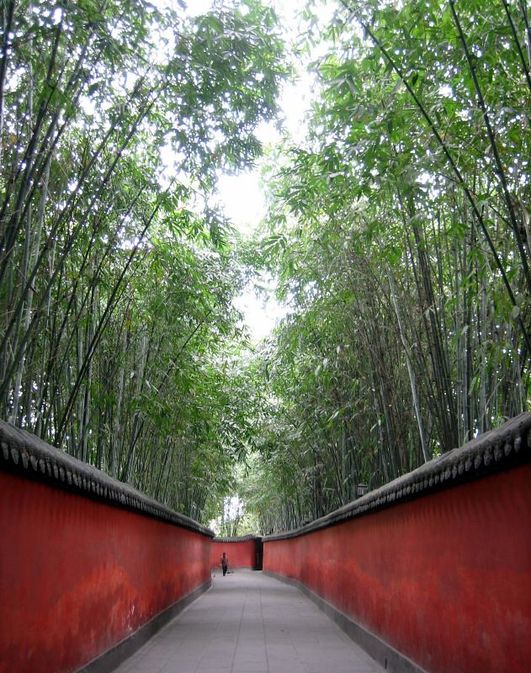
In the afternoon, go to Wuhou Shrine (武侯祠), the shrine to Zhuge Liang (诸葛亮), the strategist of the Three Kingdoms period, and to Liu Bei (刘备), the emperor he served. It is the only temple in China where a ruler and his minister are worshipped together under one roof, and that oddity is the whole point: the minister is honoured as highly as the emperor. Liu Bei’s tomb, Huiling (惠陵), stands inside the grounds, a grassy mound ringed by old cypress trees, and the halls hold statues of Liu Bei, Zhuge Liang, and the sworn brothers Guan Yu (关羽) and Zhang Fei (张飞). Most of the buildings date from a Qing-dynasty rebuild in 1672. Du Fu wrote his poem “The Prime Minister of Shu” about Zhuge Liang after visiting here, a nice thread back to the morning. My favourite corner is the red-walled corridor under the bamboo beside the tomb, where the light falls in strips and the crowds thin out. Zhuge Liang is the most admired figure in Chengdu, and this quiet shrine explains why better than any book.
Jinli (锦里), the old street next door, is where the afternoon ends. Its name goes back to the Qin and Han dynasties, when this was the quarter of the brocade weavers. Shu brocade (蜀锦), the silk brocade of Sichuan, was the wealth of the region, and the court set up a brocade office, the Jin Guan (锦官), to manage its production. Tradition credits Zhuge Liang with the remark that brocade was what paid for the war effort, and whether or not he said it in those words, the trade mattered: it travelled west along the routes we now call the Silk Road, and it made this city rich. The street you walk today is a reconstruction, rebuilt in 2004 in late Qing and early Republic style, so enjoy it for what it is: lanterns, old-style shopfronts, folk crafts, and an opera stage where you can catch face-changing (变脸), the Sichuan opera trick where the performer’s painted face changes in the blink of an eye. Go at dusk, when the lanterns come on. The Han dynasty gave this street its trade; the evening gives it its atmosphere.
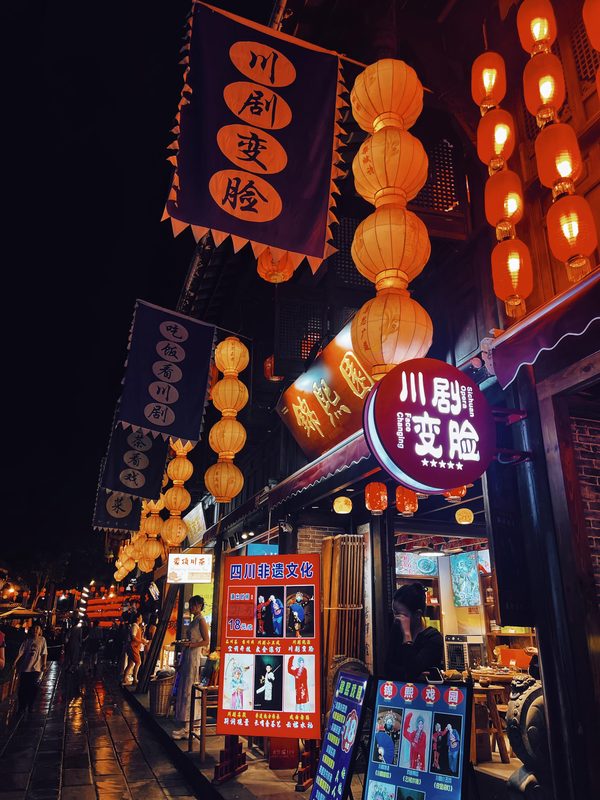
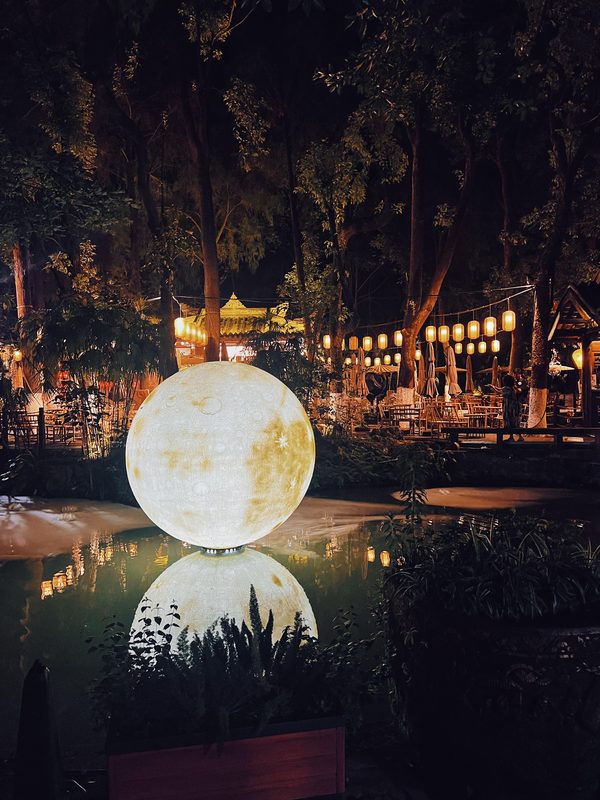
My order is always the same: the shrine first, then Jinli. The shrine gives you the history, and Jinli gives you the noise and the lights afterwards. Jinli is free to enter and takes an hour or two at a stroll. I go for the lanterns, the crafts and the street life, not for dinner — the snack stalls are fun to look at and expensive to eat from. The pond at the far end, with its moon installation, is the quietest spot on the street and my favourite photograph of the day.
Read more: Ancient Chinese Gardens: History, Elements and Culture
Day Three: A Hard Day Out, or a Gentle One — Pick One
Day three is a choice, and I mean it as a choice. Dujiangyan (都江堰) and Qingcheng Mountain (青城山) lie to the north-west of the city. The Leshan Giant Buddha (乐山大佛) lies to the south. Trying to do both in one day is the most common mistake first-timers make with Chengdu. If you love engineering and mountain walking, pick Dujiangyan and Qingcheng. If you want a shorter day and one enormous sight, pick Leshan.
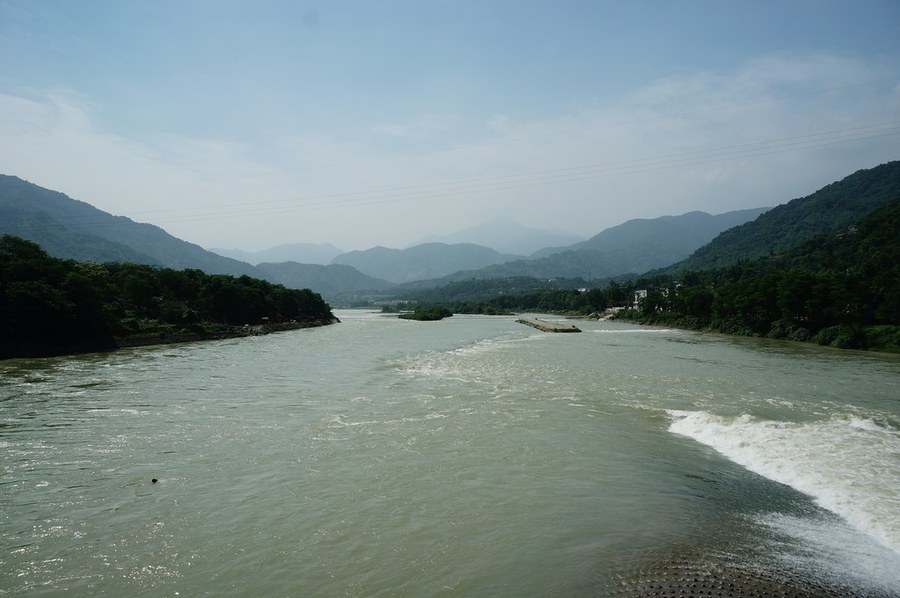
Dujiangyan is the irrigation system built around 256 BC by Li Bing (李冰), the Qin governor of Shu, and his son. It tames the Min River (岷江) without a dam: the Fish Mouth (鱼嘴) levee splits the river in two, the Flying Sand Weir (飞沙堰) spills off flood water and silt, and the Bottle-Neck Channel (宝瓶口), cut through the hillside, carries water to the plain. It still works, after more than two thousand years, watering the farmland that made Chengdu the Land of Abundance. UNESCO listed it in 2000, together with Qingcheng Mountain. My route is to enter from the upper gate and walk down: the temple to Li Bing and his son on the hill, then down to the Anlan Bridge (安澜桥), the suspension bridge over the river, and along to the Fish Mouth itself, where you can watch the river divide. An hour or two is enough, and the views from the hill are worth the climb.
Qingcheng Mountain, a short ride away, is the Taoist mountain where Zhang Daoling (张道陵) founded organised Taoism in the second century AD. The old saying calls it the most serene mountain under heaven, and on a quiet weekday, under the trees, you believe it. I walk the front mountain only: up on foot through the temples, and down by cable car, which is easier on the knees than stone steps. The summit pavilion, Laojun Pavilion (老君阁), is the goal, and the quiet, mossy temples on the way up are the reward. Be honest about this day: the mountain and the waterworks together make a long, hard, commando-style outing: four or five hours on the mountain alone, plus the waterworks, with steep stretches. Wear proper walking shoes, rest well the night before, and buy your return train tickets early, because the evening trains sell out. The trains run from the city with a change at Xipu (犀浦). Afterwards, the old town of Guanxian (灌县古城), below the waterworks, is worth a slow wander.
Leshan is the gentler option. The Leshan Giant Buddha was carved between 713 and 803, during the Tang dynasty: a seated Maitreya, 71 metres tall, cut straight into the cliff of Lingyun Mountain (凌云山) where three rivers meet. The story goes that a monk named Haitong (海通) began it hoping a great Buddha would calm the dangerous waters below; the carving took ninety years to finish. UNESCO listed it in 1996, together with Mount Emei (峨眉山). It is the largest stone Buddha in the world, and the scale is hard to take in until you are standing at its feet looking up.
My Leshan routine is simple: arrive at opening, go in at the north gate with your ID ready, and walk the route while it is still quiet. See the Buddha’s head first, then take the narrow plank walkway down the cliff face to the platform at its feet — the steps are steep, so take your time — and come back up through the temples and the forest. Done this way, the visit takes under two hours, and you are out before the worst of the crowds. One warning: after the walkway, do not drift into the Oriental Buddha Park (东方佛都) next door by mistake. It is a separate, modern park of concrete Buddhas, and it is not what you came for. In the town afterwards, try qiaojiao beef (跷脚牛肉), the local beef soup, a good lunch after the climb.
What to Eat
Chengdu was named a UNESCO Creative City of Gastronomy in 2010, the first city in Asia to receive the title, and it earns it every day. Sichuan food is famous for heat, but heat is only half of it: the other half is mala, the numbing tingle of Sichuan pepper mixed with chilli, and the sour, sweet and fragrant notes underneath. What follows is what I actually eat, in the order I eat it.
Hot Pot and Skewers
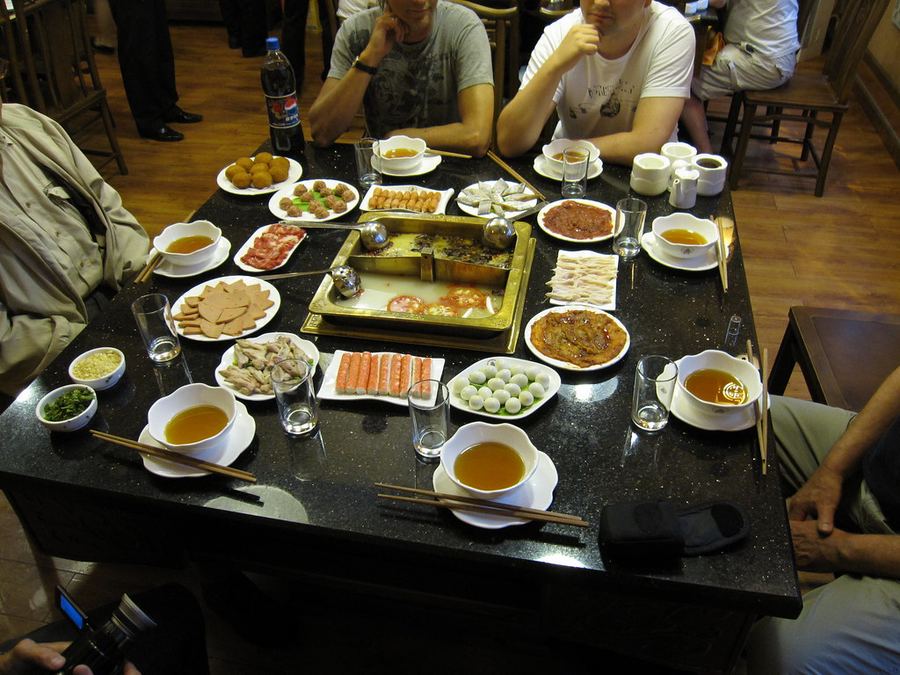
Hot pot is the meal I plan my evenings around. A pot of broth bubbles in the middle of the table, you cook raw ingredients in it yourself, and the meal stretches out for hours. My rule is a divided pot: spicy mala on one side, mild tomato or mushroom broth on the other. I always order sliced beef, tripe, lotus root and potato, and I cook things briefly — the broth does the work, and overcooking is the beginner’s mistake. For hot pot I go to neighbourhood places rather than famous ones. Ganjing Huowang (干精火旺), a community hot pot shop where most of the customers are locals, is my kind of place: smoky, noisy, and very good. The bamboo-shoot beef and the sliced pork kidney are what I order there.
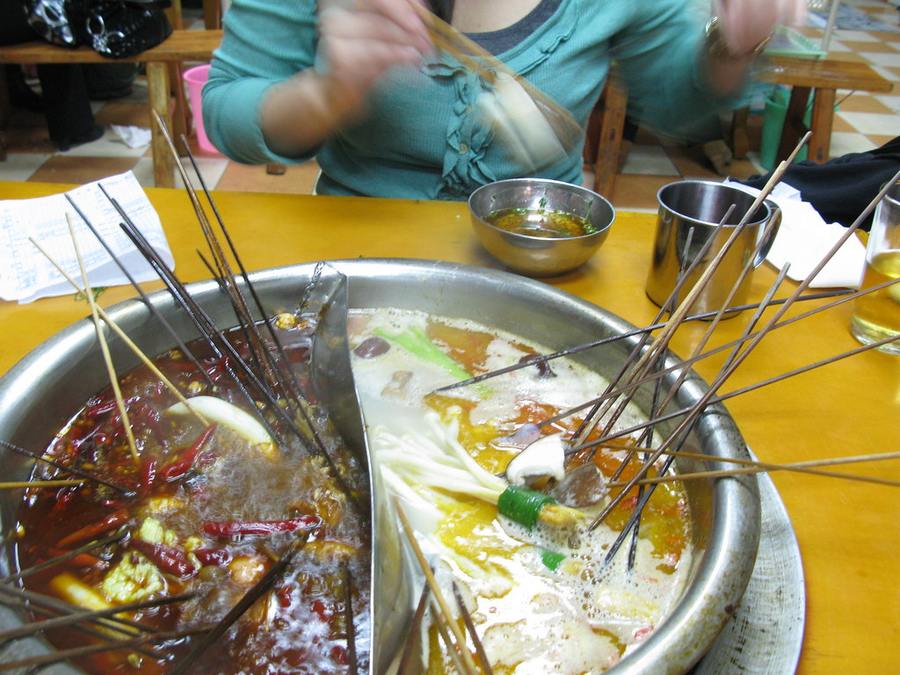
Skewers are hot pot’s quicker cousin. Chuan chuan (串串) means food on bamboo skewers, cooked in spicy broth and counted by the stick when you finish. Cold-pot skewers (冷锅串串) are the same idea served in a bowl of cooled spicy broth, ready to eat. I eat skewers at Panzi Ge (盘子哥), a seventeen-year-old hand-carried skewer shop where you carry your bundle to the table by the handle, and the small bowls of extras and the hot pot noodles are part of the ritual. Yulin skewers (玉林串串香), the old skewer house near the shopping streets, is my backup: dozens of beef skewers, and the dry dipping dish of chilli and spices. At street skewer stalls, pig brain (脑花) is my must-order — soft, rich, and nothing like as frightening as it sounds.
Two more dishes belong here. Maocai (冒菜) is a bowl of everything — meat, vegetables, noodles, offal — poached in spicy broth and served bubbling: my lunch when I want hot pot flavours without the ceremony. Mapo tofu (麻婆豆腐), soft tofu in a fiercely seasoned sauce, was invented in Chengdu, and I order it everywhere to compare. Rabbit heads (兔头), sold five-spice or mala, are the snack I nibble while walking: fiddly, messy, and addictive.
Snacks Worth Hunting Down
Chengdu’s snacks are a whole cuisine of their own, and I hunt them down street by street. Dandan noodles (担担面) are thin noodles in a spicy, nutty sauce, eaten from a small bowl — my breakfast more often than I should admit. Zhong dumplings (钟水饺) are pork dumplings in a sweet-spicy chilli oil, and sweet water noodles (甜水面) are thick, chewy noodles coated in peanut paste and chilli oil, sweet first and spicy second. These three are the holy trinity of Chengdu snacking, and I eat all three on every trip.
Three Cannons (三大炮) are sticky rice balls thrown from one pan to another with a bang — the name comes from the sound — then rolled in soybean flour and brown sugar. Sugar oil fruits (糖油果子) are fried glutinous rice balls, crisp outside and chewy inside, coated in brown sugar and sesame. Tofu pudding (豆花), silken tofu in a savoury or sweet dressing, is my mid-afternoon stop, and egg cakes (蛋烘糕), little cakes baked in copper pans with sweet or savoury fillings, are the snack I buy when I am walking and hungry. Fatty intestine noodles (肥肠粉), slippery sweet-potato noodles with pork intestine, are best eaten with a guokui (锅盔), a baked wheat cake, dunked in the soup. I eat all of this on Kuixinglou Street, at the Fuqin night market (抚琴夜市), where the stalls are real and the prices honest, and around the Yulin neighbourhood, where the old streets hide the best small restaurants in the city.
Teahouse Snacks and Sweets
Teahouse afternoons have their own food. A bowl of gaiwan tea comes with time, and time calls for nibbles: roasted peanuts, sunflower seeds, broad beans, and whatever the kitchen is making that day. My favourite teahouse drink is fermented rice wine (醪糟), the sweet, lightly fermented rice soup, served hot with osmanthus or with small rice balls floating in it. It is gentle, fragrant, and the perfect thing after too much chilli. At the park gates, look for the pan-fried hairy tofu (煎毛豆腐), tofu that grows a fine white fur before it is fried crisp. I have never quite dared it — the fur puts me off, though the locals love it. I end every teahouse afternoon with something sweet: Three Cannons or sugar oil fruits from a nearby stall, eaten slowly while the tea lasts.
Booking, Honestly
Chengdu is easier than Xi’an for booking, but the popular sights need planning. The panda base needs advance booking through the official channels, with real-name registration, and the rules change — check the official channels before you go rather than trusting any guide, including this one. Weekdays are easier than weekends, and I have known the base to be walk-in on a quiet weekday, but I never count on it. Wuhou Shrine and Du Fu Cottage are ticketed, and I buy online in advance. The Chengdu Museum (成都博物馆) is free but needs an advance reservation, and the Natural History Museum is heavily booked at weekends, so reserve early.
For the day trips, sort out the train first. Buy your return tickets as soon as your plans are fixed, because the evening trains back to the city sell out. At Leshan, entry is by ID, so carry the document you booked with, and arrive at opening for the quietest visit. On flying in: Shuangliu Airport (双流机场) is much closer to the city than Tianfu Airport (天府机场). And the usual warnings apply: ignore the touts at stations and outside sights, including the ones selling teahouse shows and black-car rides, and ask the price before you buy anything on a snack street.
What I’d Skip
The Blue Tears light show at Nanqiao Bridge (南桥), in the town below Dujiangyan, is the skip I feel most strongly about. I went once, and the water looked green to the naked eye — it only photographs blue. Chunxi Road as a destination in itself is my second skip: go for the climbing panda photograph, but do not plan an afternoon around a shopping street that sells the same brands as every other big city. The overpriced restaurants inside Kuanzhai Alley and Jinli are my third: the food is worse and dearer than the same dishes outside, and I eat on Kuixinglou Street and at Fuqin instead.
I also skip the face-changing teahouses that touts try to pull you into. The shows are low-grade, the tea is pushed hard, and the whole thing is built for visitors who do not know better. The face-changing on the Jinli opera stage is the real thing. Trying to do Leshan and Dujiangyan in one day is a skip, not a plan: they are in opposite directions, and you will spend the day travelling and see neither properly. At Leshan, do not wander into the Oriental Buddha Park by mistake — it is not part of the Buddha site. Finally, skip the pastry and tea shops inside the alleys that push bundle deals, and never buy tickets at a gate when you could have booked online.
Summary
Chengdu is the city I recommend to friends who think they have seen China, because it is unlike anywhere else in the country. The pandas are the reason most people come, and they are worth the early start. But the reason I keep coming back is quieter: a bowl of tea in a park, a poet’s garden in the rain, a red-walled corridor under bamboo, and a hot pot shared with friends. Three days gives you all of that, with time to spare.
My last piece of advice is the simplest. Do not try to see everything. Chengdu punishes the checklist and rewards the wanderer. Pick the pandas, the cottage, the teahouse, the shrine and one day trip, eat everything in sight, and let the afternoons happen. The city has been doing this for two thousand years. Trust it.