
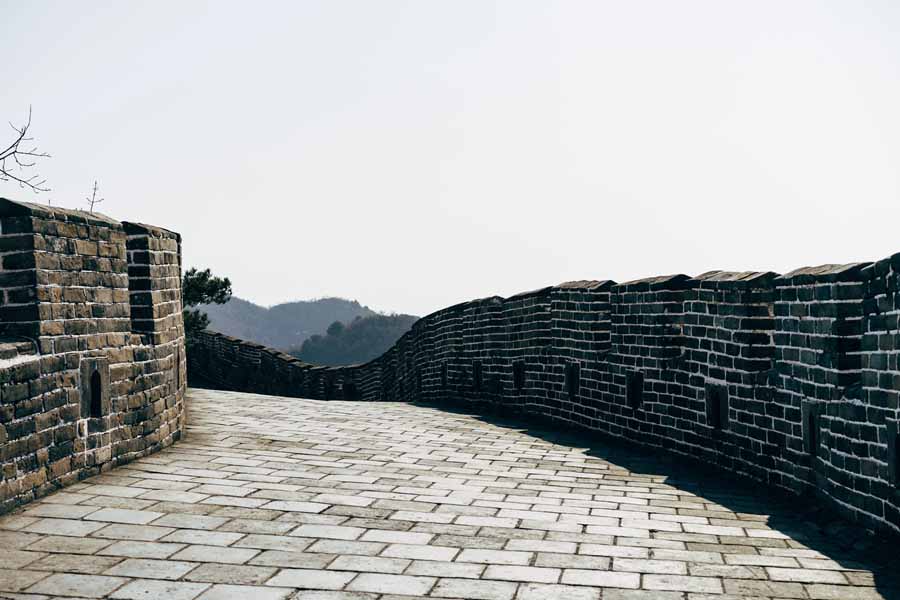
The Northern Dynasties (386 – 581 AD) were five successive dynasties that ruled northern China during the long age of division that followed the fall of the Han dynasty. Whilst a separate line of Southern Dynasties ruled from Jiankang in the south, the north passed from Northern Wei to its eastern and western successors, then to Northern Qi and Northern Zhou. Together, the northern and southern dynasties faced each other for almost two centuries.
The age is a story of fusion. The north’s first and greatest dynasty, Northern Wei, was founded not by Chinese but by the Tuoba clan of the Xianbei (鲜卑), a steppe people. Its emperors conquered the whole north, then remade their state in the Chinese image — adopting Chinese language, dress, surnames, and law, and moving their capital to Luoyang, the ancient heart of Chinese civilisation. Steppe and Chinese traditions mixed in its armies, government, and art, and out of that mixture came the institutions that would reunify all China.
The experiment nearly destroyed itself. Northern Wei split in two, and the north endured another half-century of warlords and rival states. But the western line, Northern Zhou, reunified the north in 577 AD, and in 581 AD its throne passed to the founder of the Sui dynasty. That fusion — of peoples, armies, and institutions — made China’s reunification possible.
Key Facts
- Period dates: 386 – 581 AD. The whole north was first brought under one of these dynasties in 439 AD.
- Preceding period: the Sixteen Kingdoms, the short-lived rival states that divided the north after the fall of the Western Jin in 316 AD.
- Subsequent dynasty: Sui, 581 – 618 AD, which conquered the south in 589 AD and reunified China.
- Northern Wei: 386 – 534 AD, capitals Shengle (盛乐), then Pingcheng (平城, modern Datong, 大同), then Luoyang from 494 AD.
- Eastern Wei: 534 – 550 AD, capital Ye (邺).
- Western Wei: 535 – 557 AD, capital Chang’an.
- Northern Qi: 550 – 577 AD, capital Ye.
- Northern Zhou: 557 – 581 AD, capital Chang’an.
- First founder: Tuoba Gui (拓跋珪), who founded Northern Wei in 386 AD.
- Longest reign of the period: Taiwu of Northern Wei (personal name Tuoba Tao, 拓跋焘), twenty-eight years, reigning from 424 to 452 AD.
- Final Emperor: Jing of Northern Zhou, a child who abdicated to Yang Jian (杨坚) in 581 AD.
The Origins of the Northern Dynasties
When Western Jin collapsed in 316 AD, the north broke apart. For seventy years it was fought over by the states historians call the Sixteen Kingdoms — most of them founded by non-Chinese peoples, Xiongnu, Xianbei, and others, who had long lived inside the frontier. Cities were sacked, farmland abandoned, and much of the population fled south. No kingdom lasted long, and none could hold the whole north.
The Tuoba were a clan of the Xianbei who had ruled a small frontier state, Dai, destroyed by a rival in 376 AD. In 386 AD their young chief Tuoba Gui restored the family’s fortunes, and his state soon took the name Wei — Northern Wei, to distinguish it from earlier states of that name. He ruled from Shengle, on the steppe edge, but in 398 AD he moved his capital south to Pingcheng, within reach of the Chinese farmlands. A tribal confederation was becoming an empire, campaigning north against the Rouran (柔然) confederation and south against the rival kingdoms.
The work was finished by Emperor Taiwu, who came to the throne in 424 AD. In a series of campaigns he destroyed the Xia state in the north-west, then Northern Yan in the north-east, and in 439 AD he conquered Northern Liang, the last surviving rival. For the first time since 316 AD, the whole of northern China obeyed one ruler, and the age of the Sixteen Kingdoms was over.
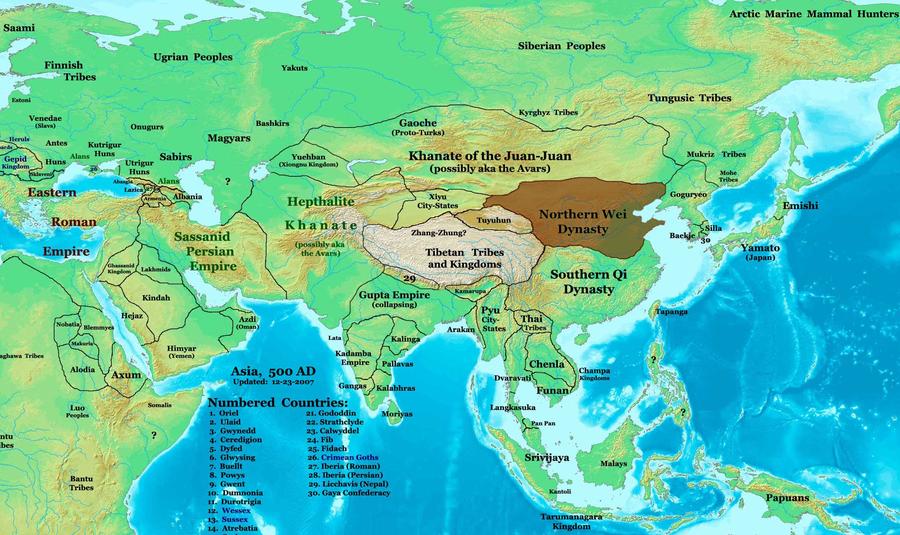
Conquest, however, was the easy part. The Tuoba and their Xianbei followers were a small military aristocracy ruling millions of Chinese farmers, and the dynasty’s survival depended on whether the two peoples could become one society. That was the task taken up by the most remarkable of all the northern emperors.
Emperor Xiaowen – The Reformer Who Remade the North
Emperor Xiaowen (born Tuoba Hong, 拓跋宏) came to the throne in 471 AD, aged four. For the first half of his reign his grandmother, the formidable Empress Dowager Feng (冯太后), governed, beginning the reforms he would complete. When she died in 490 AD, Xiaowen ruled in his own right, and pushed the transformation further than anyone had dared.
The first reforms rebuilt the countryside. Under the equal-field system of 485 AD, the state claimed ownership of the land and allotted plots to every farming family, returned and redivided as families changed — a system that shaped how land was held in ancient China for the next three centuries. Villages were organised under a ‘three elders’ system for taxation and order, and officials were put on regular state salaries instead of living by fees and gifts.
Then, in 494 AD, Xiaowen moved the capital from Pingcheng to Luoyang. Pingcheng stood close to the steppe, in a cold region that struggled to feed a court; Luoyang was the ancient capital of the Han and Jin, in the heart of China. Many Xianbei nobles hated the move, and the emperor’s own heir plotted against it, but it was made — and with it came the great sinicisation decrees. At court, the Xianbei language was banned for officials under thirty, and Chinese dress replaced steppe dress. Xianbei surnames were changed into Chinese ones: the imperial family’s own surname, Tuoba, became Yuan (元). Xianbei and Chinese great families were encouraged to intermarry.
Xiaowen died in 499 AD, on campaign against the south, leaving a dynasty transformed. His reforms gave the north one law, one tax system, and increasingly one ruling class of mixed descent. But they had a cost. The Xianbei garrisons on the northern frontier found themselves despised as backward provincials by the sinicised court at Luoyang — and they did not forget it.
Read more: Top 10 Capital Cities of Ancient China
The Northern Dynasties at their Height – and the Split
In the early sixth century, Luoyang was one of the greatest cities in the world, with perhaps half a million people, hundreds of temples, and crowded markets. Northern Wei ruled through ministries and appointed officials in the Chinese manner — a steppe-born dynasty now running the full machinery of how ancient China’s government was run. But the throne itself was weakening. Emperor Xiaoming came to the throne as a small child in 515 AD, and power lay with his mother, Empress Dowager Hu, whose corrupt rule emptied the treasury. In 528 AD the young emperor died suddenly — the histories say his own mother had him poisoned.
The explosion came from the frontier. The Six Garrisons, the military colonies that guarded the northern border, had once been the empire’s elite; after the move to Luoyang they were neglected, their supplies cut and their officers treated as inferiors. In 523 AD they revolted, and the revolt spread into civil war. In 528 AD the warlord Erzhu Rong (尔朱荣) marched south, seized Luoyang, and in the Heyin (河阴) massacre had some two thousand courtiers and officials killed. Puppet emperors followed, made and unmade by soldiers.
The end came in 534 – 535 AD. Gao Huan (高欢), the strongman who had destroyed the Erzhu clan, took one Wei emperor east to Ye and ruled the east as Eastern Wei. His rival Yuwen Tai (宇文泰) took another Wei prince west to Chang’an and ruled there as Western Wei. Each half claimed to be the true Wei; in reality the two families ruled, and within a generation both took the thrones themselves.
The Road to Reunification
In the east, Gao Huan died in 547 AD, and in 550 AD his son Gao Yang (高洋) deposed the Eastern Wei emperor and founded Northern Qi, ruling from Ye. Northern Qi was the richest of the northern states, with strong armies and a brilliant, violent court. Its early emperors campaigned successfully, but the dynasty rotted from the top: emperors murdered ministers on suspicion, favourites governed, and the last emperor, a young man more interested in pleasure than war, fled his capital as the enemy approached.
The west took the opposite path. Poorer and smaller than Qi, Western Wei survived by discipline. Its strongman Yuwen Tai rebuilt its armies as the fubing (府兵) system — regiments of soldier-farmers who farmed in peace and served in war — and fused Xianbei and Chinese officers into a single military aristocracy, the Guanlong group, named for the north-western region it guarded. From this tight circle of intermarried families would come the founders of both Sui and Tang. Yuwen Tai died in 556 AD; the next year his son was placed on the throne at Chang’an, and Western Wei became Northern Zhou.
Northern Zhou’s decisive ruler was Emperor Wu — personal name Yuwen Yong (宇文邕) — who came to the throne in 560 AD under a powerful cousin’s domination, killed that cousin in 572 AD, and ruled in his own right thereafter. He strengthened the fubing armies, curbed the Buddhist church’s wealth to fill his treasury and his ranks, and in 577 AD invaded Northern Qi. The Qi court collapsed with barely a fight. Its capital Ye fell, its last emperor was captured, and the north was one state again, for the first time since the split of 534 AD.
Art and Culture During the Northern Dynasties
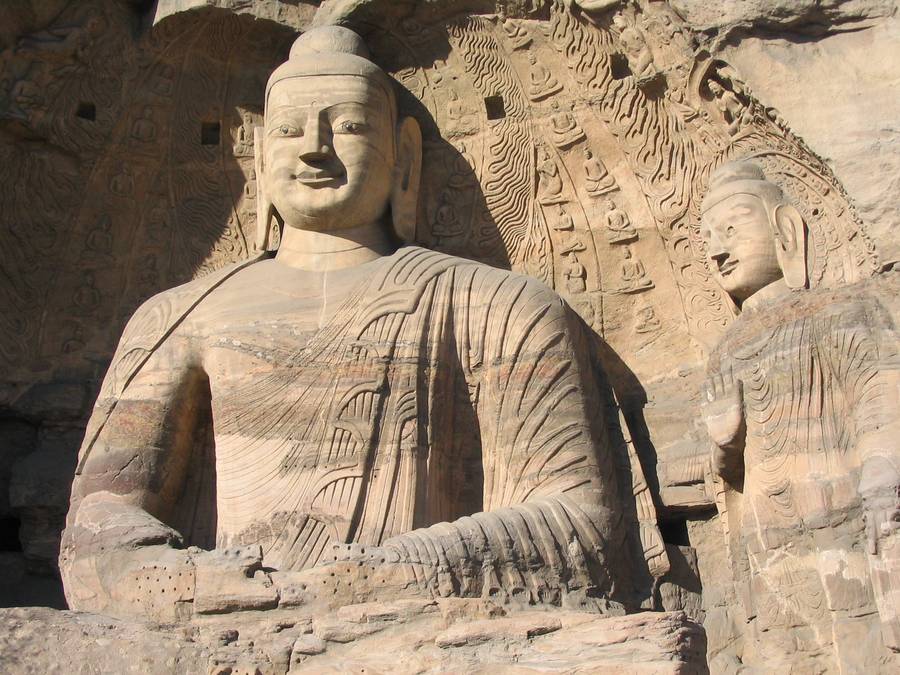
The fusion of peoples produced an art of extraordinary energy, and its supreme monuments are the Buddhist cave temples. At Yungang (云冈), outside Pingcheng, work began in about 460 AD under the monk Tanyao (昙曜): cliff caves housing colossal Buddhas, the earliest of them traditionally said to be carved with the features of Wei emperors themselves. After the move south, a second great site was begun in the cliffs at Longmen (龙门), outside Luoyang, where thousands of statues accumulated over the following centuries.
The lost world of Northern Wei Luoyang survives in a book. Yang Xuanzhi (杨衒之), writing in about 547 AD, after the city’s destruction, described its temples, markets, and foreign quarters in his Record of the Monasteries of Luoyang (Luoyang Qielan Ji, 洛阳伽蓝记): more than a thousand temples, and merchants arriving from Central Asia along the Silk Road. Two practical masterpieces also come from this age: the Qimin Yaoshu (齐民要术, ‘Essential Techniques for the Common People’), written by Jia Sixie (贾思勰) in about 544 AD, the oldest complete Chinese manual of farming; and the Commentary on the Water Classic by Li Daoyuan (郦道元), who died in 527 AD, a vast geography of China’s rivers.
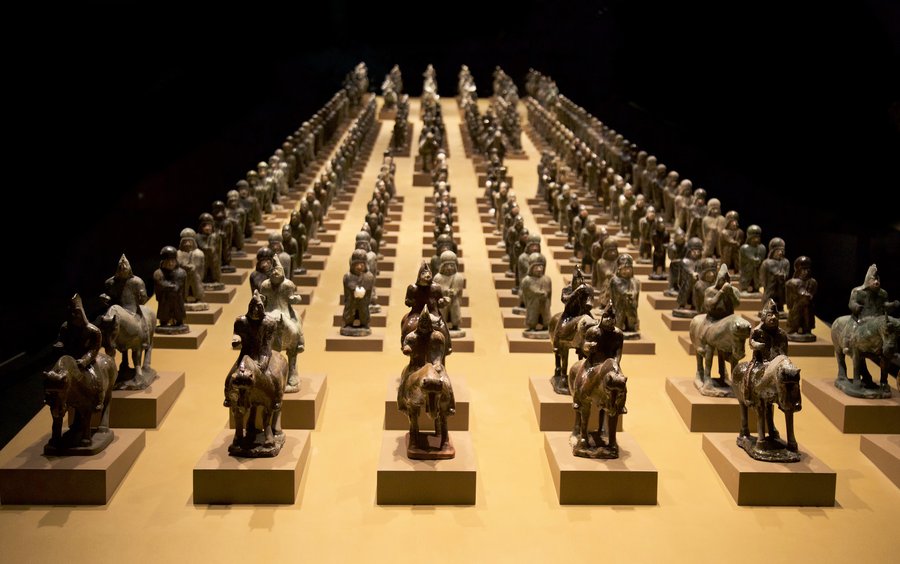
Calligraphers treasure the age’s Weibei (魏碑), the ‘Wei stele’ style — bold, angular characters carved on the cliff inscriptions of Longmen and on tomb steles, quite unlike the smooth court scripts, and a lasting influence on later Chinese calligraphy. And in the tombs of the northern aristocracy, whole processions of painted pottery figurines — soldiers, musicians, officials, servants, and horses — were buried with the dead, following the funeral customs of the age, preserving in clay a picture of the dynasty’s mixed Xianbei and Chinese world.
Religion During the Northern Dynasties
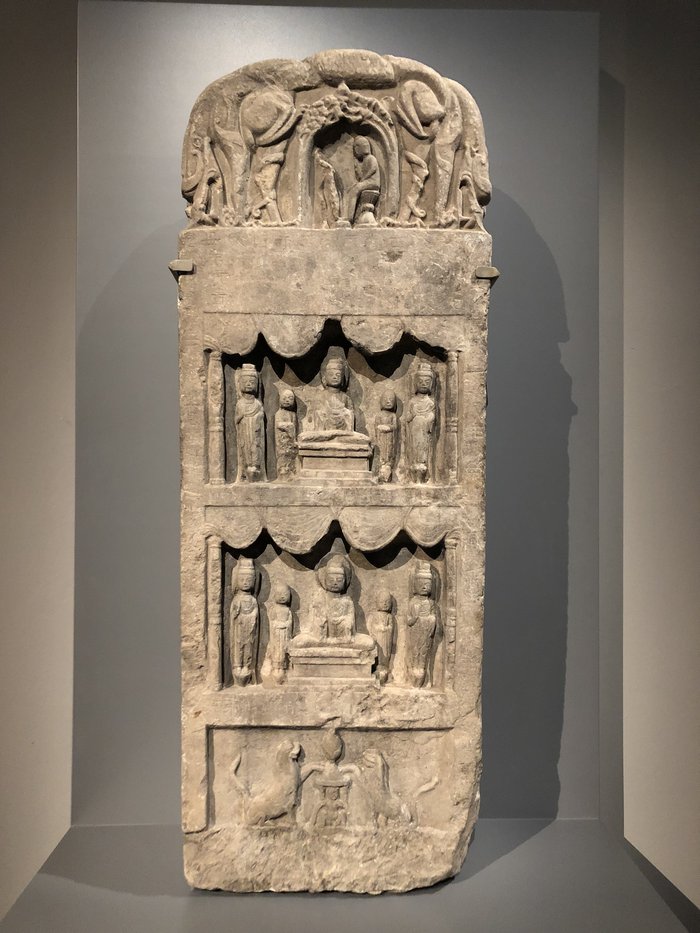
Buddhism stood at the centre of northern life. The Northern Wei court patronised it lavishly: the cave temples of Yungang and Longmen were state projects, monasteries grew rich on gifts of land and treasure, and the official history of the dynasty counts some thirty thousand temples and two million monks and nuns by the dynasty’s last years. Monks and scriptures travelled between north and south despite the political frontier.
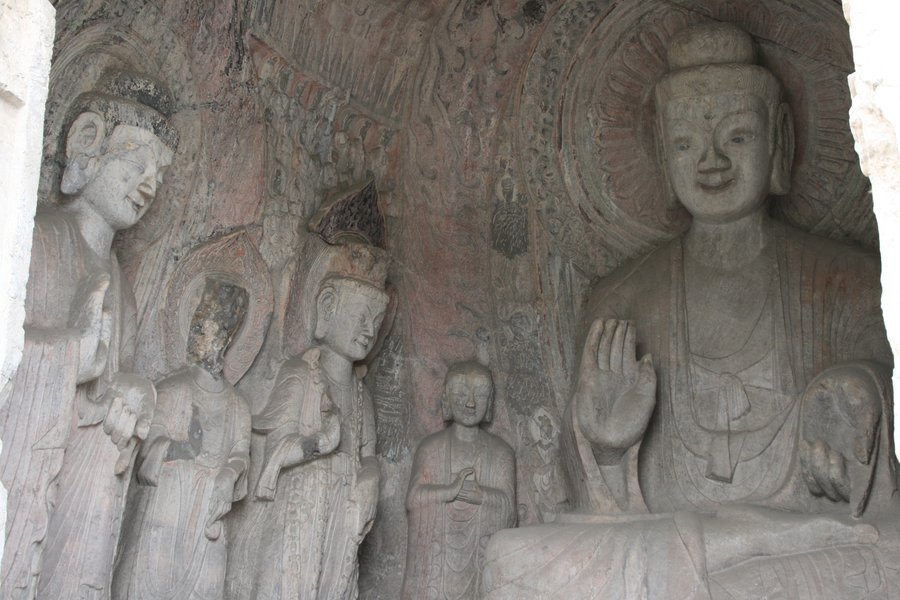
Yet the north also saw two of the great persecutions of Buddhism. Emperor Taiwu, who had unified the north, came under the influence of Kou Qianzhi (寇谦之), the Celestial Master who had reformed Daoism and won a place at the Wei court. In 446 AD, after weapons were found stored in a monastery in rebellious Chang’an, Taiwu ordered Buddhism abolished throughout his empire: scriptures and images were destroyed and monks were put to death. It was the first of the great persecutions, ending only with Taiwu’s death in 452 AD. The second persecution came under Northern Zhou’s Emperor Wu in 574 AD, who closed temples and forced monks and nuns back into lay life, partly to seize the church’s wealth and manpower for his war against Qi.
Between persecutions, the court’s official life remained Confucian in form: emperors performed the traditional sacrifices and governed through scholars trained in the classics and in the rituals and laws of the Chinese tradition. But it was Buddhism that shaped the age’s imagination, and Daoism, reshaped by Kou Qianzhi into a church fit for an emperor’s court, that first taught the northern emperors to persecute in religion’s name.
Read more: Confucius, Confucianism and the Confucian Classics
The Fall of the Northern Dynasties
The northern age ended with the early death of a strong emperor. Emperor Wu of Northern Zhou died suddenly in 578 AD, aged only thirty-five, leaving the throne to his son, Emperor Xuan. Xuan behaved so erratically — he abdicated within a year in favour of his little son, whilst inventing grander titles for himself — that power drained away from the throne. When Xuan died in 580 AD, the regent for the child Emperor Jing was the boy’s grandfather, Yang Jian, a general of the Guanlong aristocracy whose daughter had been Xuan’s empress.
In 581 AD Yang Jian forced the child to abdicate and took the throne himself, founding the Sui dynasty. The Northern Dynasties were over. Yang Jian inherited a north already fused into one society, with its equal-field farms, fubing armies, and mixed Xianbei-Chinese ruling class. Eight years later, in 589 AD, he used them to conquer the Chen dynasty in the south — and the reunification of China, which the north had rehearsed for two centuries, was complete.
Summary
The Northern Dynasties lasted from 386 to 581 AD — five dynasties, and almost two hundred years. They began with a steppe clan ruling a conquered north, and ended by producing the state from which Sui and Tang would rebuild the empire. Northern Wei unified the north in 439 AD; Xiaowen’s reforms fused its peoples; even the split of 534 AD ended in a stronger reunification under Northern Zhou in 577 AD.
The age’s deepest gift was fusion itself. The equal-field system, the fubing militia, and the Guanlong aristocracy all passed to Sui and Tang. Its art — the colossal Buddhas of Yungang and Longmen, the Wei stele calligraphy, the painted tomb figurines — remains among the glories of Chinese civilisation. An age that began in conquest ended by making one people out of two.
Read more: Ancient Chinese Dynasty Timeline