
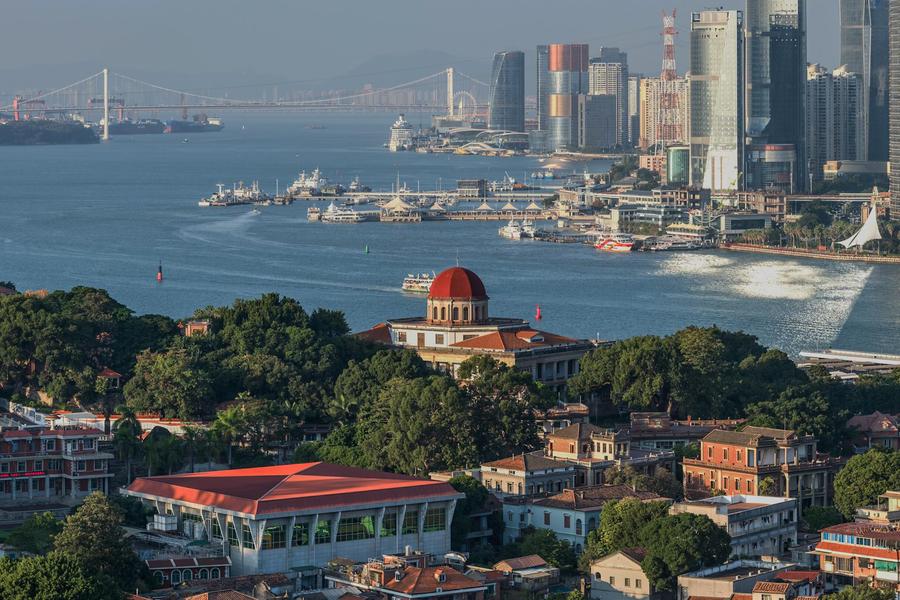
The first time I saw Xiamen properly, I was standing on the deck of a ferry with the wind in my face, watching the island come towards me. Ahead of me a low green island rose out of the water, its red-tiled roofs packed tight around a grey rock, its church spires and consulate villas standing shoulder to shoulder with banyan trees, and behind me the two curved towers of the city caught the sun. I had seen the great sights by then — the wall, the terracotta army, the Yangtze gorges — but I had never arrived anywhere quite like this, by water, with the whole city laid out in front of me.
That is the thing about Xiamen. It is not a city you conquer. It is a city you arrive in, slowly, and then you slow down with it. Xiamen is the city Chinese travellers go to when they are tired — tired of crowds, tired of queues, tired of being hurried. They come for the sea air and the banyan shade and the bowls of noodles eaten on plastic stools, and they leave wondering why they ever thought a holiday had to be a checklist.
This guide is built on three days, which is the consensus among the local bloggers and my own experience. Two days cover the old town and Gulangyu (鼓浪屿) but feel rushed; three give you the old town properly, a full day on the island, and one day for the coast or a day trip.
At a Glance
- How long: Three days — the old town, Gulangyu, and the coast or a day trip. Two days work if you must, but you will leave feeling you rushed it.
- Where to stay: In Siming district (思明区), the island centre, near Zhongshan Road (中山路) and Bashi Market (八市) for a first visit — walkable to the ferry, the old town and the food. Do not book a room facing the pedestrian street itself: the cooking fumes and the crowds are noisy late into the night. The Huandao Road (环岛路) coast is the alternative for a second or third night, if you want to wake up to the sea — but it is far from the old town, so do not make it your only base.
- Shape of the trip: Day One on foot in the old town; Day Two on Gulangyu; Day Three the coast or a day trip.
- Book ahead: The Gulangyu ferry is the booking that matters most — book it days ahead through the official mini-programs. Xiamen University needs a booking too, and the cableway is best booked ahead.
- Getting around: The old town is on foot. The metro, the BRT and the buses cover the rest, and one transport code works for all three. Do not rent an e-bike on the island.
- When to go: Spring and autumn are the kindest seasons. Summer is hot and crowded, and July to September is typhoon season — ferries can be cancelled. Winter is mild and quiet, and it is the season for escaping the cold of the north.
- My verdict: Xiamen is not a city of blockbuster sights. It is a city of sea air and slow mornings, of temple courtyards and noodle bowls, of an island you walk because there is no other way to see it. If you want a checklist, go elsewhere.
Day One: The Old Town on Foot
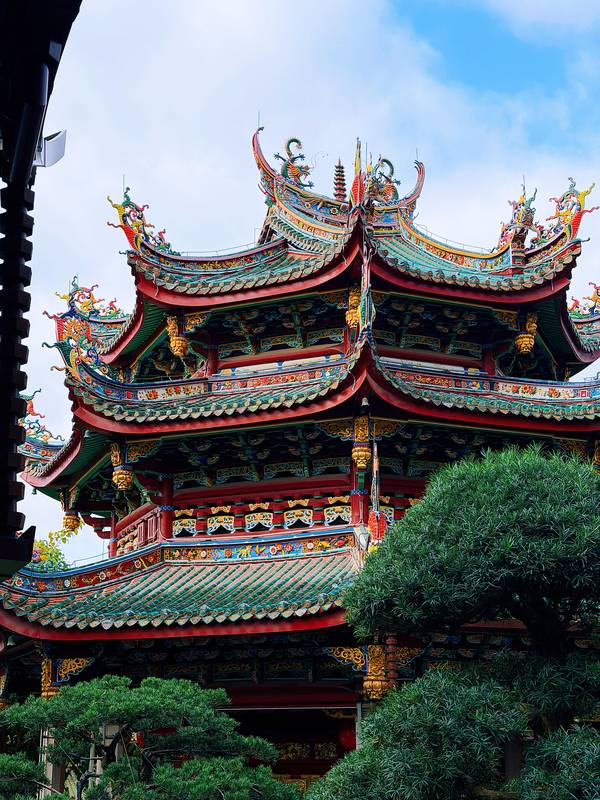
Start at Nanputuo Temple (南普陀寺), the thousand-year-old temple at the foot of the Five Old Men Peaks (五老峰), and go early in the morning, when the incense smoke is still thin and the light is soft on the yellow walls. The temple is free, and the incense inside is free too. It is a working temple, not a museum. The vegetarian cakes (素饼) sold at the temple gate are the souvenir to buy, and the climb up the Five Old Men Peaks gives you the panorama of the whole bay. Allow an hour and a half, and do not believe the touts at the gate who tell you the temple is closed today and try to put you in a car. It is open. It is free. Walk in.
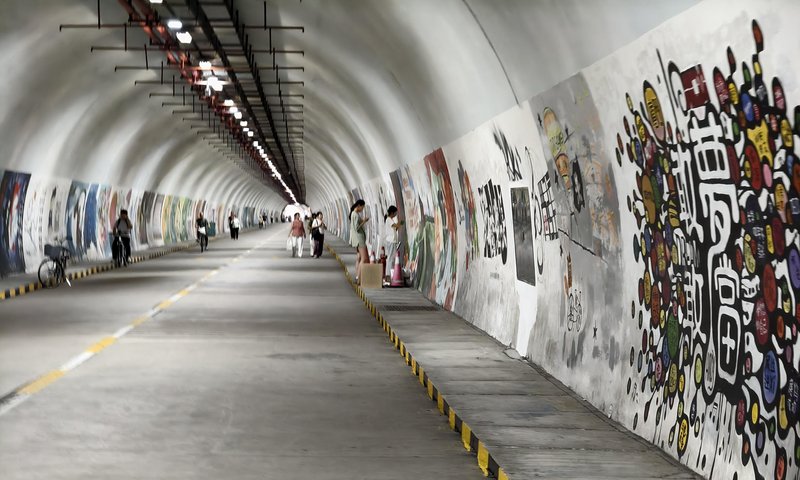
From the temple, Xiamen University (厦门大学) is a short walk away, and it is one of the most beautiful campuses in China — a garden university between the mountain and the sea, with red roofs and banyan shade and the Furong Tunnel (芙蓉隧道), a long graffiti tunnel that every student photographs. But the booking is the trap: the campus is free, but you cannot walk in without a booking made days in advance on the official account, with your original passport or ID in hand. Book a day ahead and you will very likely fail — the bloggers who tried it got no slot and only saw the gate. Book three days ahead, and even then, do not count on it. If you get in, allow two or three hours. If you do not, do not despair. The gate itself, and the streets around it, are worth a look, and the university is a school, not a scenic spot — the locals are right about that, even if the photographers are not.
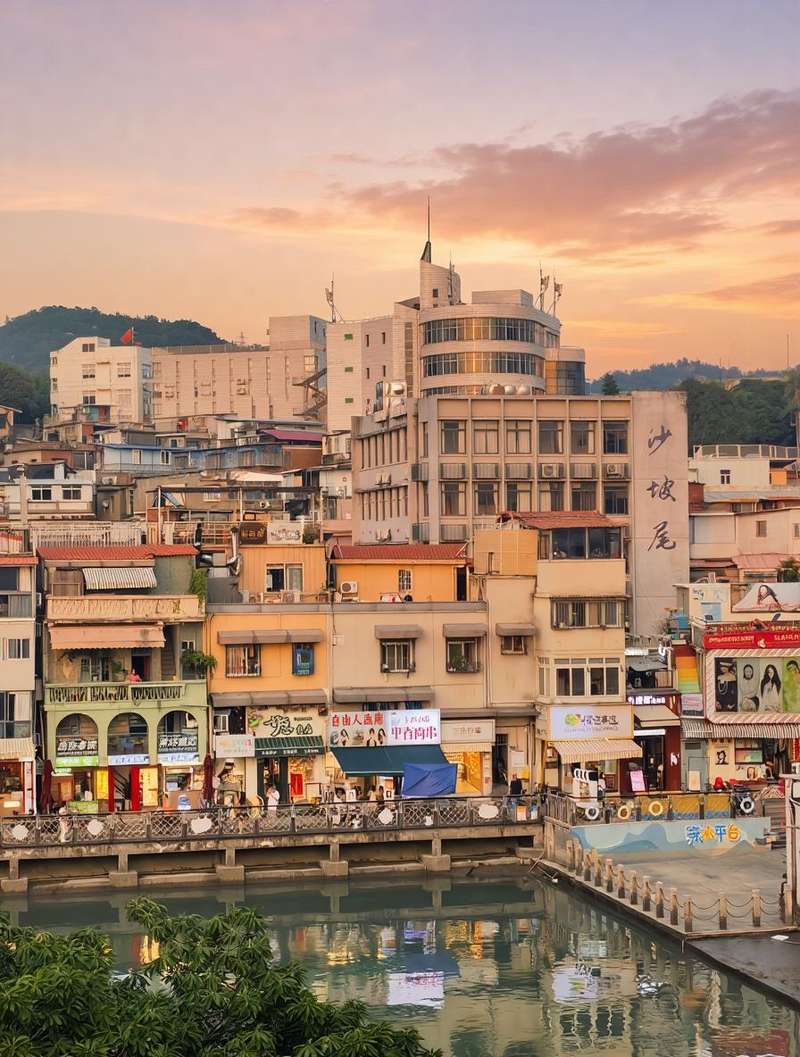
From the university, walk down to Shapowei (沙坡尾), the old fishing port turned art district, and give it an hour or two. The signature sight is the wind-shelter harbour (避风坞), where the fishing boats lie at anchor with the Twin Towers rising behind them — the photograph every visitor takes, and the one that is actually worth taking. The lanes around it hold the art shops and coffee bars, and the whole place is best in the late afternoon, when the light goes gold on the water. It is commercial, and the locals will tell you so, but the boats are real. Bring mosquito repellent if you stay into the evening.
End the day on Zhongshan Road (中山路), the old pedestrian street. It is the Nanyang arcade street (骑楼) — a long colonnade of old shophouses with covered walkways, built for the southern sun and the sudden rain — and it is best walked slowly, looking up at the architecture rather than down at the shopfronts. The main street is mostly tourist shops now, and the locals eat in the lanes off it, so treat the street as a walk, not a meal.
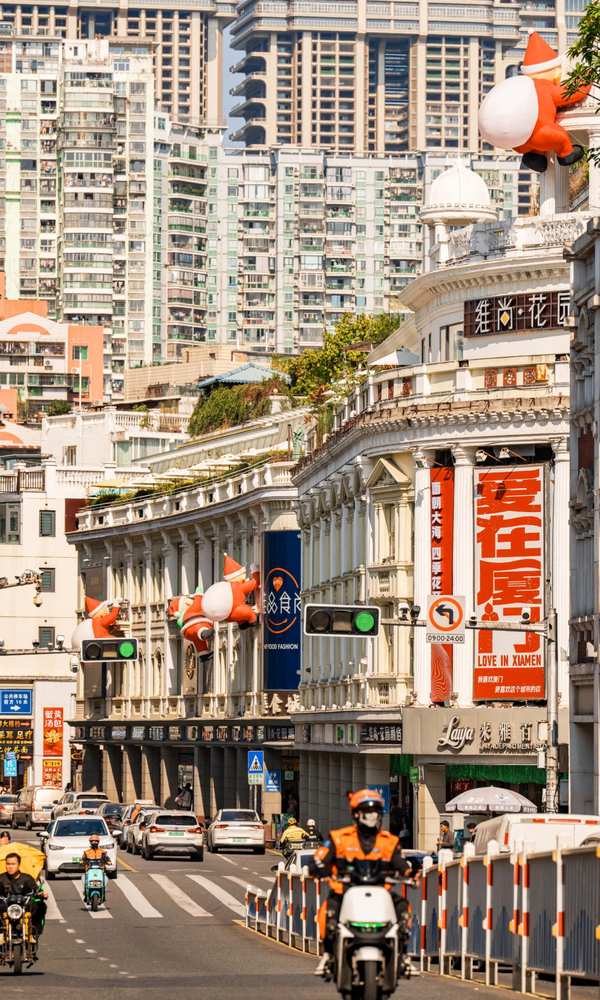
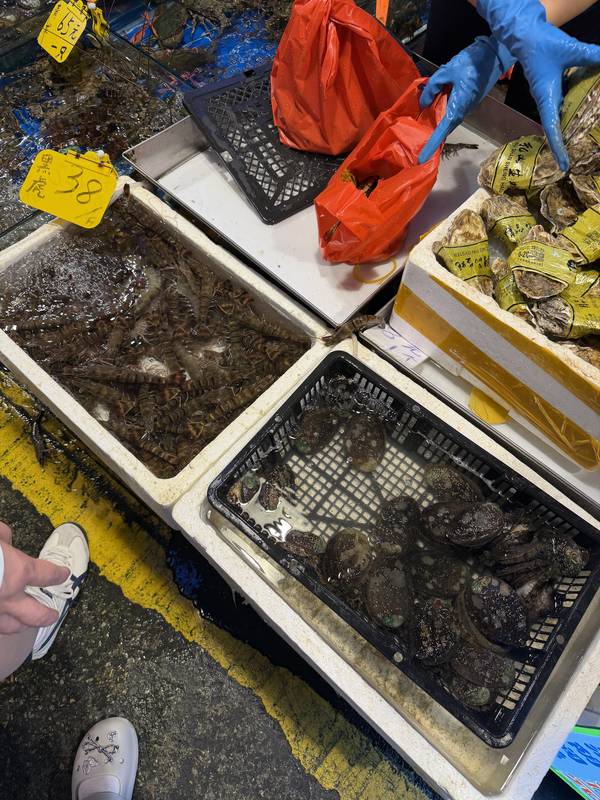
The meal is in Bashi Market (八市), the working market a few steps away, where the fish is still flapping and the food is cooked for the people who live here. Bashi is where you eat on your first night, and the food section below explains how to do it without getting fleeced. Stay in this area if you can — it is the most convenient base in the city — but not on the pedestrian street itself: a back street a few minutes’ walk away is quieter, cheaper, and still close to everything.
Day Two: Gulangyu
Day Two belongs to Gulangyu, and it begins with the ferry — the single most important practical lesson in this guide, so read this part twice.
Book the ferry days ahead, through the official mini-programs, under your real name. Do not expect to buy a ticket on the day, and do not buy one from anyone who approaches you at the pier. Daytime tourists must leave from the Dongdu Cruise Centre (东渡邮轮中心厦鼓码头) — not from Lundu Pier (轮渡码头), the citizens’ channel, which is the mistake every first-timer makes. Aim to arrive at Sanqiutian Pier (三丘田码头), the landing closest to the old streets. If Dongdu is sold out, Songyu Pier (嵩屿码头) is the fallback the locals use. The crossing takes about half an hour. There are no cars on Gulangyu. There never have been. Everything on the island is done on foot, and you will walk a great deal — the bloggers say twenty thousand steps is the minimum, and they are not exaggerating. Wear flat shoes, bring water, and think twice before bringing elderly relatives or small children.
Step off the boat and walk straight to the Most Beautiful Corner (最美转角), the bend in the lane where the red roofs, the green trees and the sea line up into the photograph that made the island famous. Go early, before the tour groups arrive in the afternoon, and you will have it almost to yourself.
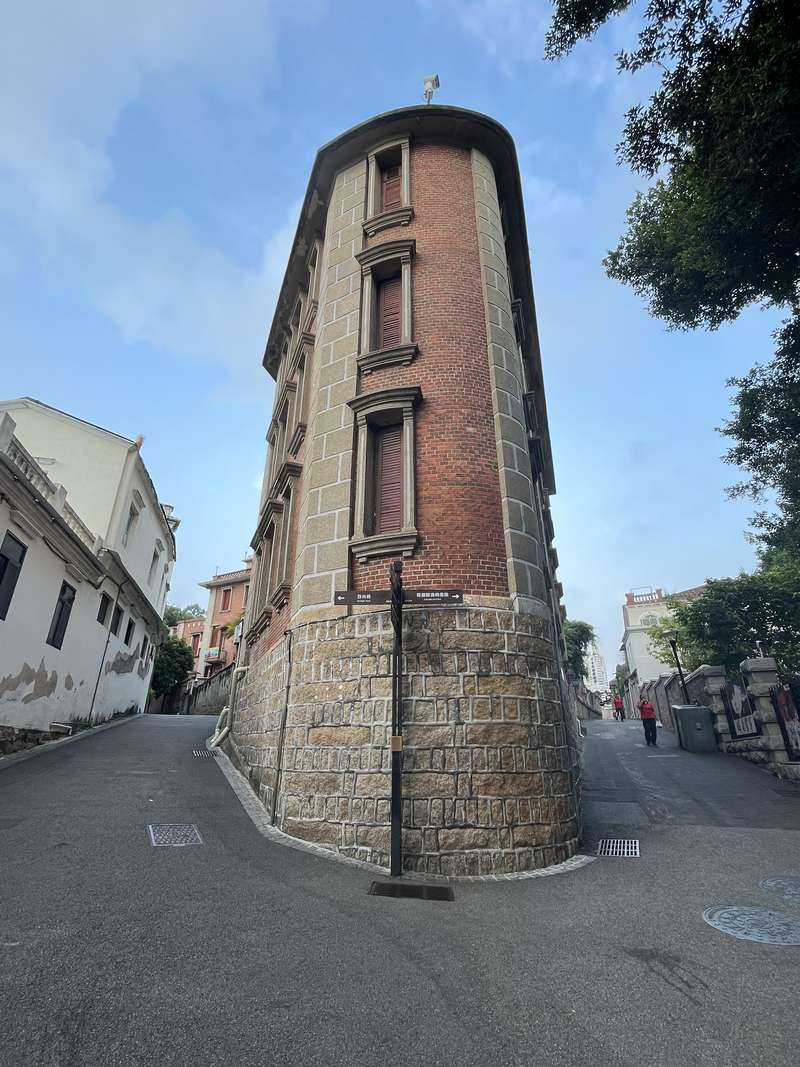
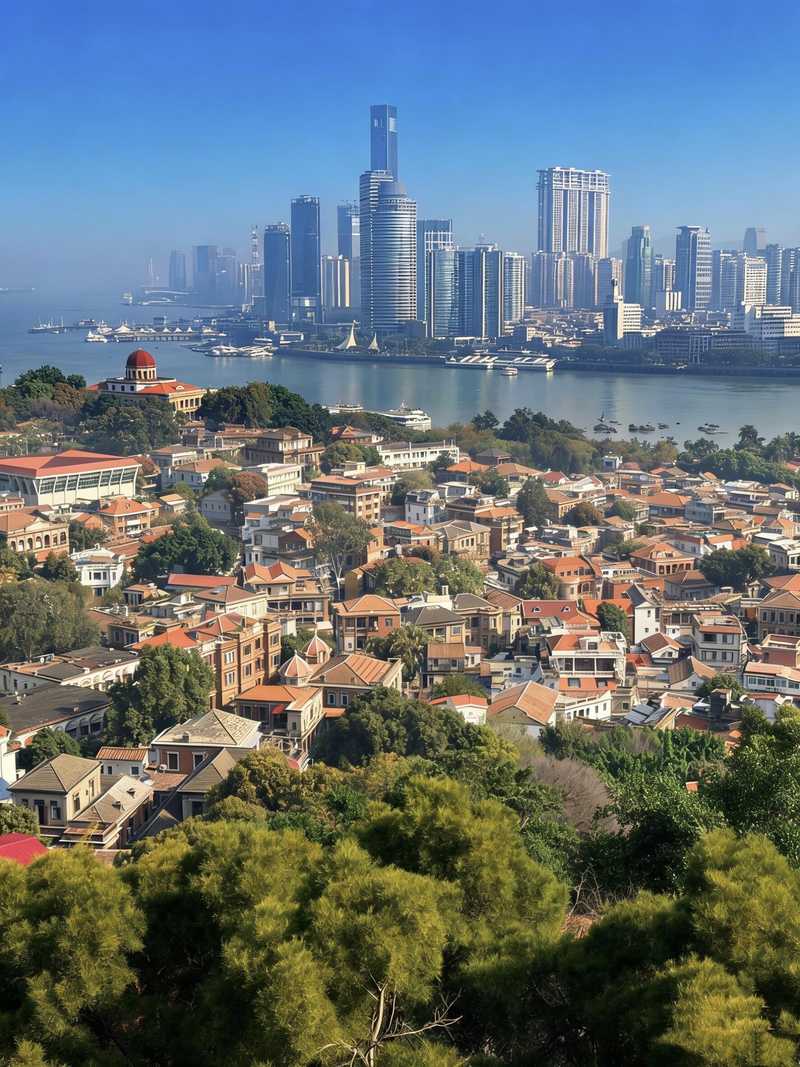
From there, climb Sunlight Rock (日光岩), the highest point on the island, and the climb is the price of the view. The rock is steep and the steps are narrow — the bloggers warn against taking elderly visitors or small children up, and they are right — but from the top the whole island opens out below you: the red tiles, the blue sea, the mainland towers across the water. Go late in the day if you can, and time it for the sunset. It is the finest view in Xiamen.
Come down and walk the lanes slowly, because the lanes are the island. Shuzhuang Garden (菽庄花园) is the garden to see — a classical garden built by a Taiwanese merchant family in the early twentieth century, laid out on the rocks by the sea, with a piano museum inside it, because this island was once known as the Piano Island. Haoyue Garden (皓月园) holds the great statue of Zheng Chenggong, facing the sea towards Taiwan, and the Bagua Building (八卦楼) — the big, strange villa most visitors walk past because it charges entry — is the one paid sight the bloggers single out as worth it: quiet inside, full of light, and the best-preserved of the island’s great houses. Longtou Road (龙头路) is the main street: eat lightly here and move on — the food on the island is expensive and mostly mediocre, and the island’s best meals are back on the mainland.
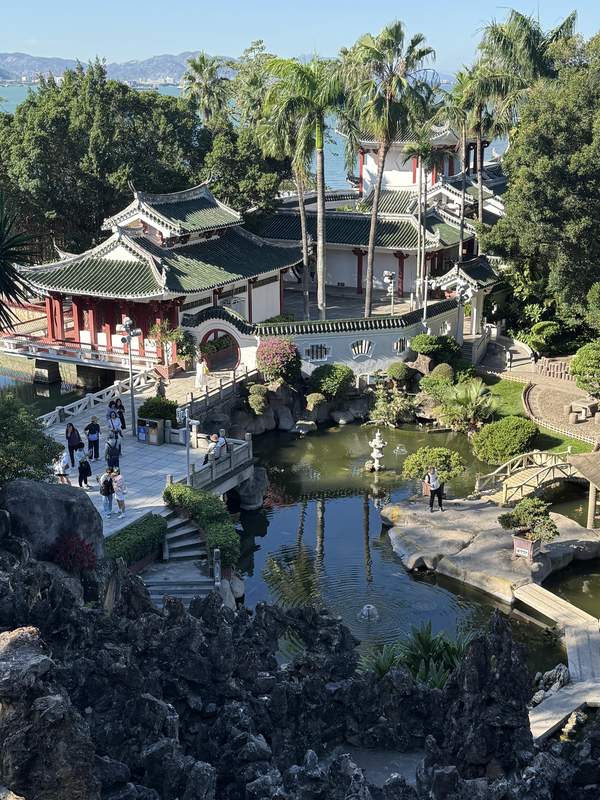
The beaches are the island’s quiet half. Gangzaihou Beach (港仔后沙滩) and Dadeji Beach (大德记沙滩) are the two to know, and the evening is the time for them: the tour groups thin out, the light goes soft, and the Twin Towers light up across the water. The bloggers who love Gulangyu all say the same thing: do not rush it. Do not try to see everything. Walk slowly, sit in a cafe, look at the villas, and let the island set the pace. The island is not a checklist. It is a place to wander, and the wandering is the point.
One honest thing more about Gulangyu. A minority of the bloggers say to reconsider it altogether — if you have not booked the ferry, if you dislike walking, if you are travelling with elderly parents or small children — and they are not wrong. The island is crowded, the small sights charge separately, and the fees add up. I still think first-timers should go, and go slowly, because there is nowhere else in China quite like it. But go with your eyes open, and do not let anyone sell you a cheap one-day tour of it: the low-price Gulangyu tour is the same trap as every other low-price tour in this city, and the booking section below explains the pattern.
Day Three: Pick a Coast or a Day Trip
On the third day, leave the old town and choose one of two days. There is no wrong choice — but do not try to do both.
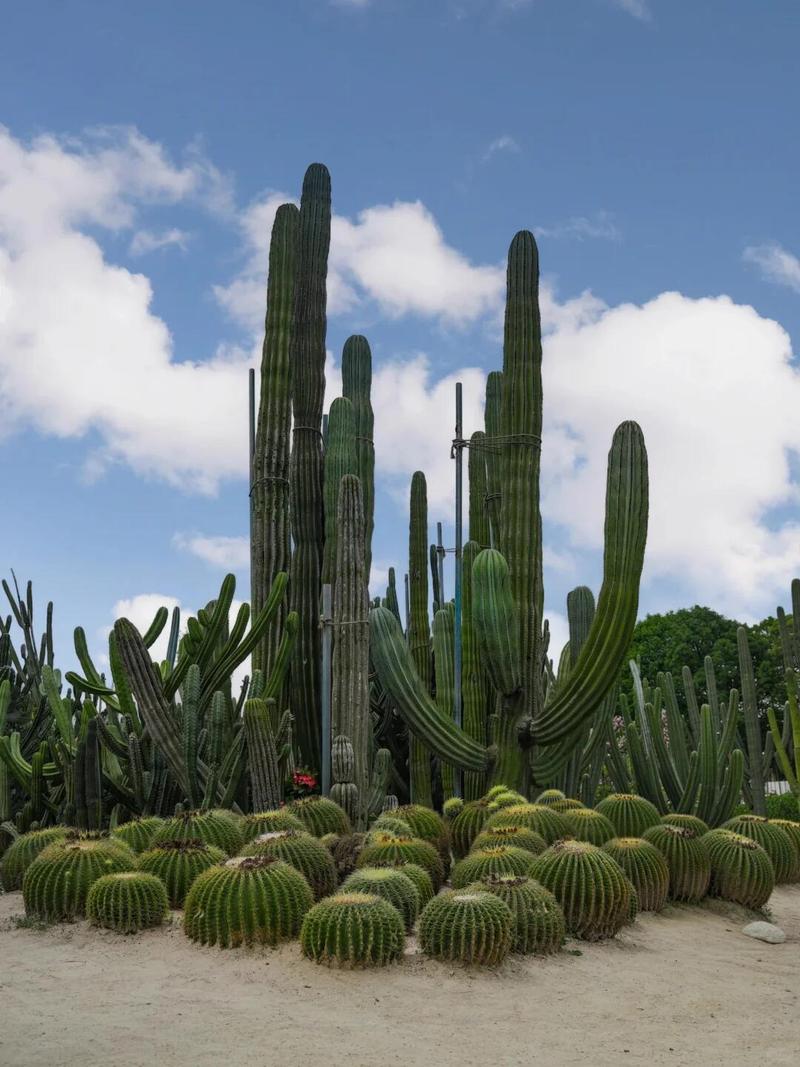
Option A: The coast — garden, cableway and sunset. Start at the Botanical Garden (植物园), and enter by the West Gate, which drops you straight into the two sights that matter: the succulent area (多肉区), a desert garden of strange shapes that photographs beautifully, and the Rainforest World (雨林世界), where the mist comes on at set times and the whole place turns into a green cloud. The garden is big, and the sightseeing bus is slow and does not announce its stops well, so give it two or three hours and do not try to see all of it. The bloggers are divided about the garden itself — some say skip it — and their advice, which I agree with, is that if you are short on time, the cableway is the better choice.
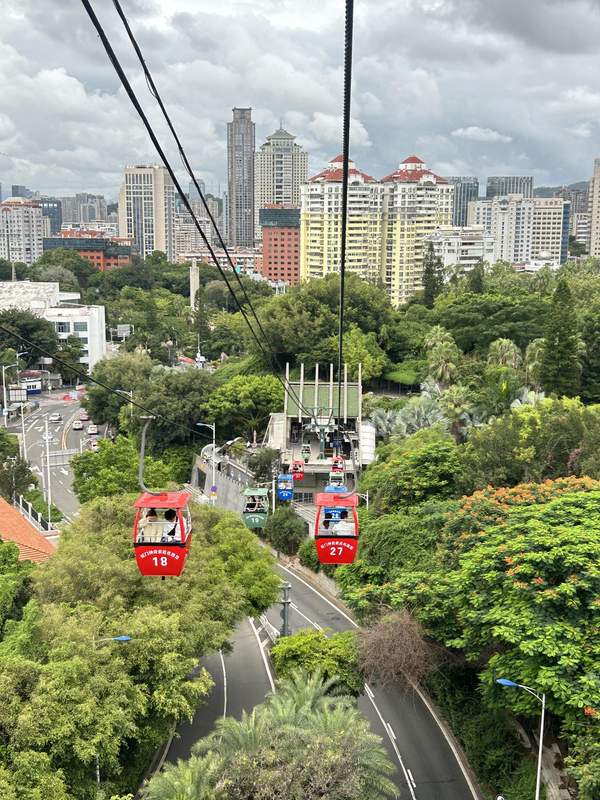
The Zhonggu Cableway (钟鼓索道) runs from beside the garden up over the city, and the ride is the panorama of Xiamen in a single sweep: the bay, the island, the towers, the green mountain behind you. Book it ahead, and allow time for the queue. Garden or cableway, pick the cableway.
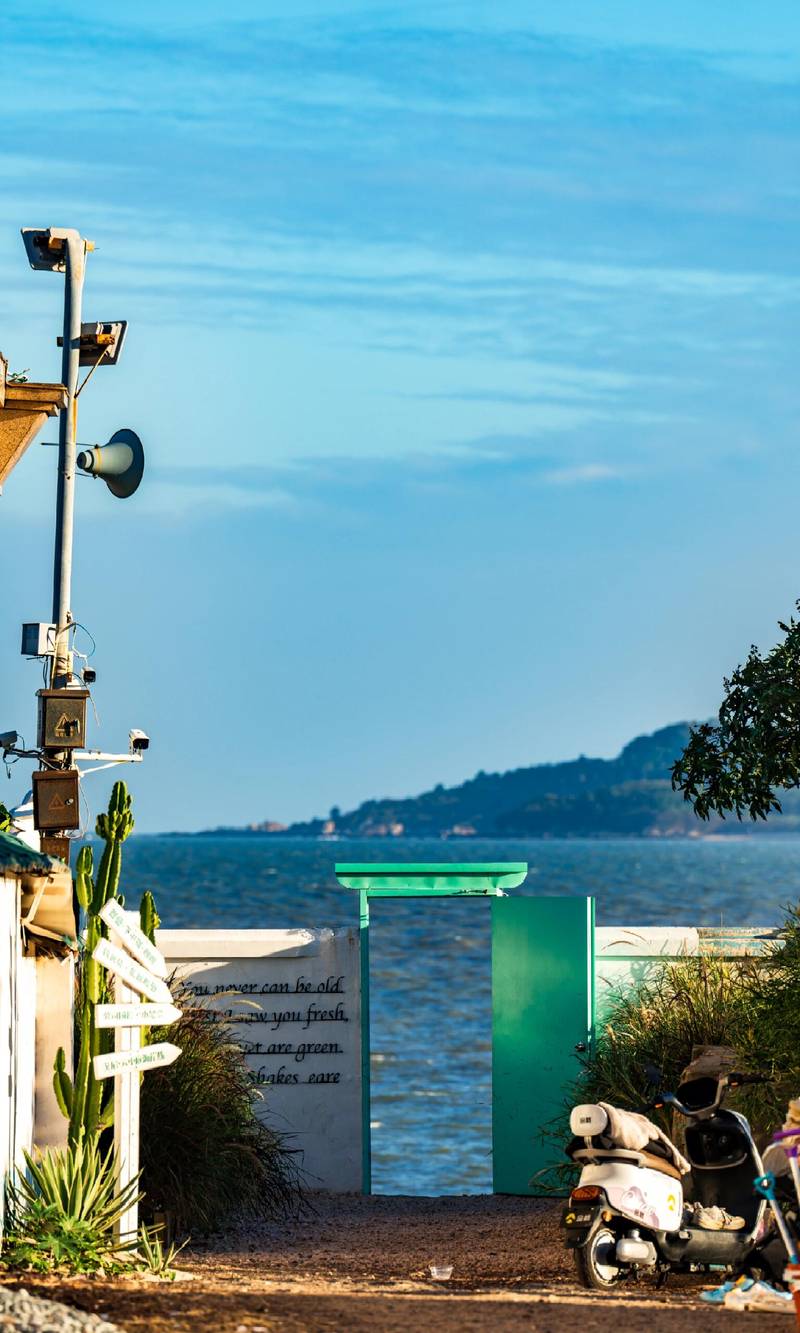
From the cableway, take the coast road — Huandao Road (环岛路), the road the city built for looking at the sea — and spend the afternoon on its beaches. Huangcuo Beach (黄厝沙滩) is the one the locals recommend: fine sand, few people, clean water. Xitouxia Beach (溪头下海滩) holds the little “Anywhere Door” (任意门) that every photographer wants, and Wangyuepo (望月坡) has the lone tree and the bookshop with the sea-view window. Baicheng Beach (白城沙滩), by the university, is the one to downgrade: crowded and jammed, and the locals do not recommend it. The way to do the coast is by bus — the coastal bus runs the length of it — or on a shared bicycle, in sections. Never rent an e-bike on Huandao Road: the stalls will tell you it is fine, and the police will fine you.
End the day on the Mountain-Sea Trail (山海步道), the walkway the bloggers call the city’s greatest invention: a path strung along the hillside above the sea, running from the D18 entrance past Wanshi Canghai (万石沧海) to the Panguita (盼归塔) and the sunset platform beyond it. It is about four kilometres of walking, and the trick is the timing — arrive at the platform before sunset, when the light turns gold towards the Twin Towers. On a sunny day the sea is blue-green and the whole coast opens out; on a cloudy day it is a let-down, so pick your weather. If your knees are bad, there is a step-free way in by lift — ask at the entrance.
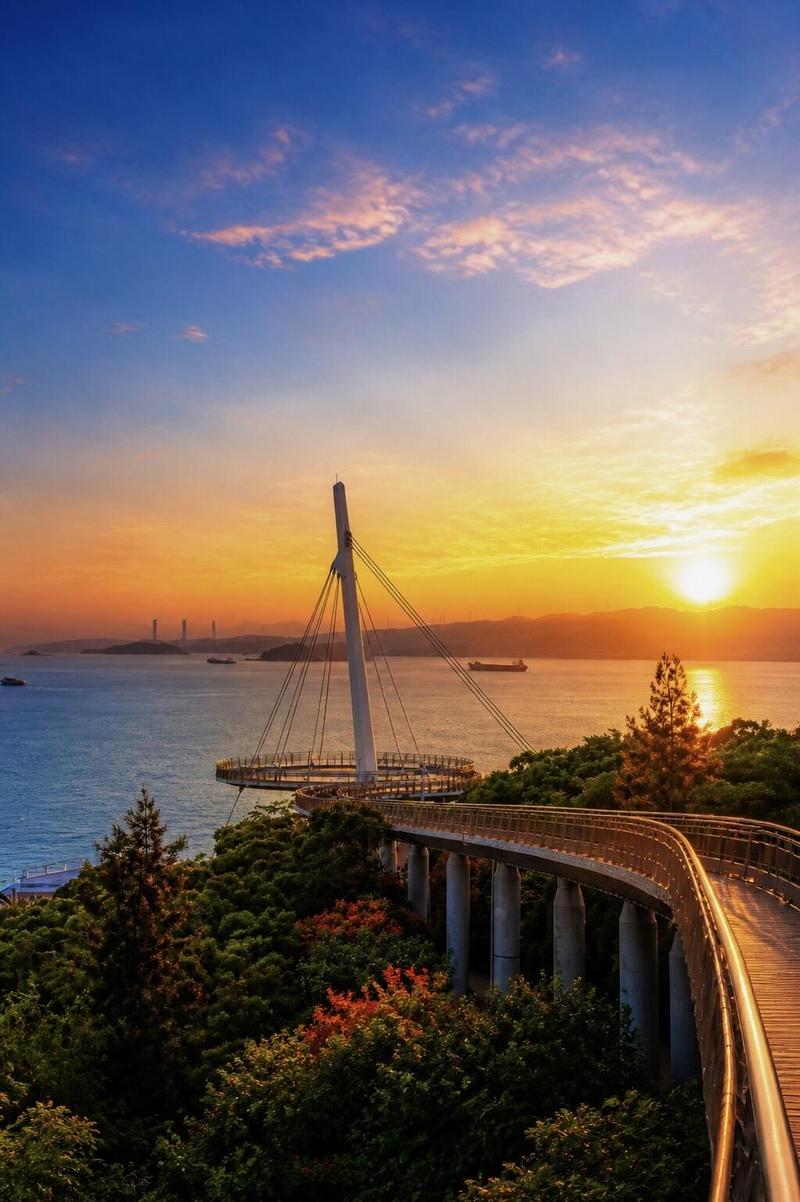
Option B: A day trip — tulou or Kinmen. The other third day leaves Xiamen altogether, and there are two trips worth it.
The tulou (土楼) of Nanjing are the great earthen fortresses of the Hakka people, two hours’ drive inland, and one cluster is enough for a day — Yunshuiyao (云水谣), the slow village of old banyans and river mills, or Tianluokeng (田螺坑), the famous “four dishes and a soup” (四菜一汤) of four round tulou and one square one seen from the platform above. Do not try to see two clusters in one day: they are an hour apart, and you will see neither properly. There is no direct public transport, so go by self-drive or a chartered car. And do not book a cheap tour. The low-price tulou tour is the most-written-about trap in Fujian: a twelve-hour day in which ten hours are shopping — silver, tea, medicine — and the tulou itself gets half an hour at the end. A tour that costs next to nothing cannot cover the ticket and the drive without shopping stops. Book a no-shopping tour, or go independently.
Kinmen (金门) is the other day trip, and it is the stranger one: a half-hour ferry from Wutong (五通) to Shuitou (水头), and you are on an island that is a different world — old Minnan villages, a tunnel cut through the rock, a folk-culture village of red-brick houses, and a town, Jincheng (金城镇), that runs on milk tea and beef jerky. Foreign passport holders can go, but the permit depends on your nationality, so confirm the rules at the Wutong ferry terminal before you book anything. Book the return ferry in advance — the waitlist is long in peak season — and take a taxi on the island rather than renting a bike in the summer heat. The full ferry and permit procedure is in Pepchina’s guide to getting from Xiamen to Kinmen.
The half-day alternative: if neither the coast nor a day trip appeals, spend the morning in Jimei (集美学村), the school village across the bay. The red-brick Jiageng architecture is the sight — the memorial hall and the park are free — and the sea metro, the stretch of Metro Line 1 that runs over the water, is the journey. The village is big and tiring on foot, so rent a small e-bike there, where it is allowed, or take your time. The old drama-house that the bloggers argue about is a quick exterior photograph at most, not a destination. And if you still have an afternoon free, Haicang (海沧), across the bay the other way, is the quiet half-day the locals recommend: a lake walk, a bay walk, and no tickets, no touts, and no crowds at all.
What to Eat
Xiamen’s food is Minnan cuisine (闽南菜), one of the great regional cuisines of China, and it is the reason many travellers remember the city better than its sights. The flavours are light, fresh and a little sweet, with the sea never far away. The rule the locals repeat is the rule for the whole city: eat in the alleys, not on the main streets, and pick the shop full of locals.
The dish to start with is shacha noodles (沙茶面), the peanut-and-satay soup noodles that are Xiamen’s signature. The trusted names are the old shops the locals name again and again: Sili (四里), Yuehua (月华) and Yousheng (友生). Order simply — too many toppings is the tourist mistake — and do not order seafood toppings: the sauce masks the freshness, and the seafood is the tourist topping. One warning, and it is a story worth telling: the real Wutang (乌糖) is the old shop on Minzu Road (民族路), and for three years a copycat Wutang (乌堂) — the same pronunciation, a different character — ran half a dozen branches around the university and Zhongshan Road, blasting “hundred-year-old shop” from a loudspeaker and buying influencer praise, until the real shop sued it and won. The lesson stands: in Xiamen, a famous old name on a main street is the thing to check twice.
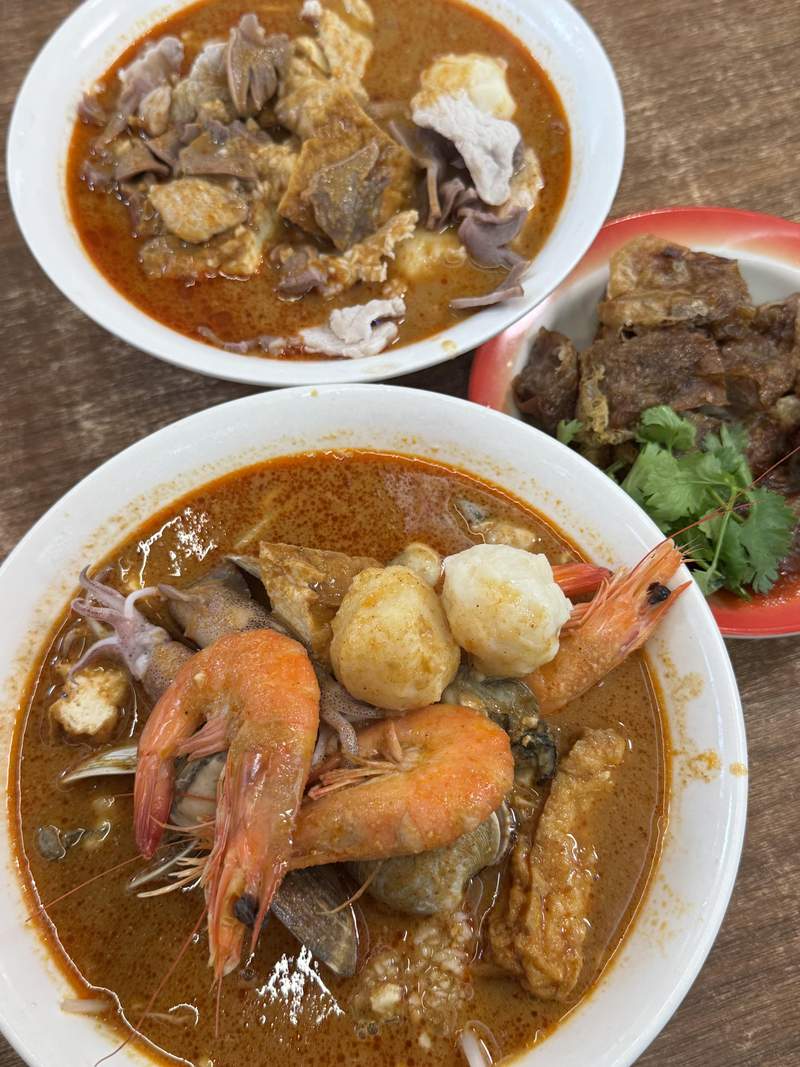
The rest of the table fills out quickly. The oyster omelette (海蛎煎) must be eaten hot — cold, it turns fishy — and the named shop is Lianhuan (莲欢). Peanut soup (花生汤) is the sweet end of breakfast, from the Sibei (思北) shops the locals queue at. Ginger duck (姜母鸭) comes in two styles, watery and tender or dry and charred. Roast pork zongzi (烧肉粽) is the other breakfast pillar, and the 1980 shop is the name to look for. The iced desserts are the relief from the heat: four-fruit soup (四果汤) and stone-flower jelly (石花膏), the translucent seaweed jelly that is the coast’s own. Vermicelli paste (面线糊) and sandworm jelly (土笋冻) are the dishes to be most careful with: the real sandworm jelly melts out of the fridge, and there is no trusted old-town shop for it.
Seafood is the meal that needs the most care. Eat it at the clearly priced shops, and ask the unit and the price before anything is weighed — whether it is charged by the jin (斤) or by the portion, and whether the price is for the whole fish or by weight. Use the fair scale at the market entrance, and do not buy from a shop whose staff tout on the street: the locals do not eat there, and the taste shows it. The bait-price board is the pattern to recognise — a board outside advertising dishes at prices the menu inside does not honour — and the unopened bag on the scales is the other: no honest shop weighs seafood without opening the bag. The “market price” dish with no price at all is the third. If you want one safe sit-down meal, the old-fashioned Minnan restaurants the locals recommend are the answer.
And then there is the tea. Minnan kung fu tea (功夫茶) is not a performance for tourists — it is a daily culture, a small table, a tiny pot, and an unhurried hour. Chinese tea culture runs deep in this city, and the trap is not the drinking, it is the buying. Never buy loose tea in a scenic area, and never buy from a shop that quotes you a price by the gram: the flower-tea shops are the biggest trap in the city. Ask the total price first, or walk away.
The gimmicks to skip are the ones the locals have never heard of: the crab-yolk soup dumplings on Zhongshan Road are not Minnan food at all, and the starfish and the adventure ice cream are internet novelties the locals do not touch. As for raw pickled seafood (生腌), I do not eat it here, and the local advice is the same: the shops that sell it are the ones the visitors keep asking about, not the ones the locals trust.
Booking, Honestly
Xiamen is an easy city to travel independently, and that is the first thing to say: the sights are concentrated, no tour is needed at all, and the low-price one-day tour is the story of this city in miniature. The pattern is always the same: a helpful stranger at the station or the pier invents a scare story — your hotel is next to a funeral parlour, the ring-island tour needs a group permit, a limited-time government discount — and steers you to a “traveller centre” to buy an expensive package. Then comes the day of shopping stops — pearls, silver, tea, medicine, duty-free tobacco — and a guide who turns cold if you do not buy, and no return to your hotel. A tour that costs next to nothing cannot cover its tickets without shopping stops. Ask in advance whether a tour is a pure-play tour with no shopping, get the promises in writing, and know that the old town is walkable and the metro will take you anywhere else. If you are cheated, the city’s complaints line is 12345, and several tourists report getting part of their money back after complaining.
The bookings that matter are three. The Gulangyu ferry: book days ahead through the official mini-programs, and remember the pier — Dongdu for tourists, never Lundu. Xiamen University: book three days ahead on the official account, with your original passport or ID. The cableway: book ahead. Nanputuo Temple is free, but the booking rules are disputed, so check the official account before you go.
The transport trap is the stations. For the city itself, go to Xiamen Station (厦门站), on the island, in the centre — the metro and the BRT run from its doors, and the ferry pier is a short ride away. Xiamen North Station (厦门北站) is off the island, in Jimei, and a long ride into the city: use it only if you are going to Jimei. The airport is changing as this guide is written: Gaoqi Airport (高崎机场), the convenient on-island airport, closes at the end of 2026, and flights move to the new Xiang’an Airport (翔安机场) off the island — check which airport your flight uses.
Inside the city, the metro, the BRT and the buses cover everything, and one transport code works for all three. Do not take an unlicensed car at the station or the airport, and do not rent an e-bike on the island: the island bans them, the rental stalls lie about it, and the fine is the same for everyone. A shared bicycle is fine, but wear a helmet — the police fine for that too. Taxis are the last warning: most will take a detour, even for locals, so use ride-hailing and the metro instead.
One practical note for foreign visitors: a brand hotel that accepts foreign guests registers you with your passport and is the least hassle. A guesthouse may not have foreign-guest qualification — confirm before you book, or you will be registering at a police station yourself. Some guesthouses do not accept foreign guests at all, so filter for foreign-guest rooms when you book. Chain front desks manage basic English; guesthouse owners mostly speak Chinese.
What I’d Skip
Zeng Cuo’an (曾厝垵) is the bloggers’ number one skip, and I agree with them. It was once a fishing village, and now it is a snack street: roadworks, mess, no character, and food that is expensive and bad. Go only if you are staying nearby and passing through. Cat Street (猫街) is the second skip: commercial, and with nothing to do in it. The Botanical Garden is the third, in part: the garden itself is skippable if you are short on time — take the cableway instead, which shows you the whole garden from above. Jimei is the fourth, in part: go for the architecture and the nostalgia, not for the drama-house, which is a quick exterior photograph at most. Baicheng Beach is the fifth, downgraded rather than skipped: crowded, coarse sand, and the locals do not recommend it when Huangcuo is a short ride away. The low-price tours are the sixth, and the “see Kinmen by yacht” boat is the seventh: the boat loops around the near sea and you cannot see Kinmen from it at all. And the commercial streets as destinations are the last skip — Zhongshan Road, Shapowei and the rest are fine for a photograph and a walk, but they are not the reason to come to Xiamen.
Summary
Xiamen is the city China goes to when it wants to slow down, and that is its gift. It was once a fishing village, then a fortress, then a treaty port, then an international settlement, and it kept the evidence — the villas, the arcades, the temples, the statue facing the sea — without turning itself into a theme park. It is a city of sea air and slow mornings, of ferry crossings and noodle bowls, of an island you walk because there is no other way to see it. Book the ferry early, eat in the alleys, and leave the tick-box list at home.
If you have more time in Fujian, the province has one more old port that pairs naturally with Xiamen: Quanzhou (泉州), the forgotten port of the Maritime Silk Road, an hour up the coast by train. But do not rush Xiamen to get there.