

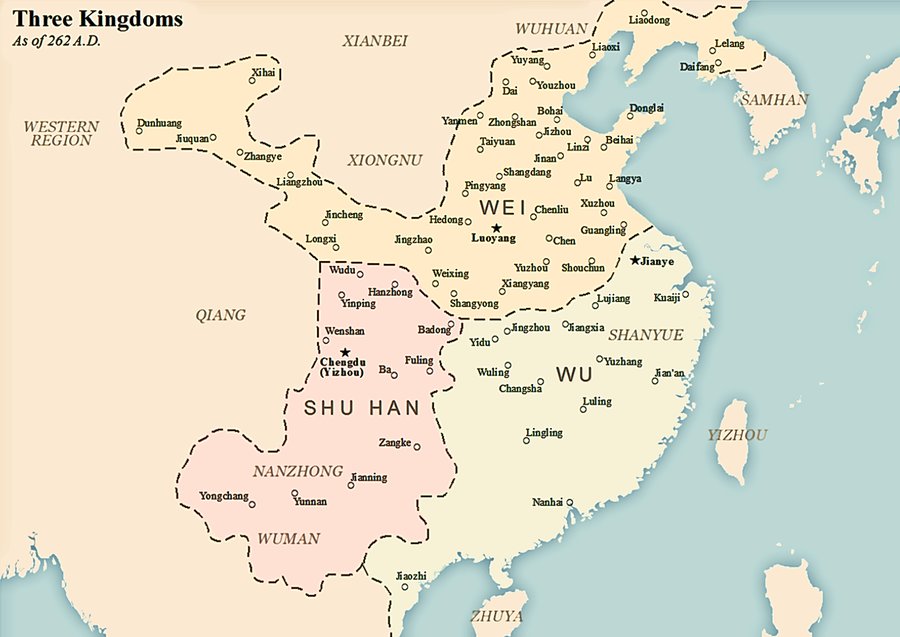
The Three Kingdoms period (220 – 280 AD) was not a single dynasty but an age of division, in which three rival states fought for control of China. It followed the collapse of the Han dynasty (202 BC – 220 AD), which had ruled China for four centuries. In the north, Cao Pi (曹丕) founded the state of Wei. In the south-west, Liu Bei (刘备) founded Shu Han. In the south-east, Sun Quan (孙权) founded Wu. Each claimed to be the one legitimate emperor of all China, and none accepted the others.
The period runs from the founding of Wei in 220 AD to the reunification of China in 280 AD, but its roots lie in the chaos of the 180s and 190s. It was an age of famous generals and battles, and China’s registered population fell catastrophically.
No period of Chinese history is better known. Its official history, the Sanguozhi (三国志, Records of the Three Kingdoms), was written by Chen Shou (陈寿) within a generation of the events, and centuries of storytelling turned its heroes into legends, above all in the great Ming dynasty novel by Luo Guanzhong (罗贯中), the Romance of the Three Kingdoms. Many of the most famous episodes, however, come from the novel rather than from history, as noted below.
Key Facts
- Period dates: 220 – 280 AD.
- Preceding dynasty: Han, 202 BC – 220 AD.
- Subsequent dynasty: Jin (Western Jin), 266 – 316 AD, which reunified China in 280 AD.
- Wei: 220 – 266 AD, capital Luoyang, founded by Cao Pi.
- Shu Han: 221 – 263 AD, capital Chengdu (成都), founded by Liu Bei.
- Wu: capital Jianye (建业, modern Nanjing). Sun Quan became King of Wu in 222 AD and emperor in 229 AD; the state fell in 280 AD.
- Total number of emperors: 11 – five of Wei, two of Shu Han, and four of Wu.
- Longest reign: Sun Quan of Wu, who ruled the Wu territories from 200 AD, succeeding his brother Sun Ce (孙策); King of Wu from 222 AD and emperor from 229 to 252 AD.
- Final emperor: Sun Hao (孙浩) of Wu, who surrendered to Jin in 280 AD.
The Origins of the Three Kingdoms
In 184 AD the Yellow Turban Rebellion broke out, led by the faith healer Zhang Jue (张角), leader of the Way of Supreme Peace. The Han government crushed the rebellion, but only by allowing governors and strongmen to raise armies of their own. In 189 AD the warlord Dong Zhuo (董卓) seized Luoyang, placed the boy Emperor Xian on the throne as his puppet, and burned the capital. The coalition that marched against him soon quarrelled and broke up, and for the next decade China was fought over by a dozen warlords.
The strongest of them was Cao Cao (曹操). In 196 AD he took the fugitive Emperor Xian into his protection, and from then on governed in the emperor’s name whilst holding the real power himself. In 200 AD, at the Battle of Guandu (官渡), he defeated the much stronger Yuan Shao (袁绍). By 207 AD Cao Cao had unified the whole of northern China.
In 208 AD Cao Cao marched south to finish the work. He occupied Jing Province (荆州) on the middle Yangtze, whose governor had just died, and chased Liu Bei south. Liu Bei’s adviser Zhuge Liang (诸葛亮) persuaded Sun Quan, the young ruler of the south-east, to join an alliance, and in the winter of 208 AD the allied fleet, commanded by Sun Quan’s general Zhou Yu (周瑜), met Cao Cao at the Battle of Red Cliffs (Chibi, 赤壁). Cao Cao’s northern soldiers, sick and unused to fighting on water, were defeated and his fleet burned. The histories speak of enormous armies, but the figures are disputed and certainly exaggerated. Cao Cao retreated north and never again came so close to conquering the south. Liu Bei took over most of Jing Province, then seized Yi Province, modern Sichuan, in 214 AD. The three-way division of China had taken shape.
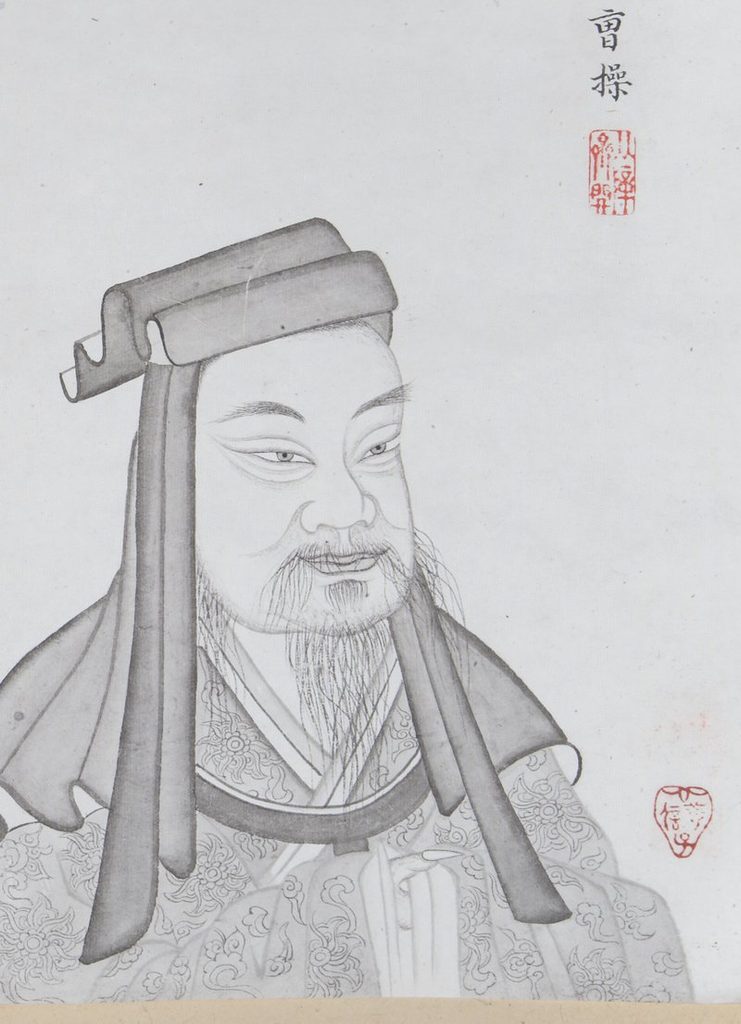
Cao Cao – The Man Who Made the Three Kingdoms
Cao Cao (born in 155 AD, and died in 220 AD) was the true founder of the Three Kingdoms age, although he never wore an imperial crown. The son of a palace official, he rose through the wars of the 190s to become the strongest man in China. He became Chancellor of the Han in 208 AD, and in 216 AD the puppet emperor was made to grant him the title King of Wei. The Han court still existed, but every important decision was his – a lesson in how ancient China’s government was run when real and formal power came apart.
His power rested on more than armies. Cao Cao set up tuntian (屯田), military-agricultural colonies in which soldiers and refugees farmed state land for a share of the harvest. The colonies guaranteed grain for his armies and brought abandoned farmland back into cultivation. He recruited officials for their ability rather than their family name, and punished corruption harshly.
In a famous edict of 210 AD, Cao Cao compared himself to King Wen of Zhou, who had prepared the way for a dynasty he never lived to found: if the Mandate of Heaven rested with his family, he wrote, he would be content to be its King Wen. He died at Luoyang in 220 AD, still only a king. Within the year his son Cao Pi had forced Emperor Xian to abdicate and taken the throne as the first emperor of Wei. Cao Cao received the posthumous title Emperor Wu of Wei – an emperor only after death, and only on paper.
Read more: Top 10 Capital Cities of Ancient China
The Three Kingdoms at its Height – The Three-Way Balance
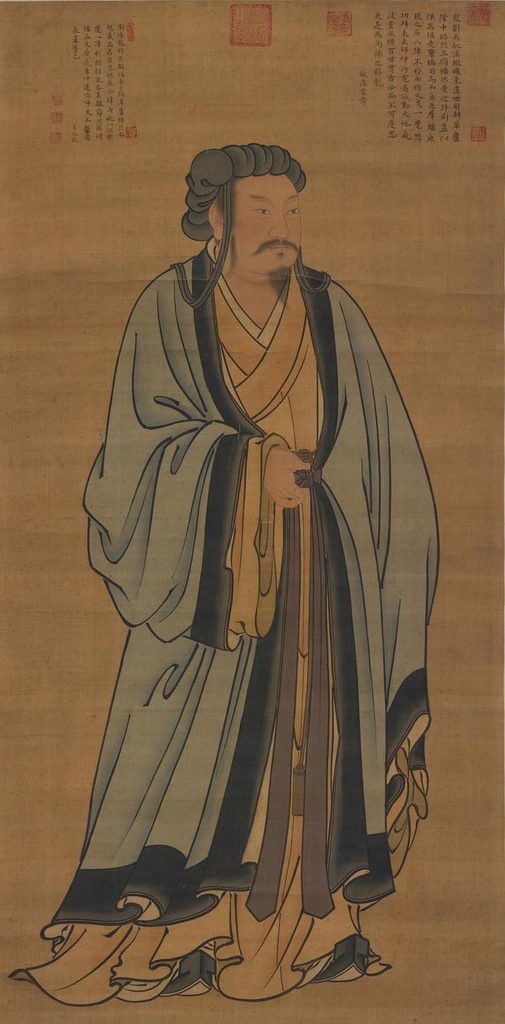
The three states were then founded in quick succession. In 220 AD Cao Pi took the imperial title and founded Wei. In 221 AD Liu Bei proclaimed himself emperor at Chengdu, claiming that his state, Shu Han, continued the Han dynasty. Sun Quan, who had ruled the south-east since 200 AD, took the title King of Wu in 222 AD, and in 229 AD finally declared himself emperor at Wuchang (武昌); later the same year he moved his capital to Jianye. Wei was by far the largest and richest state, holding the old northern heartlands. Shu Han, the smallest, survived behind the mountains of Sichuan, and Wu behind the Yangtze River.
The balance depended on the Shu Han–Wu alliance against Wei – and the alliance nearly destroyed itself at the start. In 219 AD Liu Bei’s sworn brother and greatest general, Guan Yu (关羽), who held Jing Province for Shu Han, won a brilliant victory in the north. But Wu, which claimed Jing Province for itself, struck behind his back. Guan Yu was captured and executed, and Jing Province passed to Wu. Liu Bei’s other sworn brother, Zhang Fei (张飞), was murdered by his own officers in 221 AD. Liu Bei then led a great invasion of Wu to win Jing Province back and avenge Guan Yu. Wu’s general Lu Xun (陆逊) waited until the invading army was stretched out and exhausted, then attacked with fire at the Battle of Xiaoting (猇亭, also called the Battle of Yiling, 夷陵) in 222 AD. The invasion collapsed. Liu Bei fled west and died in 223 AD, leaving his state to his young son Liu Shan (刘禅).
Shu Han was saved by its chancellor, Zhuge Liang. He repaired the alliance with Wu, governed the small state with famous honesty, and from 228 AD led five Northern Expeditions out of Hanzhong (汉中) against Wei, hoping to restore the Han dynasty. Distance, mountains, and failing supplies defeated the expeditions as much as Wei’s armies did, under the patient Sima Yi (司马懿). In 234 AD Zhuge Liang died on campaign at the Wuzhang Plains (五丈原), and the expeditions died with him.
Inside Wei, power was quietly changing hands. In 220 AD the official Chen Qun (陈群) created the Nine-Rank system for grading candidates for office, which shaped how government officials were chosen in ancient China for centuries – although the great families soon captured it and became a hereditary ruling class. The Sima family rose with them. In 249 AD Sima Yi seized power in the Gaoping Tombs coup, and his sons completed the work.
Art and Culture During the Three Kingdoms
War did not stop Chinese culture; in some ways it sharpened it. The age is remembered for the poetry of the Jian’an (建安) era, the reign period of the last Han emperor. Cao Cao, Cao Pi, and Cao Pi’s younger brother Cao Zhi (曹植) were all major poets, and their poetry, written in an age of plague and battle, has a directness earlier court poetry lacks. Around them gathered a group of writers known as the Seven Masters of Jian’an. Cao Pi also wrote the Lunwen (论文, ‘Discourse on Literature’), preserved in his Dianlun (典论), one of the earliest works of literary criticism in China.
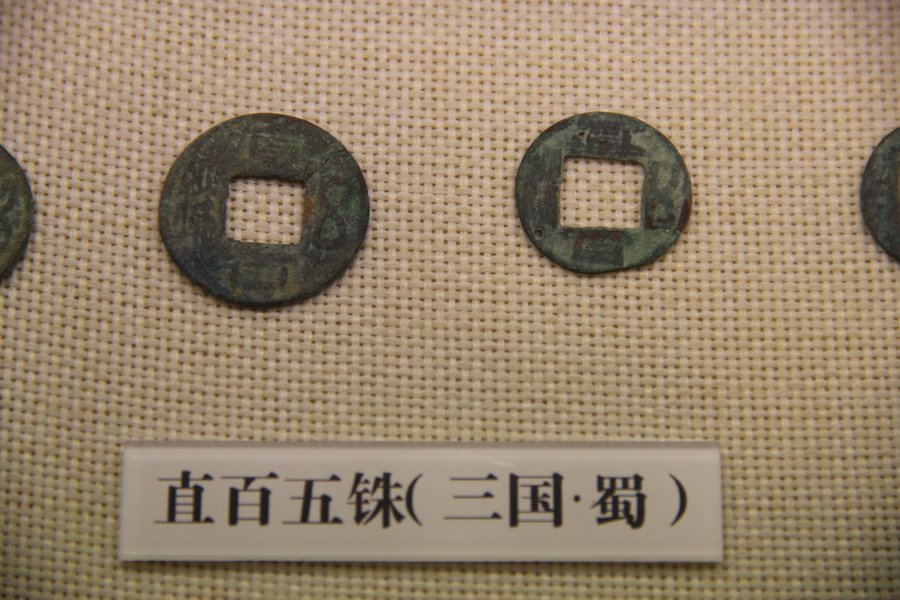
The period also produced Zhong Yao (钟繇), a senior Wei official who helped to create the standard script still used for Chinese characters today, and the physician Hua Tuo (华佗), famous for operating on patients under an anaesthetic powder, who died in about 208 AD after angering Cao Cao. Shu Han, short of resources, cast oversized coins officially worth a hundred ordinary coins, the zhibai wuzhu (直百五铢), and paid for its wars with the difference.
Above all, the age gave China its best-loved story. The historical record is Chen Shou’s Sanguozhi, compiled in the 290s AD and enriched in 429 AD by the notes of Pei Songzhi (裴松之), which added hundreds of anecdotes from other sources. It became one of the classic histories at the heart of ancient Chinese education. The famous Romance of the Three Kingdoms, by contrast, is a novel of the 14th century, written in the Ming dynasty by Luo Guanzhong, one of the Four Great Classical Novels of China. In the novel, Zhuge Liang becomes a near-magician who borrows arrows with straw boats and frightens an army away with an empty city, and Guan Yu performs feats beyond any human general. These episodes are fiction, invented by storytellers and the novelist, not history. But it is the novel, retold in operas, films, and computer games, that made the Three Kingdoms China’s most famous age.
Religion During the Three Kingdoms
Confucianism remained the official ideology of all three states, and every emperor performed the traditional rites and sacrifices. But it had lost its unquestioned authority along with the Han dynasty itself, and many scholars turned instead to Daoist ideas, or withdrew from public life altogether.
Religious Daoism, by contrast, was growing into an organised church. The Yellow Turbans’ Way of Supreme Peace had been destroyed with the rebellion, but in the mountains of Hanzhong, Zhang Lu (张鲁) governed a small theocratic state for the Way of the Five Pecks of Rice, named for the five pecks of rice its members contributed. Its parishes, confession of sins, and charity hostels became a model for later Daoist organisation. Zhang Lu surrendered to Cao Cao in 215 AD, and his movement spread north under official tolerance. Buddhism, too, grew slowly, as foreign monks translated scriptures at Luoyang and in Wu. Families still honoured their ancestors and buried their dead with goods for the afterlife, following the funeral customs of earlier ages.
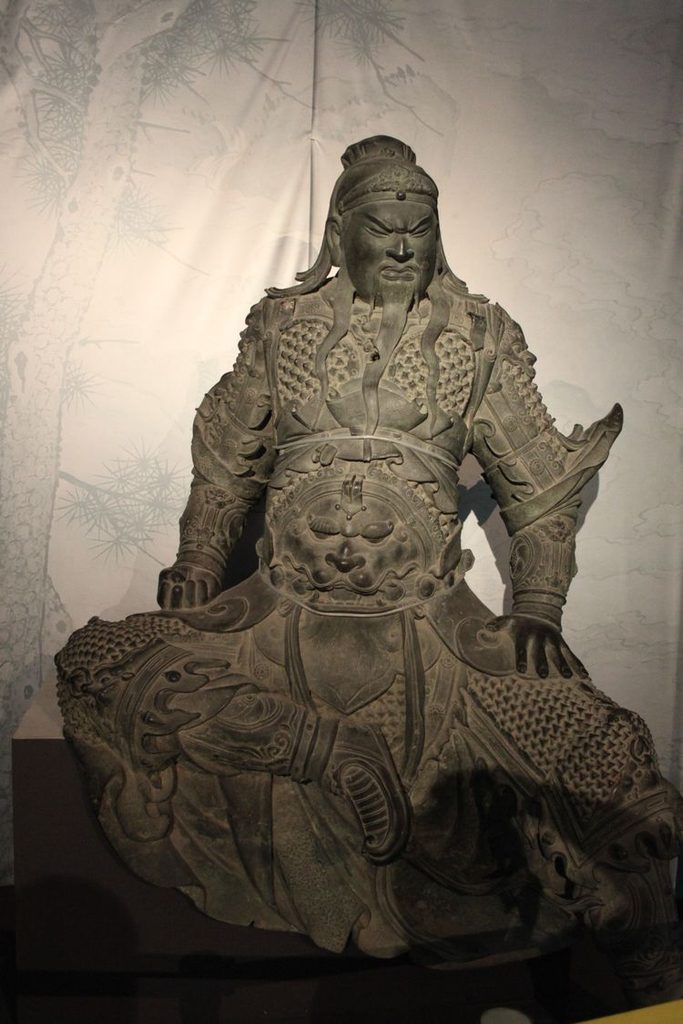
One figure of the age rose higher after death than any emperor. Guan Yu, executed in 219 AD, came to be worshipped in later centuries as a god of loyalty, righteousness, and war, with temples in almost every Chinese town.
Read more: What Were the Rituals and Laws in Ancient China?
The Fall of the Three Kingdoms
Shu Han fell first. Exhausted by decades of expeditions, it could not match Wei’s resources. In 263 AD Wei invaded in overwhelming force. Whilst the main Shu Han army was held at the mountain passes, the Wei general Deng Ai (邓艾) led his men over trackless mountains the defenders thought impassable, and appeared without warning before Chengdu. Liu Shan surrendered his city and his state without a siege. A last revolt at Chengdu was crushed within months, and Shu Han passed into Wei’s hands.
Wei itself fell next – not in battle, but in the same quiet way that the Han had fallen to the Cao family. In 266 AD Sima Yi’s grandson, Sima Yan (司马炎), forced the last Wei emperor to abdicate, just as Cao Pi had forced Emperor Xian to abdicate, and founded the Jin dynasty. Only Wu remained, rich and defended by the Yangtze, but weakened after Sun Quan’s death by short reigns and murderous regents, and finally by Sun Hao, whose cruelty undermined the state from within.
In 280 AD Jin attacked Wu from six directions at once, with fleets sailing down the Yangtze from Sichuan. The river defences were broken, Jin troops reached Jianye, and Sun Hao surrendered, as Liu Shan had done, and was taken to Luoyang as a prisoner. After a century of division, China was one empire again.
The human cost of that century can be read in the census figures. The Han government at its height had registered almost 60 million people. The Jin census of 280 AD registered about 16 million. These are registered figures, not a true count – millions had fled, died, or been hidden from the tax registers on great families’ estates – but they still show a society shattered by three generations of war.
Summary
The Three Kingdoms period lasted for sixty years and had eleven emperors, and is one of the most vivid ages in Chinese history. It began in the ruins of the Han empire and ended with the reunification of China in 280 AD. Its three states were never equal: Wei held the people and the farmland of the north, Shu Han survived on courage and good government in a mountain province, and Wu trusted to a great river. In the end, resources told, and the winner was not even one of the original three, but the Jin dynasty that had quietly taken Wei over from inside.
The age also marked a lasting change in Chinese society. The Nine-Rank system, created in 220 AD, turned government service into the inheritance of great families for centuries to come. Yet the period lived on in the imagination as no other age of division has done. The unified empire built by the Qin dynasty and maintained by the Han had fallen apart; what held men’s loyalty was no longer the empire, but the memory of heroes – of Cao Cao’s ambition, Liu Bei’s benevolence, Zhuge Liang’s devotion, and Guan Yu’s loyalty. In that sense, the ‘age of heroes’ never really ended at all.
Read more: Ancient Chinese Dynasty Timeline