
The Shang dynasty (c. 1600 – c. 1046 BC) lasted for about 550 years and holds a unique place in Chinese history: it is the earliest Chinese dynasty whose existence is firmly supported by archaeology. For earlier ages we depend on histories written many centuries later, but for the Shang we have evidence from the ground itself – royal tombs, palace foundations, bronze vessels, and above all the oracle bones, the earliest known body of Chinese writing. The first surviving accounts of it were written by the Zhou dynasty (1046 – 256 BC) that succeeded it.
According to those traditional histories, the Shang was China’s second dynasty, following the Xia dynasty (c. 2070 – c. 1600 BC). The Xia, however, remains semi-legendary. No writing from its own time has ever been found, and many scholars associate it instead with the Bronze Age culture excavated at Erlitou (二里头). With the Shang, by contrast, Chinese history steps out of legend and into the archaeological record.
The Shang kings ruled a Bronze Age state centred on the Yellow River valley in the North China Plain. Their capital moved repeatedly before settling at Yin (殷), near modern Anyang (安阳), and the dynasty’s later half, spent there, is often called the Yin dynasty. The Shang rulers were kings, not emperors – the imperial title was not created until more than 800 years after the dynasty fell. All dates for this period are approximate: Chinese chronology only reaches its first exactly datable year in 841 BC, and Shang dates rest on later traditional chronology combined with archaeology.
Key Facts
- Dynasty dates: c. 1600 – c. 1046 BC.
- Preceding dynasty: Xia, c. 2070 – c. 1600 BC (a dynasty known from later texts, not yet confirmed by contemporary writing).
- Subsequent dynasty: Zhou, 1046 – 256 BC.
- First Shang king: Tang (成汤), reigning from c. 1600 BC.
- Total number of Shang kings: 31, according to the traditional king list.
- Longest Shang king reign: Wu Ding (武丁), fifty-nine years, reigning from c. 1250 to c. 1192 BC.
- Final King: Di Xin (帝辛), reigning until 1046 BC.
The Founding of the Shang Dynasty
The Shang began as one of the peoples of the Yellow River valley, whose leaders, according to tradition, had served the Xia kings for generations. Under their leader Tang they grew rich and powerful, whilst the last Xia king, Jie (桀), was remembered by later writers as a cruel tyrant who had lost his people’s support.
According to the traditional account, Tang gathered his allies and defeated Jie at the Battle of Mingtiao (鸣条), in around 1600 BC. Jie fled into exile, the Xia came to an end, and Tang founded the Shang dynasty, ruling from a capital at Bo (亳). Because this story was written down many centuries after the event, its details cannot be checked, but archaeology does show powerful Bronze Age states rising in the valley at just this time.
The Shang state that Tang founded was not a tightly governed empire. The king ruled the royal domain around his capital directly, and beyond it a patchwork of allied and dependent chiefs governed their own lands, sending tribute and soldiers to the king and marrying into the royal family. Ordinary families farmed the fields around the towns and villages – the earliest stage in the long history of how land was held in ancient China.
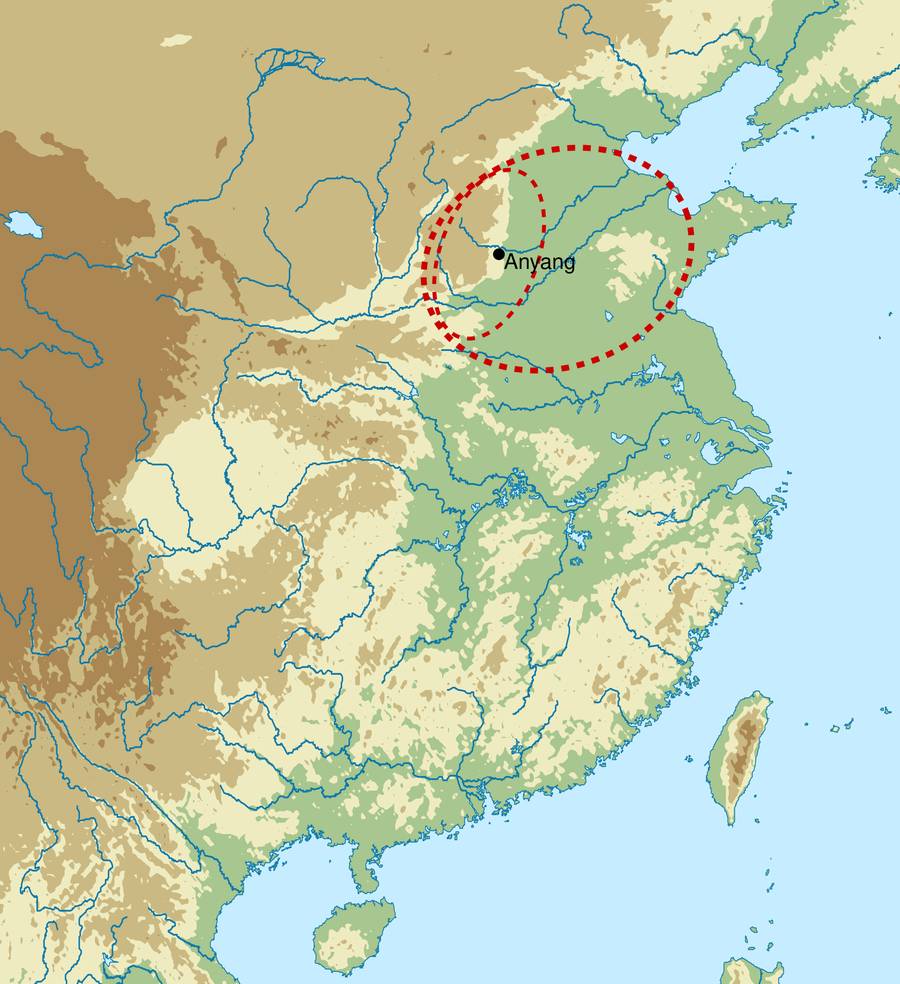
One weakness of the early Shang was that its capital kept moving. Tradition counts six or seven removals, caused by floods, by attacks, or by quarrels within the royal family, and great walled cities of the early Shang have been excavated at Zhengzhou and elsewhere in Henan province. Stability finally came under King Pan Geng (盘庚), who in around 1300 BC moved the capital to Yin, near modern Anyang. Yin remained the royal capital for the remaining two and a half centuries of the dynasty, and almost all our evidence for the Shang comes from this settled, later period.
The Shang Dynasty Founder and First King – Tang
Tang, known to later tradition as Cheng Tang, ‘Tang the Accomplished’, reigned from around 1600 BC as the first king of the Shang dynasty. Later Chinese writers made him the model of a virtuous founder, the mirror image of the wicked Jie whom he had overthrown. A famous story in later texts describes a great drought early in his reign, during which Tang offered himself as a sacrifice to bring rain, and was spared when the rain fell. It cannot be verified, but it shows how completely later ages contrasted the good founder of the Shang with the bad last king of the Xia.
What can be said from archaeology is that the state Tang founded worked. Around the king stood a royal court of officials, scribes, and diviners, supported by bronze-casting workshops, stores of grain, and armies raised from the capital and its allied chiefs. This royal court, in which government, warfare, and religious ritual were all handled by the king and his household, was the earliest form of how ancient China’s government was run.
Tang also set the pattern of Shang kingship: the king was war leader, ruler, and chief priest of the dynasty, responsible for sacrifices to the royal ancestors, on whose favour the fortune of the state was believed to depend.
Read more: Top 10 Capital Cities of Ancient China
The Shang Dynasty at its Height – The Reign of Wu Ding (c. 1250 – 1192 BC)
The Shang dynasty reached the height of its power under King Wu Ding, who reigned for fifty-nine years, from around 1250 to around 1192 BC – the longest reign of the dynasty. From his capital at Yin, Wu Ding’s armies campaigned in every direction, against the Qiang (羌) and other peoples of the north and west, and Shang influence spread far beyond the royal domain. It was in Wu Ding’s time, around 1250 – 1200 BC, that horse-drawn chariots first appeared in China: a Shang general now went into battle standing in a chariot, directing his archers and infantry.
Wu Ding’s court is also the best documented of the dynasty, because most of the surviving oracle bones date from his reign. The king divined constantly – about wars, harvests, weather, sickness, childbirth, and the wishes of his ancestors – and the carved records of those divinations let us see a Shang king at work almost day by day.
The most remarkable figure of the reign was Fu Hao (妇好), one of Wu Ding’s consorts. The oracle bones show that she was far more than a royal wife. She led armies in person – for one campaign the inscriptions record her raising 13,000 troops, the largest force mentioned in any oracle bone text – and she also conducted sacrifices as a priestess, whilst the king anxiously divined about her health, her journeys, and her childbearing.
Fu Hao died in around 1200 BC and was buried at Yinxu (殷墟), the ruins of Yin, in a tomb that was found undisturbed in 1976 – the only Shang royal tomb ever discovered unlooted. It held 468 bronze objects, more than 200 of them ritual vessels, many inscribed with her name, together with 755 objects of jade, weapons, mirrors, and thousands of cowrie shells, buried with her according to the funeral customs of the Shang royal house.
Art and Culture During the Shang Dynasty
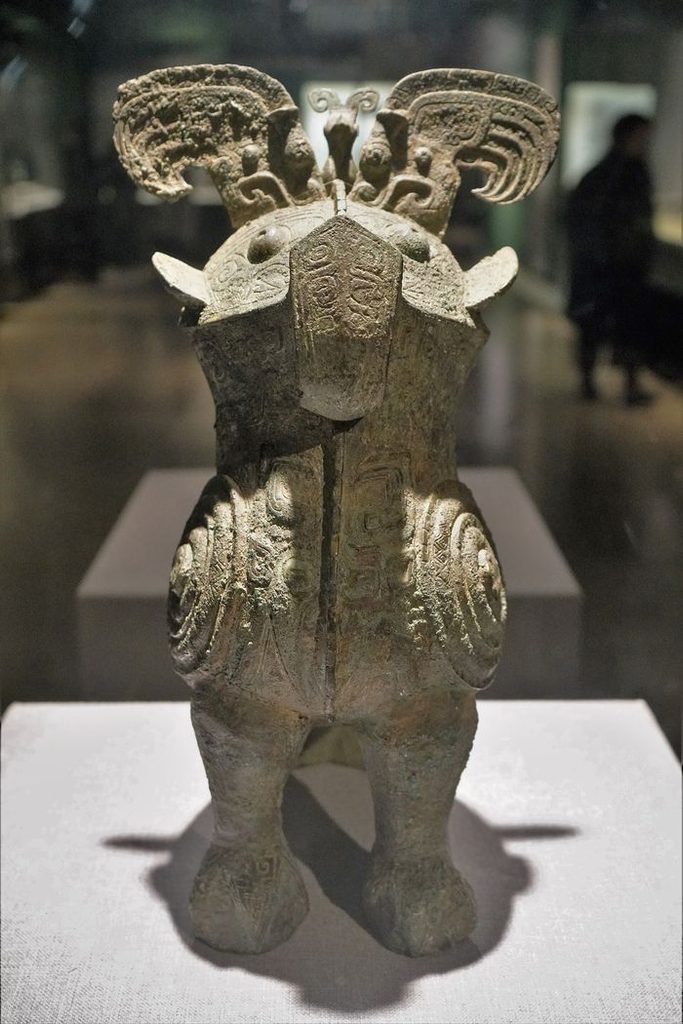
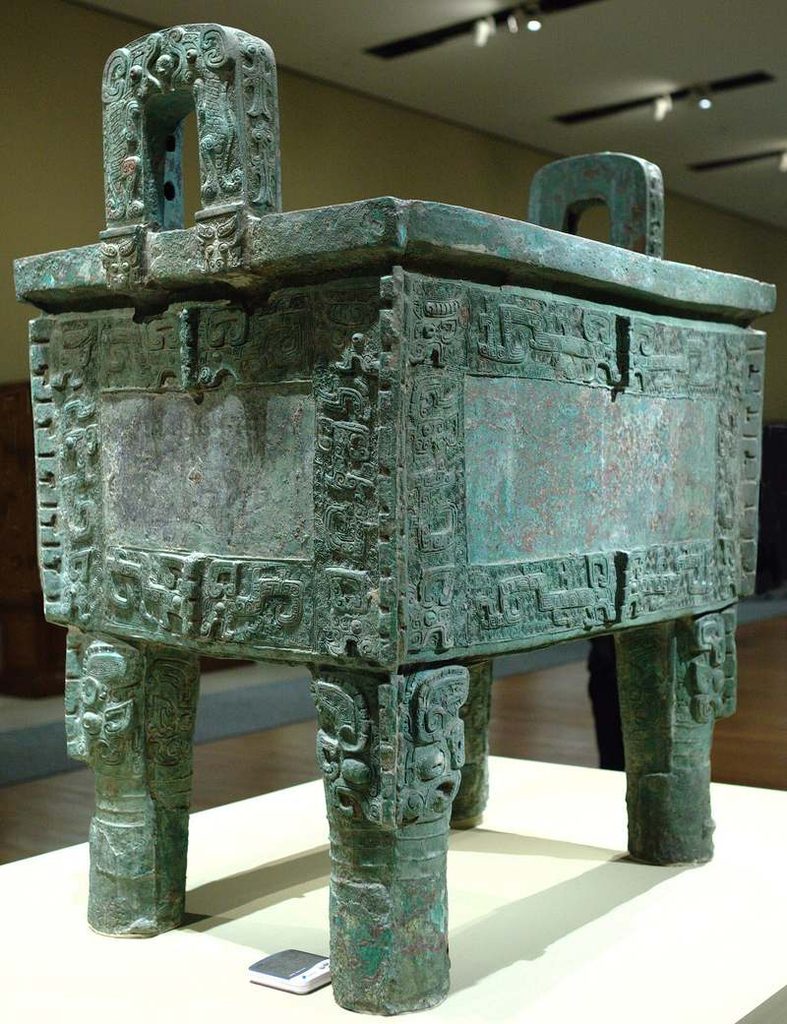
The Shang is known above all for some of the finest bronze casting of the ancient world. In royal workshops, craftsmen cast ritual vessels – great cauldrons called ding (鼎), wine vessels, and food vessels – using clay piece-moulds, which allowed complicated shapes and decoration of astonishing sharpness. The vessels were made to hold offerings of food and wine for the royal ancestors, and the commonest decoration is the taotie (饕餮), a mysterious animal-mask design with two staring eyes, whose exact meaning is still debated.
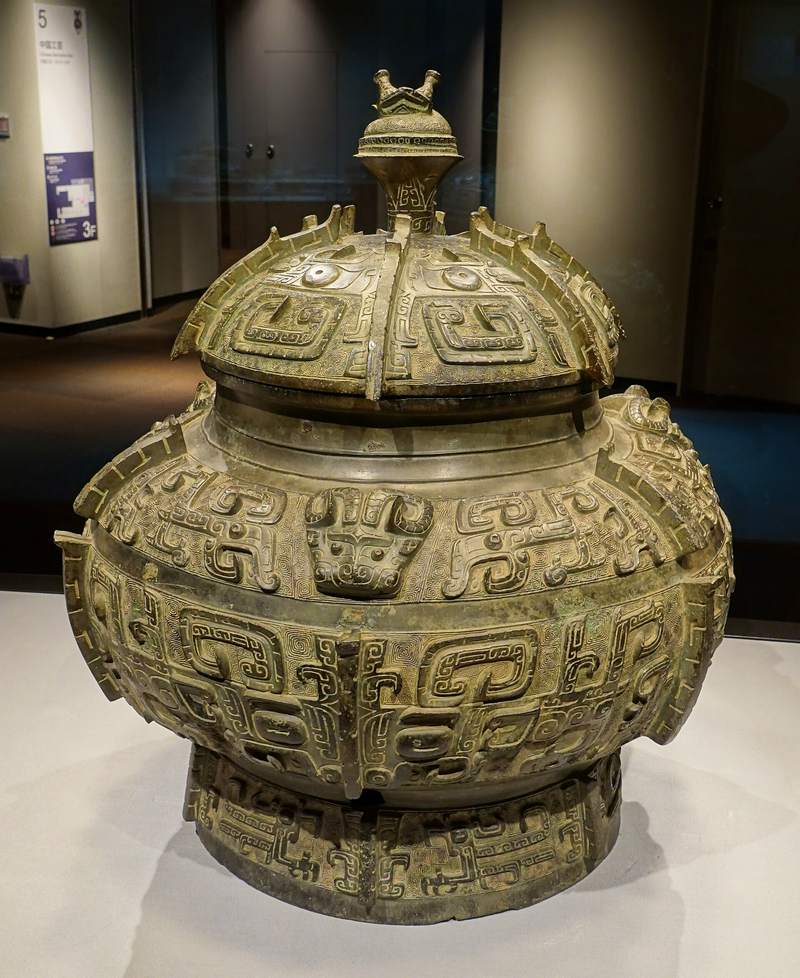
The greatest of all Shang bronzes is the Houmuwu Ding (后母戊鼎), cast in the late Shang period. This huge rectangular cauldron weighs 832.84 kg, making it the largest ancient Chinese ritual bronze vessel to survive anywhere in the world. Casting it in a single pour demanded enormous quantities of copper and tin and hundreds of skilled workers – a measure of the wealth and organisation of the late Shang court.
The Shang’s second great gift to China was writing. The oracle bone script, known in Chinese as jiaguwen (甲骨文), is the earliest known body of Chinese writing. Diviners carved questions onto ox shoulder blades and turtle shells, applied a hot point until the bone cracked, and read the answers in the cracks. Some 4,500 different characters have been identified in the inscriptions, and many are the direct ancestors of characters still written today. Days were recorded in the inscriptions by a cycle of sixty combinations of the ten Heavenly Stems and twelve Earthly Branches – a system of counting time that remained in use in the Chinese calendar for the next 3,000 years. The script the Shang created also became, in later ages, the foundation of ancient Chinese education, in which mastery of written characters was the road to office and honour.
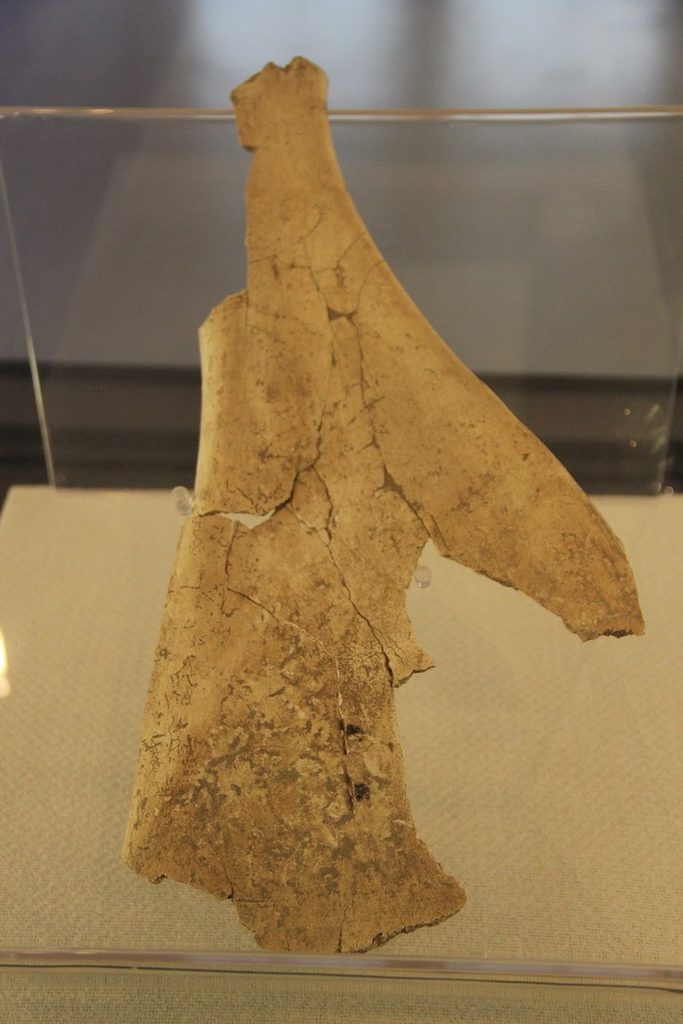
For centuries the bones themselves were forgotten. Farmers near Anyang dug them up and sold them as ‘dragon bones’ for traditional medicine, until in 1899 the scholar Wang Yirong (王懿荣) is traditionally credited with recognising the scratches on them as ancient writing. The bones were traced to the village of Xiaotun (小屯), at Anyang, and scientific excavation of the site – the ruins of Yin, or Yinxu – began in 1928. Well over 100,000 oracle bone fragments have now been found, together with palace foundations and eleven great royal tombs. Most startling of all, the inscriptions named the Shang kings in almost exactly the order given in the king list recorded by the historian Sima Qian (司马迁) in his Records of the Grand Historian, written under the Han dynasty more than a thousand years after the Shang fell – a history long suspected of being legend turned out to be remarkably accurate.
Religion During the Shang Dynasty
At the head of the Shang religious world stood Shangdi (上帝), the supreme god, who was believed to command the weather, the harvests, victory in war, and the fortunes of the king. Below Shangdi stood the royal ancestors. The Shang believed that dead kings lived on as powerful spirits who could plead with Shangdi for their descendants – but only the living king could approach them. This made the king the indispensable link between his people and the gods, and divination and sacrifice were not a private hobby but the central business of the Shang state.
Ancestor worship shaped everything. The dead kings received offerings of food and wine in the great bronze vessels, and the oracle bones were the king’s way of asking the ancestors questions and reporting his plans. Animal sacrifice was practised on a large scale, and archaeology at Yinxu confirms that human beings were also sacrificed in royal rituals, at the foundations of great buildings, and in the burials that accompanied the royal tombs.
The Shang left no temples of stone and no scriptures, but its religious ideas never disappeared. Reverence for ancestors became a permanent part of Chinese life, and five centuries after the Shang fell, Confucius (551 – 479 BC) was still teaching that honouring one’s ancestors was the root of a good society – the world from which Confucianism would later grow.
Read more: What Were the Rituals and Laws in Ancient China?
The Fall of the Shang Dynasty
After Wu Ding, the Shang kings kept their throne for another century and a half, but the dynasty slowly weakened. The royal domain did not grow, campaigns against neighbouring peoples drained the treasury of bronze and men, and the endless round of sacrifices and royal building placed heavy demands on the population. The later kings all ruled from Yin, and the oracle bones of their reigns show a court still performing every ritual with great care, whilst its real power shrank around it.
The final king, Di Xin, had his court at Zhaoge (朝歌), near Yin. In the accounts written by the Zhou dynasty that overthrew him, Di Xin is one of the great villains of Chinese history: a king who tortured his critics, listened only to his favourite consort Da Ji (妲己), and amused himself with a lake of wine and a forest of hanging meat – the famous ‘wine pool and meat forest’. These stories come from texts written by the victors and by later ages, and most historians believe they were greatly exaggerated, and in part probably invented, to justify the conquest that followed.
Di Xin is usually known by another name: King Zhou of Shang (商纣王). This is a trap for the unwary reader. ‘Zhou’ here is a different word, with a different character, from the Zhou of the Zhou dynasty: it was a deliberately ugly posthumous name, meaning something like ‘the cruel and unjust’, fastened on Di Xin by the dynasty that destroyed him.
In 1046 BC King Wu of Zhou led his allies east against the Shang. At the Battle of Muye (牧野) the Shang army collapsed – later tradition claimed that Shang soldiers, forced to fight for a hated king, turned their weapons against their own side. Di Xin fled back to his capital, and, according to tradition, climbed his great tower, wrapped himself in his jades, and burned himself to death as the Zhou entered the city. The Zhou allowed his son to continue ruling the Shang people as a vassal, and Shang royal descendants later held the small state of Song (宋); but the Shang dynasty, after some 550 years, was over.
Summary
The Shang dynasty lasted for about 550 years and had thirty-one kings, and it is considered to be one of the formative periods in Chinese history. It was during the Shang that China acquired its writing system, reached the height of Bronze Age art in its ritual vessels, developed the calendar cycle it would use for three thousand years, and formed the ancestor-centred religion that shaped Chinese family life ever afterwards. When the Qin dynasty finally unified China in 221 BC, more than 800 years after the Shang fell, it ruled through written documents, in a script whose first surviving form is Shang oracle bone writing.
The Shang kings have no stone monuments, and their capital is a field of ruins and excavated pits beside a modern city. But every Chinese character written today descends from the script their diviners carved into bone more than 3,000 years ago. In that sense, the ‘Bronze Age’ dynasty never really disappeared at all.
Read more: Ancient Chinese Dynasty Timeline