
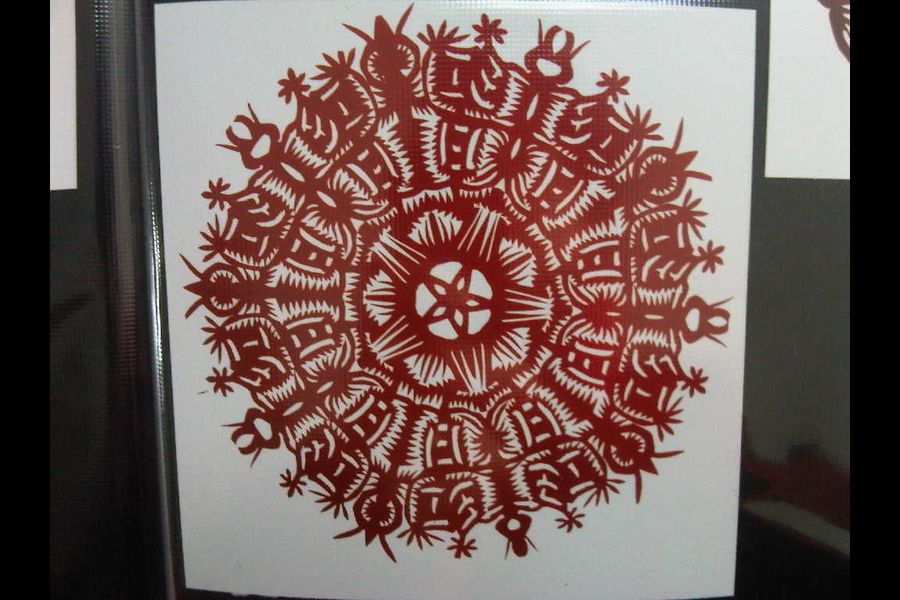
A sheet of red paper, a pair of scissors, and a few minutes of work — that is all it takes to make a Chinese paper cut. The result can be as simple as a flower or as fine as lace: a fish swimming through waves, a pair of mandarin ducks, a whole scene from a folk tale, all cut from a single sheet with no joins and no glue. It is one of the oldest folk arts in China, and one of the most familiar. At the New Year it appears on windows and doors across the country, and it has been pasted, framed, printed and exhibited for more than a thousand years. The art is called jiǎnzhǐ (剪纸), and it is made, for the most part, by ordinary people — above all by women — working at home with tools that cost almost nothing.
Paper cutting is a young art compared with bronze or jade, and an old one compared with most of the crafts practised today. It could only begin once paper existed, and paper itself was a Chinese invention. From that starting point it spread to every province, took on local styles, and became part of the furniture of Chinese life: weddings, births, festivals and funerals all had their own cuts. In 2009 it was placed on UNESCO’s Representative List of the Intangible Cultural Heritage of Humanity, which made official what Chinese families had known for centuries — that a cut piece of paper can carry a whole world of wishes.
Key Facts
- Chinese name: jiǎnzhǐ, “cut paper”
- Born: with paper itself; the oldest surviving pieces date from the 6th century
- Tools: scissors or small knives; paper folded for symmetry
- Main colour: red, for luck and happiness
- Uses: window flowers, weddings, births, festivals, embroidery patterns
- Regional schools: North, Jiangzhe and South
- National listing: 2006, first batch of China’s intangible heritage
- UNESCO: 2009, Representative List of the Intangible Cultural Heritage of Humanity
- Made by: mostly women, at home, passed from mother to daughter
Origins
The story of paper cutting begins, as many Chinese stories do, with a tale from a very old book. The Records of the Grand Historian tells of a young king of the Zhou dynasty who cut a paulownia leaf into the shape of a jade tablet and gave it to his younger brother, saying he would make him lord of a small state. The king had been joking, but his minister wrote the words down, and a king’s word could not be taken back — so the brother became a lord after all. The tale is about a leaf, not paper: paper would not be invented for another thousand years. But it shows how old the Chinese delight in cutting shapes was, long before the first sheet of paper existed.
Paper itself was the work of Cai Lun (蔡伦), a court official of the Eastern Han dynasty, who is traditionally credited with making the first proper paper in 105 AD. Archaeologists have since found even older pieces of hemp paper, from the second century BC, so Cai Lun probably improved an existing craft rather than inventing it from nothing. Either way, paper was cheap, light and easy to cut, and once it was widely available, people began to cut it. The oldest paper cuts that survive come from the Northern Dynasties (386–581): five small roundels, called tuánhuā (团花), found in tombs at Astana, near Turpan in Xinjiang. They show paired horses, paired monkeys, flowers and stars, cut from hemp paper by folding it and cutting through several layers at once. The dry desert air preserved them for some 1,500 years, and they prove that the craft was already skilled in the sixth century — and probably older still, since only a few pieces survived. The Turpan cuts were probably not decorations at all: they were found in tombs, and were most likely offerings, placed with the dead — a reminder that paper cutting began as a ritual art, not a decoration.
By the Tang dynasty (618–907), paper cutting had grown from a household pastime into a recognised art. It was used to decorate doors and windows, to make patterns for embroidery, and to cut ornaments for lanterns and fans. In the Ming and Qing dynasties (1368–1912) it reached its peak: every province had its own style, and professional cutters sold their work in markets. Paper cutting also travelled: it spread with paper along the trade routes to Korea, Japan and beyond, and each country made its own version of the art.
How It Is Made
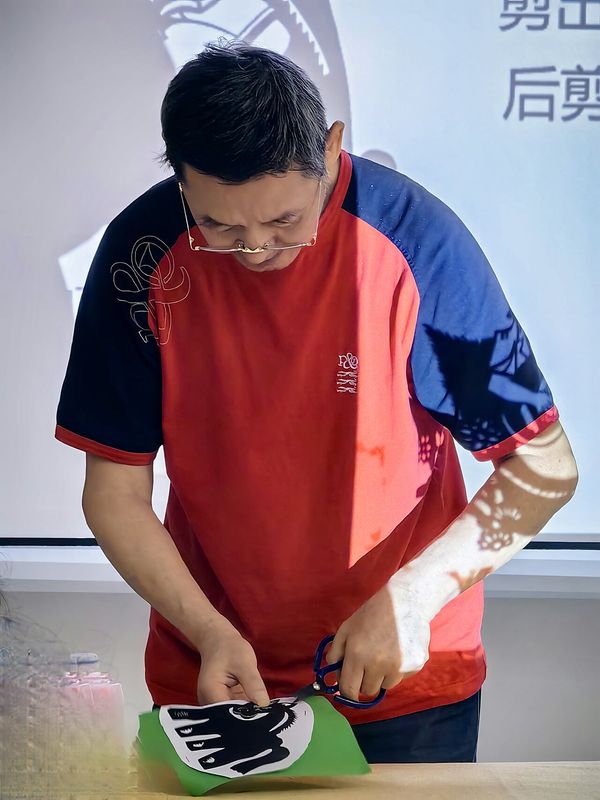
There are two ways to cut paper, and most cutters use both. The first is the scissors method: several sheets — up to eight — are fastened together, and the cutter works freehand with a pair of sharp, pointed scissors, following a pattern drawn on the top sheet or held in the mind. The second is the knife method: a single sheet is laid on a soft surface and carved with small knives, gouges and punches, which can make finer lines than scissors. For symmetrical designs the paper is folded — in half, in quarters, or again and again — so that one cut makes a whole pattern of repeated shapes. A cut is often made in a single sitting, and a skilled cutter works without stopping to draw: the design is in her hands as much as in her head. In Yuxian (蔚县) the work is carved through stacks of thin paper, dozens of sheets at a time, then dyed by hand — one design may pass through many hands before it is finished.
Most paper cuts are red, and the reason is simple: in Chinese culture red stands for luck, happiness and celebration. A red cut pasted on a door or window at the New Year is a wish made visible. Other colours are used too — Yuxian cutters dye their work in bright pinks, greens and yellows — but red remains the colour people reach for first. White paper has its own place: it is the colour of mourning, and paper cuts made for funerals are white, as are some cuts used in rituals for the dead. The colour of the paper, like the pattern cut into it, is part of the message.
The best-known paper cuts are the window flowers, chuānghuā (窗花), pasted on window panes at the New Year. They are shaped to fit the panes, and when the light shines through them the whole room is patterned with luck. Paper cuts are also made for weddings and for the birth of a child, and they are pasted on doors, walls, lanterns and gift boxes. Some are not decorations at all: cutters also make patterns for embroidery, called huāyàngzi (花样子), which women pasted onto cloth and stitched over — a paper cut as a sewing guide, used and then thrown away.
Regional Schools
Paper cutting is usually divided into three schools, and the differences between them are easy to see. The North School, from northern Shaanxi (陕西) and Hebei, is bold and simple: big shapes, strong lines, little fine detail, and designs built on symmetry. It is the style of the window flowers of the north, cut by village women for their own homes. The Jiangzhe School, from Yangzhou in Jiangsu and Yueqing (乐清) in Zhejiang, is the opposite: fine, flowing lines, delicate flowers and birds, and compositions as careful as paintings. The South School, from Foshan in Guangdong and Fujian, is decorative and elaborate, with layered colours and a taste for ornament. Every part of China cuts paper, but no two regions cut it quite the same way.
The South School deserves a closer look, because it works in a different way again. In Foshan, in Guangdong, cutters back their paper with copper or gold foil, so the finished cut glitters; in Zhangpu (漳浦), in Fujian, they combine cutting, carving, pasting and painting, building up layers until the work looks almost three-dimensional. Southern cuts are often made as gifts, to be hung in a home as a picture rather than pasted on a window. Southern cutting has long been a workshop trade, with guilds and shops of its own.
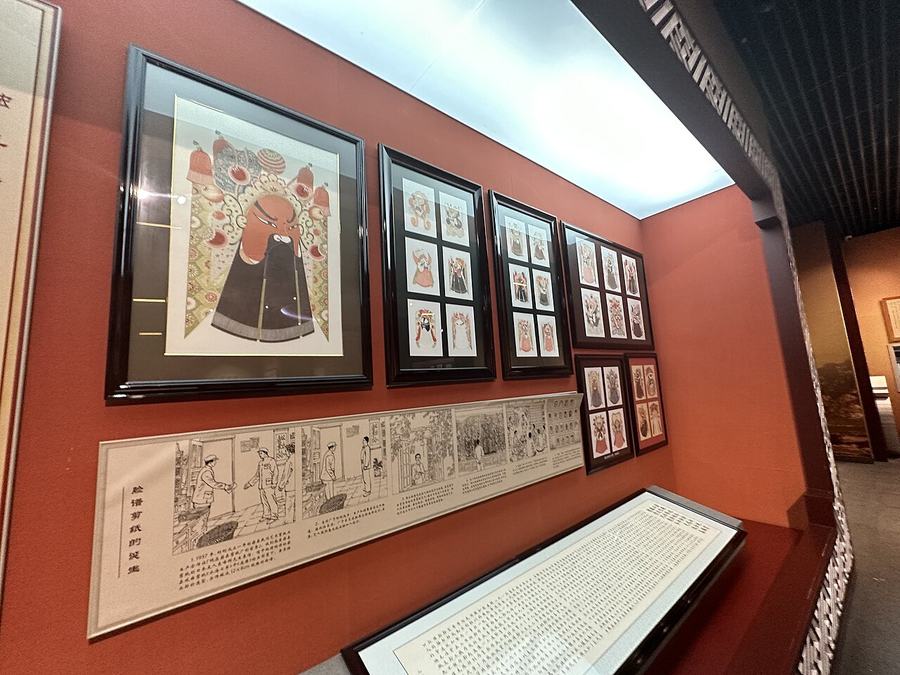
Yuxian, a county in Hebei, has a style of its own. Yuxian cutters work with knives rather than scissors, cutting very thin paper, and then dye the finished cut by hand in bright colours — pink, green, yellow and blue — layer by layer. Most of their subjects are opera figures, folk tales and festival scenes, and the colour makes the figures look almost alive. The style was developed by a peasant cutter named Wang Laoshang (王老赏, 1890–1951), who took his models from New Year woodblock prints and local opera, and in a working life of more than forty years produced close to a thousand designs. His opera figures — generals, scholars, painted-face clowns — are still the models other Yuxian cutters follow today.
The finest southern work comes from Yangzhou, and its most famous master was Zhang Yongshou (张永寿, 1907–1989). The son of a cutter, he began as a maker of embroidery patterns and ended as an artist whose work was shown in museums. His most famous piece, A Hundred Chrysanthemums, shows a hundred different chrysanthemum flowers, no two alike, cut with a line so fine it looks drawn. Yangzhou now has a museum of its own, the China Paper Cutting Museum, founded in 2007, which collects the work of the schools from all over China and keeps Zhang Yongshou’s pieces on display.
What the Patterns Mean
A paper cut is rarely just a picture. Almost every pattern is a wish, and the wishes are hidden in puns. The Chinese language is full of words that sound alike, and paper cutters use them like a code. A fish, yú (鱼), sounds like the word for surplus, yú (余), so a fish — or two fish, or a child holding a fish — means “year after year with surplus”, plenty to eat and money to spare. A bat, fú (蝠), sounds like the word for blessing, fú (福), and five bats together stand for the five blessings: long life, wealth, health, love of virtue and a peaceful end. A pomegranate, full of seeds, means many children; a peony means wealth and honour; a pair of mandarin ducks means a happy marriage. To read a paper cut, you have to listen to it as well as look at it.
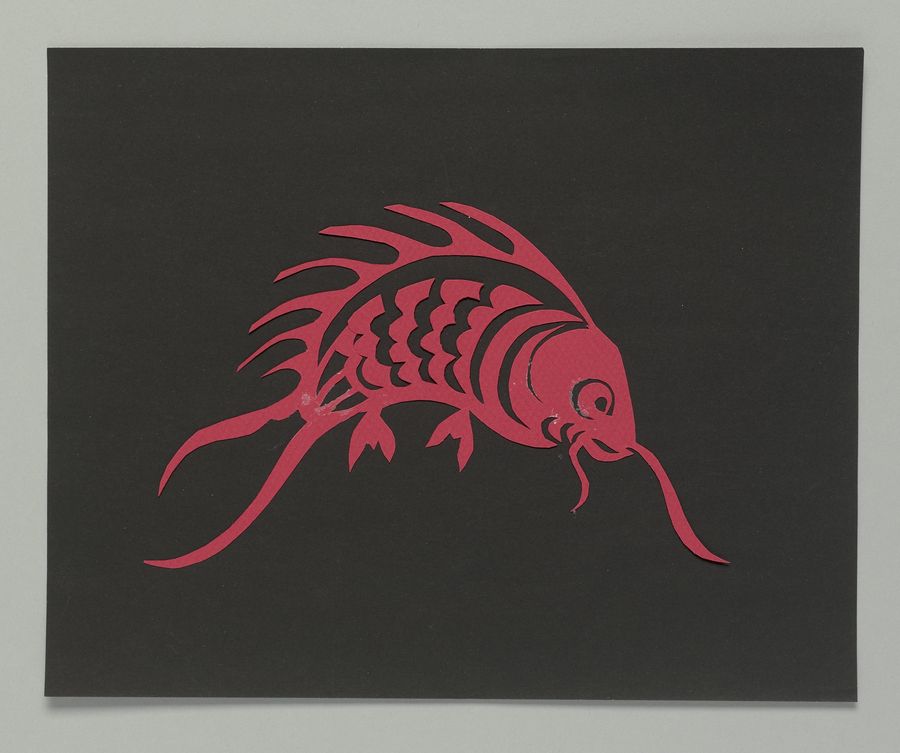
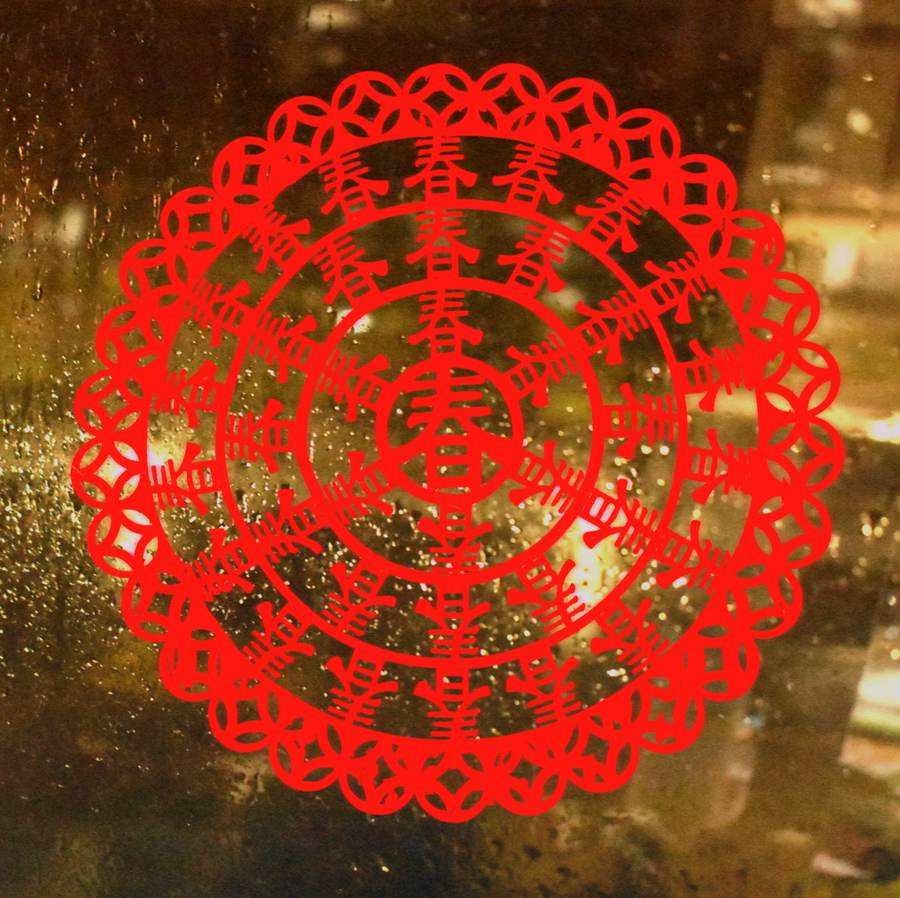
Some patterns are words themselves. The double happiness character, shuāngxǐ (双喜), is two copies of the character for joy joined together, and it is cut in red paper and pasted on doors and walls at every wedding. The twelve animals of the Chinese zodiac are cut too, one for each year, and children are given the animal of their birth year as a paper cut to keep. Opera characters, folk heroes and scenes from old stories are cut as well, so that a window can tell a tale to anyone who stops to look at it. A paper cut of the character for spring, chūn (春), is pasted on doors at the New Year.
The window flower is the most familiar of all. At the New Year, families paste fresh cuts on their windows — flowers, fish, magpies, the character for spring — and the old cuts are taken down and thrown away. The cutting itself is part of the festival: in many villages women gather to cut together, and girls learn the craft from their mothers and grandmothers. The same patterns appear on clothing, too. A cutter’s huāyàngzi, pasted on cloth as a guide for the needle, carried the same wishes into embroidery, so that a child’s shoes or a bride’s dress could carry a fish for plenty or a bat for blessing.
Paper Cutting Today
Paper cutting was named one of the first items on China’s own list of intangible cultural heritage on 20 May 2006, and in 2009 UNESCO placed it on the Representative List of the Intangible Cultural Heritage of Humanity, calling it “a popular art integral to everyday lives”. The listing changed the craft’s fortunes. Villages that had cut paper for their own festivals began to teach it, sell it and build museums around it. In Yangzhou the China Paper Cutting Museum opened in 2007. In Guangling (广灵), in Shanxi, a fourth-generation cutter named Zhang Duotang (张多堂) built a paper-cutting park and museum that draws half a million visitors a year, and his family’s work — 38 steps from paper to finished cut — is now exported abroad. Paper cutting is now one of the best-known of China’s folk arts, in the company of games like mahjong.
Contemporary artists have taken the craft further. Lü Shengzhong (吕胜中) makes large paper-cut installations of little human figures, shown in galleries in China and abroad since the 1990s. Younger buyers, part of the “China chic” movement, buy framed cuts as wall art, and whole villages in Fujian now build their tourist trade around paper cutting. The craft still appears where it always has, too: stylised paper-cut patterns appeared on official merchandise and in venue decorations at the 2008 Beijing Olympics, and every New Year the red window flowers go up again.
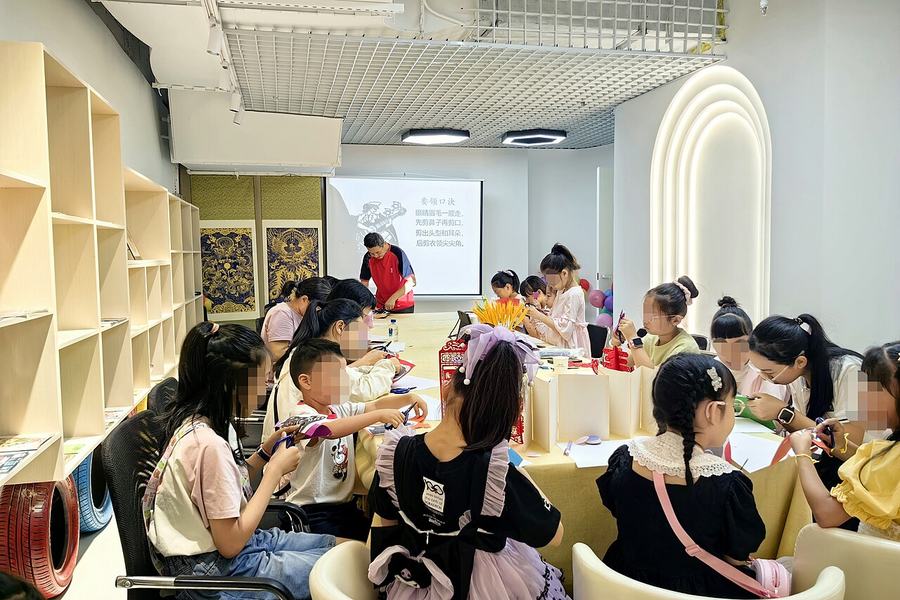
The craft is not without its troubles. In many villages the young have left for the cities, and the old cutters worry that no one will take up the scissors. But the UNESCO listing brought classes, competitions and museum jobs, and schools in paper-cutting regions now teach the craft to children. The China Paper Cutting Museum in Yangzhou runs training courses, and in Guangling the industry park includes a vocational school that trains new cutters. A craft that was once made at home, by women, for their own families, is now taught, collected and sold — and still, every New Year, pasted on windows in red paper, exactly as it was a hundred years ago.
Summary
Paper cutting began with paper itself, some two thousand years ago, and the oldest pieces that survive are fifteen centuries old. It is made with scissors or knives, folded or flat, red or coloured, and it carries its wishes in puns: fish for plenty, bats for blessing, pomegranates for children, peonies for wealth. It has three great schools, a museum of its own, and a place on UNESCO’s list. But its real home is still the window at the New Year, where a piece of red paper, cut by hand, says what words cannot: good luck, long life, and plenty for the year to come.
Read more: The Beauty of Bamboo, Chinese Bamboo Weaving craft