
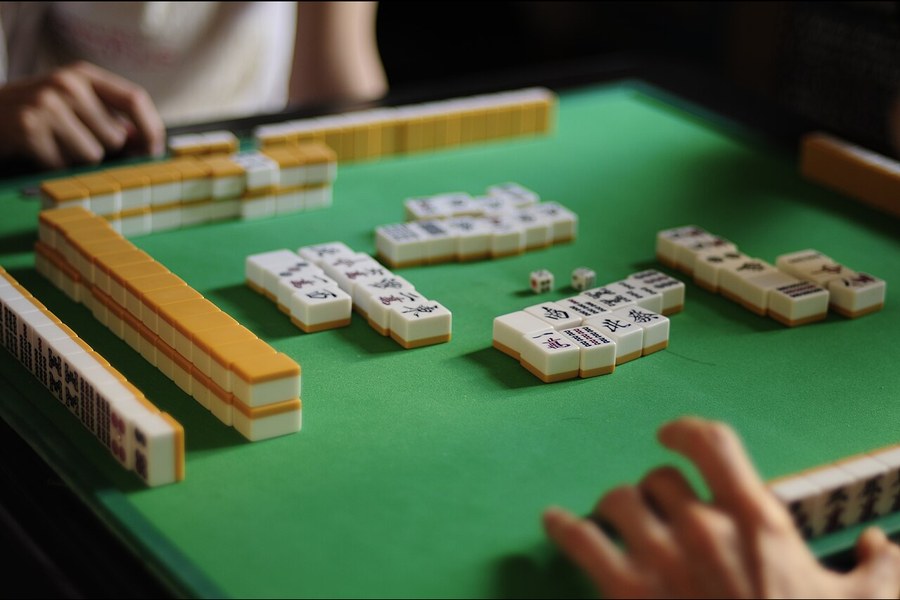
Four people sit around a square table, and the room is full of a sound like dry bones rattling in a box. The players build walls of small tiles, draw and discard in turn, and watch each other’s hands. The game is mahjong, and it is one of the most widely played games on earth. It is played in village courtyards and city teahouses, in parks and at family gatherings. It is a game of luck and skill in almost equal measure: a good player wins more often than a lucky one. The game’s Chinese name is májiàng (麻将), and it was originally called máquè (麻雀), meaning “sparrow” — the clatter of the tiles was said to sound like sparrows chattering.
Mahjong is a young game by Chinese standards. It was born in the busy port cities of eastern China in the middle of the nineteenth century, and within a hundred years it had travelled to Japan, to America and to almost every country in the world. Everywhere it went, it changed. The Japanese made it faster and stricter. The Americans gave it jokers and a printed card of hands. The Chinese themselves banned it, then brought it back as a sport. Yet the game at the centre of all these versions is the same: four players, a wall of tiles and the work of turning a random hand into a winning one.
Key Facts
- Chinese name: májiàng, originally máquè, meaning “sparrow”
- Born: mid-nineteenth century, during the Qing dynasty, in eastern China
- Players: four
- Standard set: 144 tiles (136 without the Flowers and Seasons)
- Suits: Characters, Bamboo and Circles; the four Winds; the three Dragons; Flowers and Seasons
- A winning hand: four sets and a pair
- Banned: after 1949 as gambling; revived in the 1980s
- Official rules: published in 1998 by the China State Sports Commission
- Spread abroad: Japan 1924; the United States, early 1920s
Origins
The story of mahjong begins with a legend. It says that Confucius invented the game more than two thousand years ago, and that the three Dragon tiles stand for the Confucian virtues. It is a good story, but it is not true: Confucius lived in the sixth century BC, more than two thousand years before the game existed. Another legend credits the admiral Zheng He (郑和), who is said to have invented mahjong to amuse his sailors on their voyages across the Indian Ocean in the early fifteenth century. That, too, has no evidence behind it. Mahjong is not an ancient game. It is a modern one, and its history can be traced.
The real story starts with playing cards. China had money-suited card games for centuries: the earliest references in Chinese records date from 1294, and the cards were first called Yezi (叶子), meaning “leaves”, because they were leaf-shaped. In the Ming dynasty, one of these card games was Ma Diao (马吊), played with four suits of money cards. One suit was later dropped, and the three that remained — coins, strings of coins and myriads of coins — became the Circles, the Bamboo and the Characters of mahjong.
The change from cards to tiles happened in the middle of the nineteenth century, around the time of the Taiping Rebellion (1850–1864), in the port cities of Ningbo (宁波) and Shanghai. The most often told version names an official from Ningbo, Chen Yumen (陈鱼门, 1817–1878), who is said to have taken the three-suited card game, added the four Winds and the Red Dragon, and had the designs carved onto bamboo and bone tiles instead of paper — paper cards blew away on a windy deck, while tiles stayed put. But no document proves that Chen Yumen invented the game, and other accounts name other inventors: army officers in Shanghai, two brothers in Ningbo, even Hong Xiuquan (洪秀全), the leader of the Taiping Rebellion himself. The honest summary is that mahjong had no single inventor. It grew out of the card games of the lower Yangtze, shaped over several decades, and by the 1870s it had taken the form we recognise today.
The Tiles and the Rules
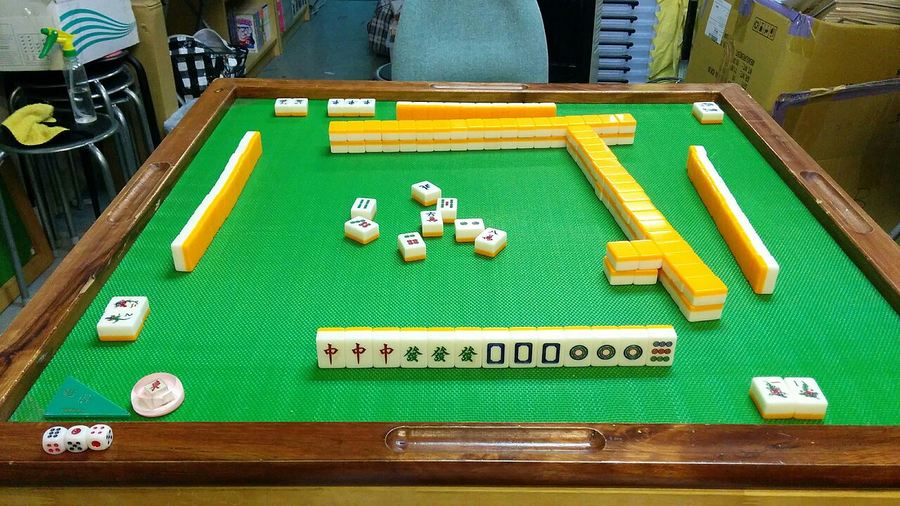
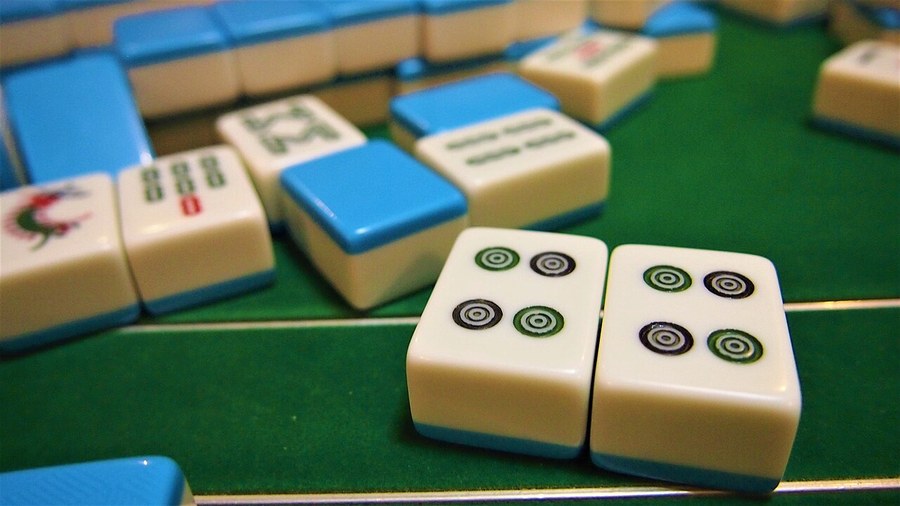
A standard mahjong set holds 144 tiles. Most belong to three suits, each numbered from one to nine, with four copies of every tile. The Characters suit (Wan, 万) shows the Chinese character for ten thousand; the Bamboo suit (Tiao, 条) shows sticks of bamboo; the Circles suit (Tong, 筒) shows rings or coins. Then come the honour tiles: the four Winds — East, South, West and North — and the three Dragons: Red (Zhong, 中), Green (Fa, 发) and White (Baiban, 白板). Last come the eight bonus tiles, the four Flowers and the four Seasons, drawn and set aside for extra points. Without them, a set holds 136 tiles.
Four people play around a square table. The tiles are shuffled face down and built into four walls, two tiles high, forming a square in the middle of the table. Each player takes thirteen tiles — the dealer fourteen — and arranges them in a hidden row behind a small rack. Play moves anticlockwise. On a turn, a player draws a tile from the wall and discards one, face up, into the middle of the table. The aim is to complete a winning hand: four sets and a pair. A set is either three identical tiles, called a Pung (碰), or three tiles in a run in the same suit, called a Chow (吃). A player may also claim a discarded tile to complete a set, and four identical tiles make a Kong (杠), which earns a replacement tile from the wall.
That is the whole game in outline, and it takes about ten minutes to learn. Playing it well takes much longer. The skill lies in reading the discards, judging what the other players are collecting, and deciding when to break up your own hand to stop someone else from winning. A player who watches the table knows which tiles are safe to throw away; a player who does not watch feeds the winning tile to an opponent. Luck decides the tiles you draw; judgement decides what you do with them. This balance is the reason the game has lasted: a beginner can win a hand, and an expert can win a session.
The rules, however, are not the same everywhere. China has never had one single way of playing mahjong. Every province, and often every city, plays by its own house rules, with different scoring, different winning hands and different ideas about which tiles count. In Sichuan (四川), the local game uses only 108 tiles and plays on until three of the four players have won, a form known as “bloody battle”. In Guangdong, the game keeps the Flowers and Seasons and counts them for points. In Shanghai, the old rules are fast and simple, with little scoring beyond the win itself. A player who learns the game in one city and sits down in another will find the table familiar and the rules strange — and the first thing experienced players do in a new place is ask how the house plays.
Mahjong at Home
In China, mahjong is first of all a family game. It is the sound of the New Year. When relatives gather for the Spring Festival, the table comes out after dinner, the tiles are shuffled with a noise like rain on a roof, and the game runs late into the night. Grandparents play with grandchildren, uncles argue about the rules, and someone makes tea while someone else brings out oranges and melon seeds. The stakes are usually small — a few coins, a forfeit, the washing-up — because the point is not the money. The point is the table itself: four people, face to face, with nothing between them but the tiles.
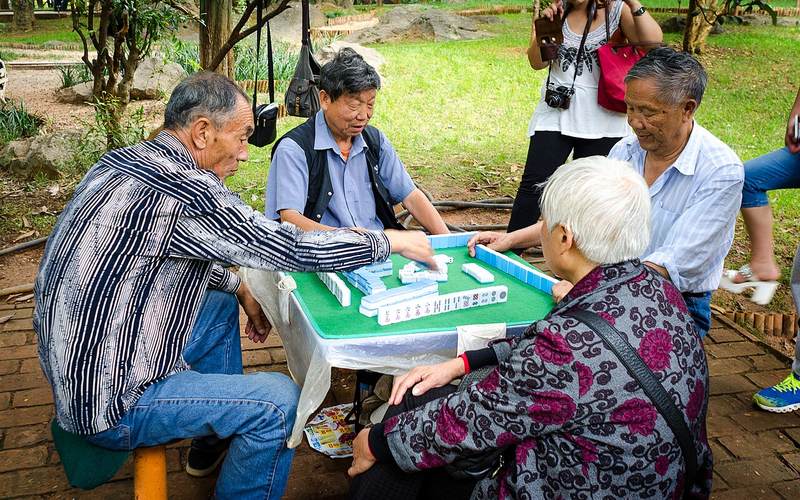
Outside the home, mahjong belongs to the teahouse and the street. In the old teahouses of Chengdu and Chongqing, tables of players sit for hours over pots of tea, and the clatter of tiles is as familiar as the call of the tea waiter. In parks and on pavements, retired men and women set up folding tables in the morning and play until the light goes, watched by onlookers who follow every discard. The game is a social institution as much as a pastime: it gives old friends a reason to meet and newcomers a way to join a neighbourhood. To be invited to a table is to be accepted; to be a regular is to have a second family.
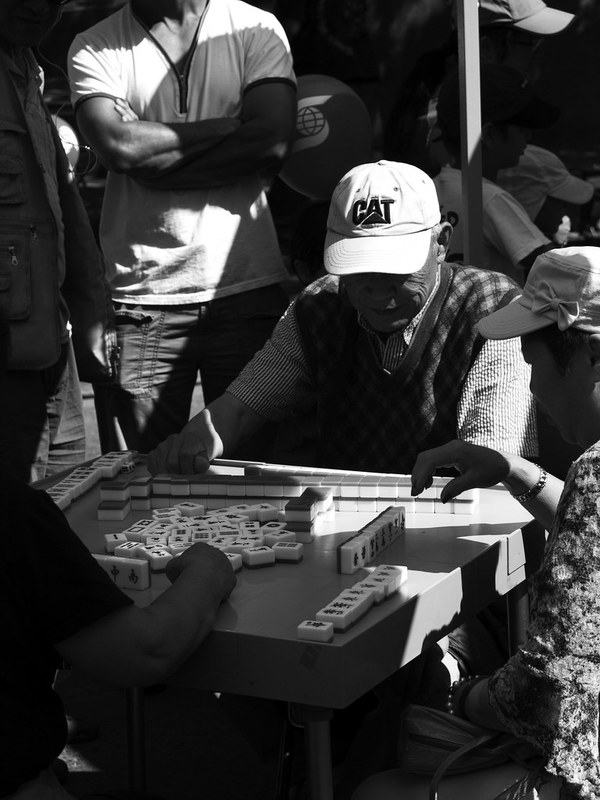
The association with gambling is real, and it should not be hidden. Mahjong has always been played for money as well as for fun, and in some rooms the money is the point. High-stakes games run in back rooms and private clubs, and the game has ruined players who could not stop. Chinese literature and film are full of tables where fortunes change hands, and the game’s reputation as a gambler’s pastime is part of its history. But for most players, most of the time, the money is small and the game is social. The same tiles that empty a wallet in a gambling den fill an evening in a family living room. Mahjong’s place in Chinese life is not decided by the highest stakes it has ever carried, but by the millions of ordinary games played for nothing more than pride and company.
Banned and Revived
After 1949, the new government of China treated mahjong as a form of gambling and banned it. The game went quiet in public, though it never left private homes, where the ban was hard to enforce. During the Cultural Revolution in the 1960s, the ban was enforced harshly: mahjong was condemned as part of the “old culture”, and many sets were confiscated and destroyed. For a decade, the tables were folded away.
The game came back in the 1980s, as China opened up and old pastimes returned to the streets and teahouses. By then, the question was how to keep the game and lose the gambling. The answer came in 1998, when the China State Sports Commission published a new set of official rules, generally known as the Chinese Official rules, or Guobiao Majiang (国标麻将). The principles were printed in the rulebook itself: no gambling, no drinking and no smoking. International tournaments now include team events as well as individual ones. The World Mahjong Organization was founded in Beijing in 2006, and the first World Championship followed in 2007. A game that had been banned as a vice was now played for medals.
Mahjong Around the World
Six centuries after Marco Polo carried tales of China to Europe, mahjong followed the same road west — and it changed at every port. It reached Japan around 1924, when a soldier named Saburo Hirayama brought it home and opened a club in Tokyo. The Japanese simplified the Chinese game and then made it stricter: the version the world now calls riichi mahjong is built around two ideas of its own. A player who is one tile away from winning may declare riichi — a bet, paid for with a thousand points, that the hand will win without being changed — and certain tiles, called dora, score bonus points. Japanese mahjong is usually played with 136 tiles, without the Flowers and Seasons, and discards are laid out in neat, openly readable rows, so that every player can see what has been thrown away. It became a professional game in Japan, and it is the version most of the world now plays online. A national federation followed in 1929, and by the 1970s tens of thousands of parlours were open across Japan.
The game’s arrival in America was louder. In 1920, Joseph Park Babcock, an American working for the Standard Oil Company in Shanghai, published a slim red rulebook in English, trademarked the spelling “Mah-Jongg”, and began shipping sets to the United States. Within three years it was a national craze: department stores could not keep sets in stock, and clubs opened in New York, Chicago and San Francisco. The craze burned out almost as fast as it had caught fire: by the middle of the decade, so many competing rule books had appeared that players could no longer agree on how to play, and the fashion faded.
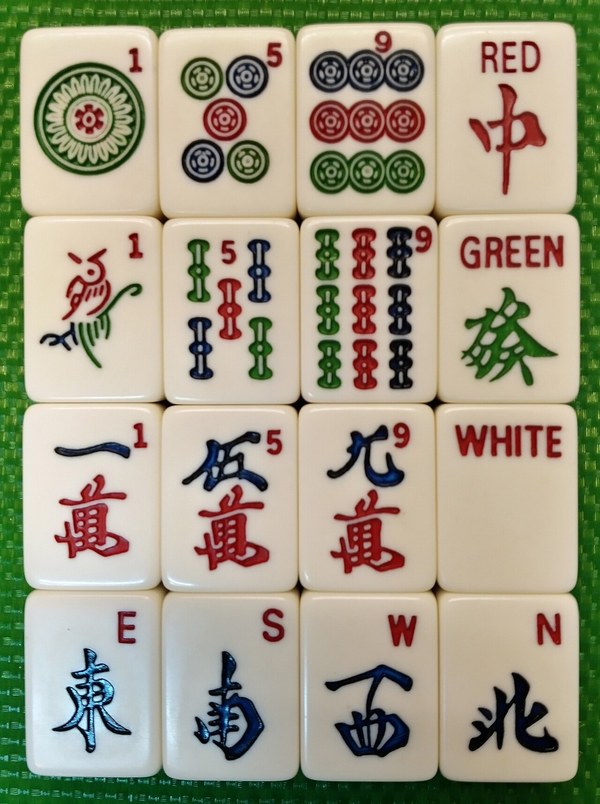
What saved the American game was standardisation. In 1937, a group of Jewish American women in New York founded the National Mah Jongg League, to fix one version of the rules and keep it. The League’s game is a different creature from the Chinese one. An American set holds 152 tiles — the usual 144, plus eight jokers that can stand in for any tile except in a pair. There is no Chow: runs do not count, and a winning hand must match a pattern on the League’s card, reissued with new hands every April. Before play begins, the players pass tiles in a ritual called the Charleston: three tiles to the right, three across, three to the left. It is still played that way in living rooms and community centres across the United States, most of all by the women whose grandmothers founded the League.
From these three centres the game spread further, and each place made its own version. Southeast Asia plays its own fast local games, and Europe has its own tournament rules. Online, millions meet at virtual tables, where the tiles are pixels and the clatter is silent, but the decisions are the same ones players have made for a hundred and fifty years: which tile to keep, which to throw, and when to risk everything on the next draw.
Summary
Mahjong began as a card game in Ming China, became a tile game in a port city of the Qing dynasty, and grew into one of the world’s great games. It has been a family pastime and a gambler’s vice, a banned relic and an official sport. Its history is short — about a hundred and fifty years — but it has outlived the empire that produced it, the ban that tried to kill it and the craze that tried to own it. What lasts is the table: four players, a wall of tiles, and the small question that has kept people playing since the nineteenth century — what will the next tile be?