
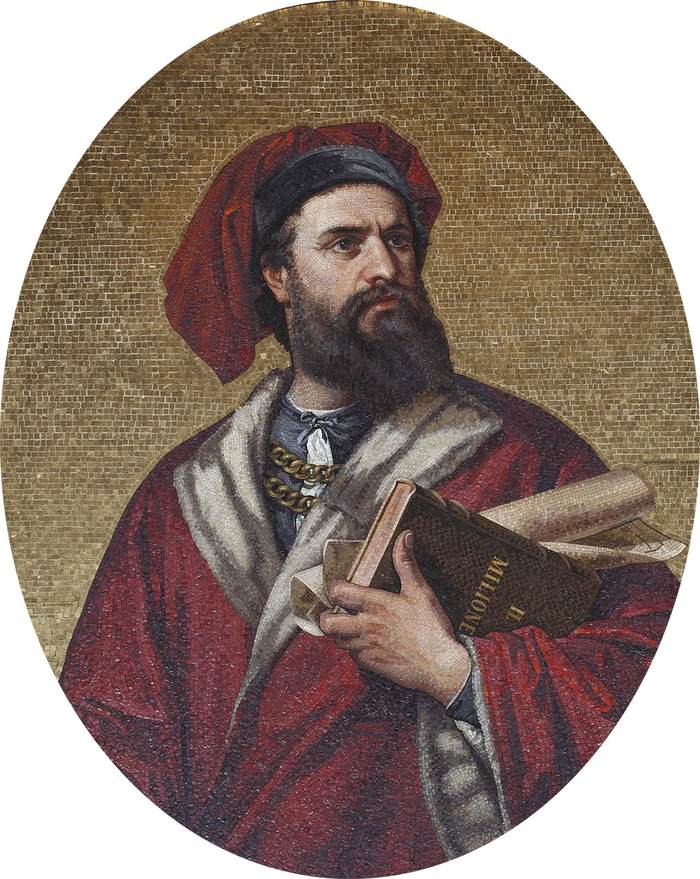
Marco Polo (1254–1324) wrote the most famous travel book of the Middle Ages, and for seven hundred years readers have argued about whether any of it is true. A Venetian merchant, he claimed to have spent about seventeen years in China at the court of the Mongol emperor Kublai Khan (忽必烈). When he came home, his stories of paper money, coal, and cities with twelve thousand bridges sounded like invention. His fellow Venetians nicknamed him Il Milione, “the Million”, said to be because he talked of nothing but millions — and the doubt stuck with the nickname.
The book itself gives reasons for doubt: dictated in prison, written down by another man, and copied and changed for centuries, no two early versions agree. And the book leaves out things a traveller in China might be expected to notice. Yet much of what he described — paper money, relay stations, the salt monopoly, great port cities — matches Chinese and Persian sources. The question is not simply whether he went, but which parts of his book can be trusted.
What follows keeps those two questions apart: where the book’s claims match other evidence, it says so, and where a claim rests on Polo’s word alone, or appears only in a late version, it says that too. The result is a stranger and more interesting figure than either the hero of legend or the fraud of the sceptics: a young merchant who saw a China Europe could barely imagine, and whose book Europe spent centuries trying to believe.
Key Facts
- Born: 1254, in Venice; died 1324, in Venice
- Father and uncle: Niccolò and Maffeo Polo, Venetian merchants
- Set out: 1271, aged seventeen, with his father and uncle
- Arrived: the Mongol court, in the summer of 1275
- Years in China: about seventeen, 1275–1291
- Returned: Venice, 1295
- The book: dictated in 1298, in a Genoese prison
- Written down by: Rustichello of Pisa, a writer of romances
- Known as: Il Milione, “the Million”
The Road to China
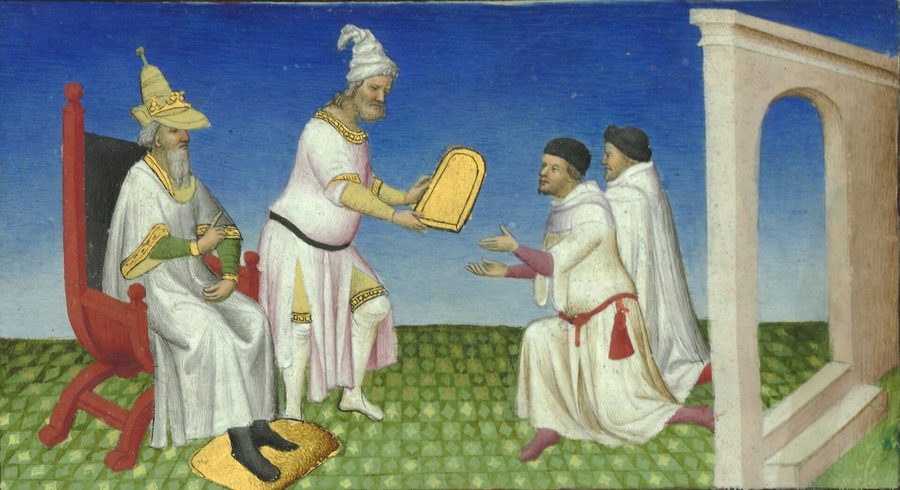
Marco Polo was seventeen when he left Venice, but the road to China was already familiar to his family. His father Niccolò and his uncle Maffeo, Venetian merchants trading in the east, had already travelled overland to Kublai Khan’s court, setting out in 1260. They returned west in 1269 carrying, the book says, the Khan’s request for holy oil from Jerusalem and learned men to teach at his court. He also gave them a golden tablet of safe conduct, a paiza, for their journey. Whether the request was quite as the book describes it, the brothers had plainly impressed the Khan.
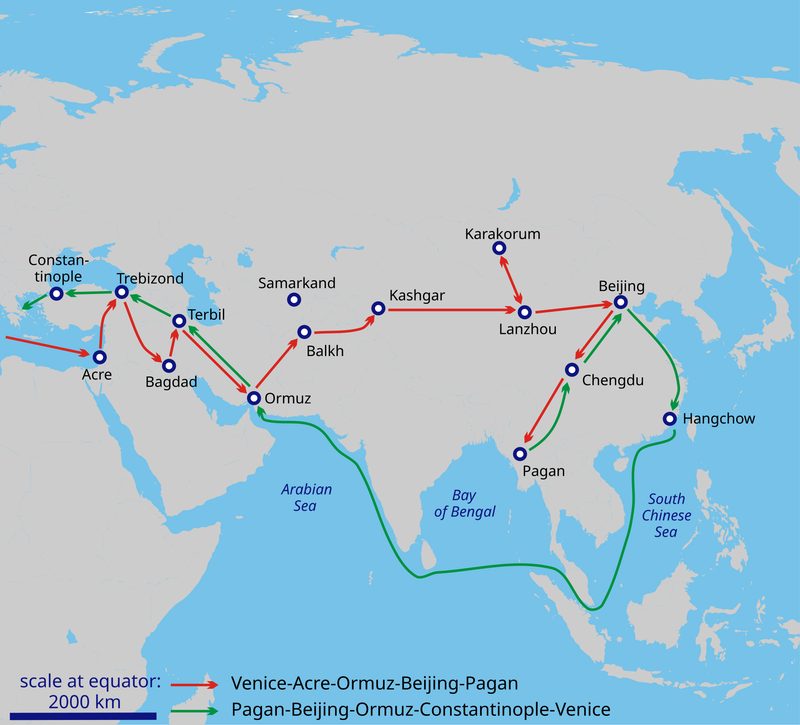
In 1271 the two brothers set out again, this time taking seventeen-year-old Marco with them. They sailed from Venice to Acre, on the coast of the Holy Land, and then turned east, through Persia and across the Pamir Mountains, by way of Kashgar (喀什) and the Lop Nor (罗布泊) region. The journey took three and a half years. They reached Shangdu (上都), the Khan’s summer capital, in the summer of 1275. Marco was twenty-one, and had crossed Asia on horseback and on foot.
The route they followed was part of the old network of overland trade routes known as the Silk Road, which had linked China with the west for centuries. The Tang dynasty capital, Chang’an, had welcomed merchants from Persia, India, and Central Asia centuries earlier. What had changed was the scale: the Mongol conquests begun by Genghis Khan, Kublai’s grandfather, had joined most of Asia under one family, and a merchant with the Khan’s protection could travel from the Mediterranean to the Pacific. That protection made the Polos’ journey possible.
At Kublai Khan’s Court
Shangdu, the Xanadu of later English poetry, was Kublai Khan’s summer capital, on the grasslands of what is now Inner Mongolia. In winter the court moved south to Dadu (大都), the “great capital”, on the site of present-day Beijing, which Polo called Cambaluc. Kublai had founded the Yuan dynasty in 1271, and by 1275 he ruled all of northern China and was completing the conquest of the south. Polo called the north Cathay and the south Manzi, and the two names stuck in Europe for centuries.
What Marco did at court rests on his own word. He said the Khan valued his reports and sent him on missions as an envoy, including to the far south-west, to Yunnan (云南), and on a sea voyage to India, and that he learned the languages and customs of the empire. None of this can be checked against Chinese records, which never name him — though the missions fit the kind of work the Khan’s envoys did, and the places match the geography.
One claim must be set aside. In some versions of the book, Polo is said to have governed the city of Yangzhou (扬州) for three years. That story appears only in the version published by the Italian editor Ramusio in the sixteenth century, more than two centuries after Polo’s death. It is in none of the earliest manuscripts. It should not be treated as fact, and Polo should not be called the Khan’s minister: the book never gives him such a title.
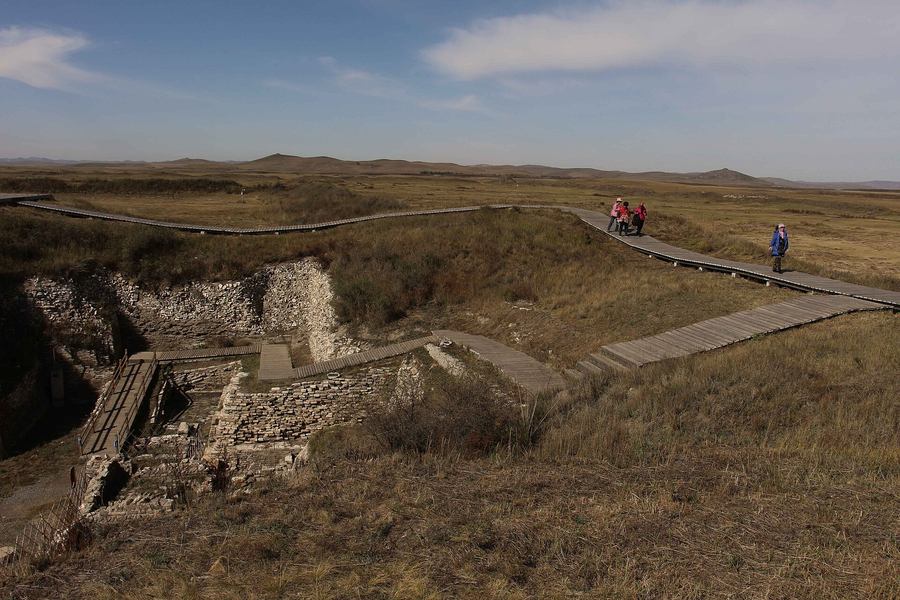
The court Polo described was a Mongol court ruling China, not a Chinese one. The Khan hunted on a grand scale, feasted in great halls hung with silk, and moved between his capitals with the seasons — a world that vanished with the dynasty.
The China He Saw
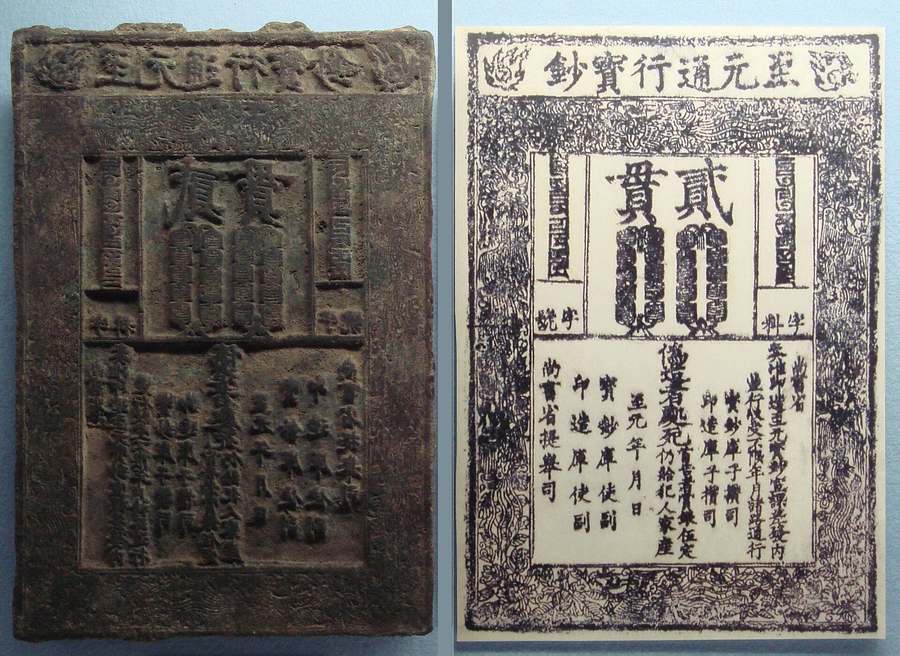
The most famous of Polo’s true reports is the paper money. Europe used only coins, and money made of paper seemed absurd. Polo described notes of many values, printed with the Khan’s seal and bearing a warning against forgery, circulating through the whole empire on the Khan’s authority alone. He was right: the Yuan empire ran on paper money, known as chao (钞), and surviving notes and printing plates show exactly the system he described.
He was right about coal, too: black stones dug from the ground that burned like charcoal and held their heat longer than wood, heating whole cities through the winter. China had burned coal for centuries, while Europe barely used it. To readers at home, burning stones sounded as unlikely as paper money.
The relay system impressed him as much: roads lined with horse stations, where riders could change horses and press on day and night. He put the number of stations at more than ten thousand — his figure, not a census — but the system was real, and Chinese records confirm its scale and organisation.
No city is described at greater length than Hangzhou (杭州), which Polo called Quinsay. The former capital of the Song dynasty, which the Mongols conquered between 1276 and 1279, it remained the greatest city of the south: canals, markets, and pleasure boats, rich beyond anything in Europe. Polo claimed it had twelve thousand bridges. The number is his and cannot be checked; the canals, markets, and crowds are confirmed by Chinese descriptions. He called it the finest city in the world, and for once the exaggeration is easy to forgive.
He was equally struck by the salt monopoly, which filled the Khan’s treasury with revenues almost beyond reckoning, by his account, and by the fine porcelain, thin and white, exported across Asia. At Quanzhou (泉州), which he called Zayton, he saw one of the great seaports of the world, crowded with ships trading to India and beyond. What he did not see matters too. He never visited Japan, which he called Cipangu: his tale of a palace roofed with gold was hearsay, picked up from others, and he never claimed to have seen it himself.
The Voyage Home
In 1291, after about seventeen years in China, the Polos left by sea, sailing from Quanzhou with a Mongol princess, Kököchin, travelling to Persia to marry the Ilkhan Arghun. The voyage took about eighteen months, by way of Sumatra and India, and was a disaster: of more than six hundred who set out, he said, only eighteen survived, among them the three Polos and the princess.
They reached Persia to find that Arghun had died before they arrived. The princess married his son Ghazan instead. The Polos travelled on overland and by sea, and reached Venice in 1295, after twenty-four years away.
The Persian historian Rashid al-Din confirms that a Mongol princess travelled to Persia by sea in these years — but names three envoys, Ulatai, Apusqa, and Coja, and no Polo. The discrepancy is real, and the strongest single piece of evidence against the book’s account of the voyage. Defenders answer that Rashid al-Din may have named only the senior Mongol envoys and left out three Venetian merchants travelling with them. The argument cannot be settled, and the voyage remains where doubt is most reasonable.
The Book
The book itself has a history as tangled as the journey. In 1298 Marco Polo was captured by the Genoese at the Battle of Curzola, in one of the endless wars between Venice and Genoa. In prison he met Rustichello of Pisa, a writer of Arthurian romances, and dictated his story to him in Old French touched with Italian — the language of romance, not of Venetian account books.
No manuscript in Polo’s own hand survives. More than a hundred versions exist, in many languages, differing greatly: some long, some short, some adding stories and some leaving them out. Copyists changed place names, rounded numbers up, and added marvels, and Rustichello’s own style — the romance writer’s taste for splendour and superlatives — shaped the book from the start. Some of the exaggeration blamed on Polo belongs to the men who wrote his book down and copied it after him.
The book is known by two names: Le Devisement du Monde, “The Description of the World”, and Il Milione, “the Million”, the nickname said to have been given to Polo because he talked of millions. Neither is Polo’s own title: the book he dictated had no fixed text and no fixed name.
Did He Really Go?
In 1995 the historian Frances Wood published Did Marco Polo Go to China? Her case rested on what Polo left out. He never mentions the Great Wall, or foot-binding, or tea, or Chinese writing, or chopsticks. A man who had lived seventeen years in China, she argued, would surely have noticed them. She suggested that he had picked up his stories from merchants in the Black Sea ports and never travelled further east than Persia.
Most specialists were unconvinced, and the defenders’ answers have largely held. Polo moved in Mongol and Persian circles, and probably spoke Mongolian, Persian, or Turkic rather than Chinese — likely, though unprovable. The Wall he would have seen was not the great stone wall built under the Ming dynasty centuries later, but ruined earthworks, barely worth a mention. Foot-binding was not yet widespread. Tea was a Han Chinese custom; the Mongol court drank milk and kumiss, fermented mare’s milk. His place names, in Mongol and Persian forms, sound like words heard spoken, not read in a book.
Two pieces of evidence weigh most heavily for the defenders. Polo’s account of the murder of the Khan’s minister Ahmad Fanakati, known in Chinese sources as Ahema (阿合马), in 1282, matches the Chinese accounts, as does his account of the Mongol invasions of Japan in 1274 and 1281. A man inventing his travels in a Black Sea port would have had to invent, very accurately, events he could not have read about in Europe.
One fact must be stated plainly: no Chinese source names Marco Polo — no record in the histories of the Yuan dynasty, no document bearing his name. That silence is real, though Chinese histories rarely named foreign merchants at court. The scholarly position today is careful: most specialists accept that Marco Polo reached China, but judge the details case by case — some confirmed, some exaggerated, some borrowed, and some, like the governorship of Yangzhou, best left aside.
Legacy
Whether or not every detail is true, the book changed Europe’s picture of the world. Christopher Columbus owned a Latin edition and covered its margins with notes — his annotations survive — and the search for Polo’s Cathay and Cipangu lay behind his voyage west. The Catalan Atlas of 1375, the great map of the age, drew on Polo for its picture of Asia. For two centuries, Polo’s book was Europe’s window on China.
Centuries later the book worked a different kind of magic. In 1797–98 the poet Samuel Taylor Coleridge, reading about Kublai Khan’s summer capital, composed “Kubla Khan”, published in 1816. Its opening lines fixed Xanadu — Shangdu, as an English poet imagined it — in the English imagination for ever, as the home of the ‘stately pleasure-dome’. Most who know the name Xanadu today know it from the poem, not the book.
The world Polo described did not last: in 1368 the Yuan dynasty fell to Zhu Yuanzhang, founder of the Ming, and the Mongol peace that had carried him across Asia was gone. Polo himself died in 1324, a wealthy merchant of Venice. On his deathbed, the story goes — it comes from Ramusio, in the sixteenth century — friends urged him to take back his exaggerations, and he answered that he had not told half of what he had seen. The story is probably too good to be true. The book, with all its faults, remains the best account Europe had of China for two hundred years.
Summary
Marco Polo left Venice at seventeen and came home at forty-one, with a story nobody believed and a book nobody could agree on. Much of what he described — paper money, coal, relay stations, great cities — was true, and Europe learned it from him. Some of it rests on his word alone, and some, added by later hands, should not be believed at all. The book must be read as it was made: a merchant’s memories, told to a romance writer in prison, copied and changed for centuries. Read that way, it remains what it has always been — the most vivid account of a world Europe had never seen, by a man who, most historians now believe, really did go there.
Read more: Chinese Dynasty Timeline