
Stand on a hill in the Chinese countryside, and an old master will tell you what he sees: the ridge behind you is the back of a chair, the hills to your left and right its arms, and the river curling in front a belt of jade, holding the good fortune in. This is feng shui (风水), literally “wind and water”: the Chinese art of choosing where to put a grave, a house, a village or a whole capital city, and how to arrange what stands on it. At its heart is a single idea: the land holds a kind of vital breath, called qi (气), which rides on the wind and scatters, but gathers where it meets water.
For more than two thousand years, feng shui has shaped China: it chose the sites of emperors’ tombs and the line of the Forbidden City, decided where villages planted their woods and families put their beds. It travelled to Hong Kong, where bankers still consult its masters, and to California, where it became a home-design fashion. Some call it a science of the environment, others a superstition; either way, it is one of the oldest ways of thinking about how people and places belong together.
Key Facts
- Chinese name: feng shui, “wind and water”
- Core idea: qi, a vital breath that rides the wind and gathers at water
- Oldest text: the Book of Burial (Zangshu, 葬书), traditionally attributed to Guo Pu (郭璞, 276–324)
- Two schools: the Form school (形势派), which reads the land, and the Compass school (理气派), which reads direction and time
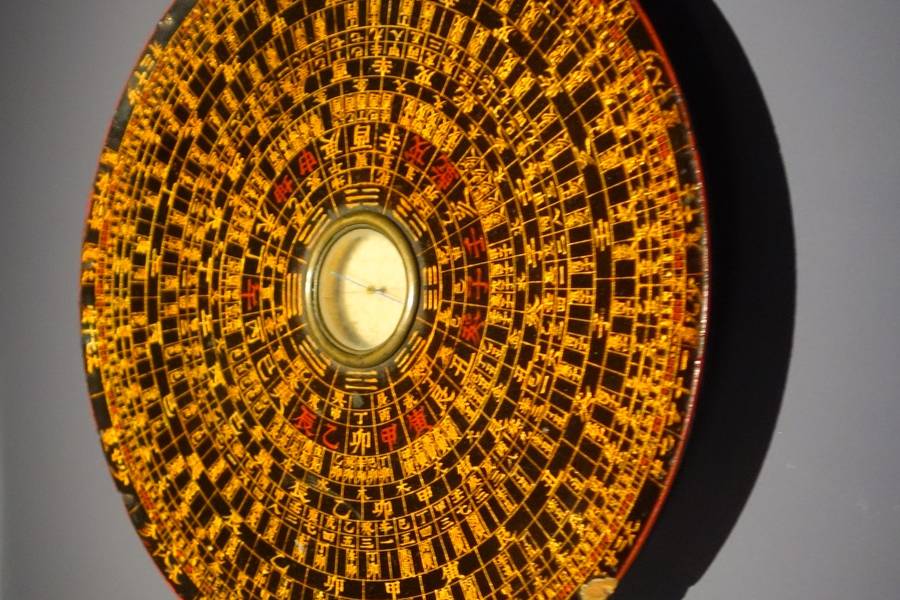
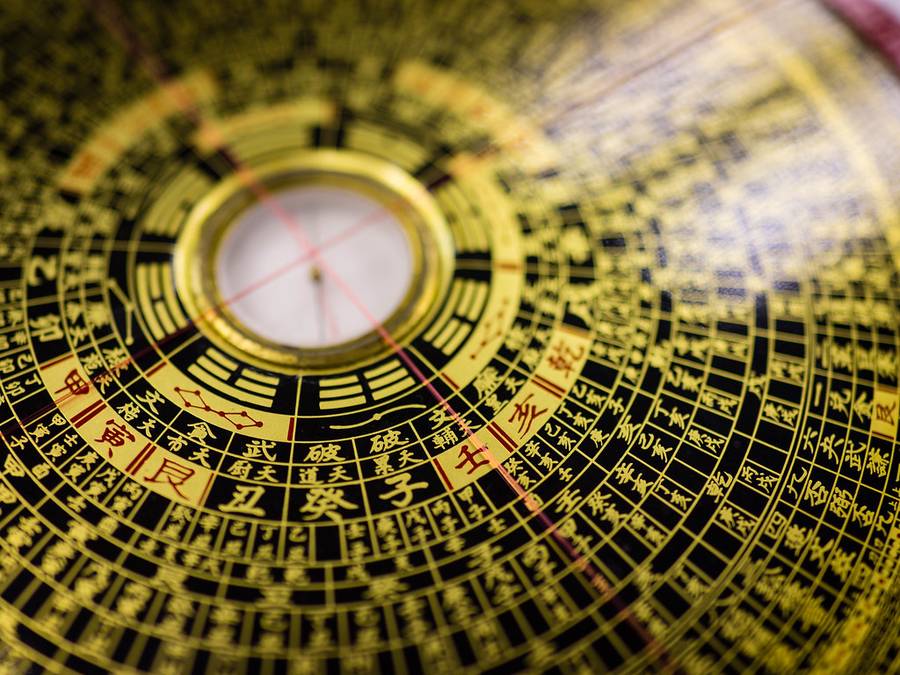
- Tool: the luopan (罗盘), a compass ringed with directions, trigrams and time cycles
- Key ideas: yin-yang (阴阳), the five phases (wuxing, 五行) and the eight trigrams (bagua, 八卦)
- Famous sites: the Forbidden City in Beijing and the Ming Tombs
- In the West: brought to the United States in the 1970s by Lin Yun (林云)
- Heritage status: on no UNESCO list, and on no national list in China
Origins
Feng shui began with the dead. Long before it was about houses, it was about graves: in early China, people believed the fortunes of the living depended on the resting places of their ancestors — bury the dead well, and the family would prosper; bury them badly, and trouble would follow. Graves of the Shang dynasty already show careful orientation, and the roots reach back to the early Zhou dynasty. An older name for the art, still used today, is kanyu (堪舆), a word that joins heaven and earth.
The name comes from a short passage in the Book of Burial, the art’s oldest text, traditionally attributed to Guo Pu, a scholar of the Jin dynasty — though scholars believe the text may have been put together later, and the attribution is debated. In it, the writer explains the name in a single line: “Qi rides the wind and scatters, but is retained when encountering water. The ancients gathered it to prevent its dissipation, and guided it to assure its retention. Thus it was called feng shui.” The book then sets the order of work: water first, shelter from wind second.
The ideas behind the art came together in the Han dynasty, when yin-yang cosmology, the five phases, the trigrams of the Book of Changes and the stems and branches of the calendar were woven into a single system. From then on, feng shui was practised at every level of society, from the imperial court to the villages of China.
Qi, Yin-Yang and the Five Phases
Three ideas carry the whole art. The first is qi, the vital breath. Practitioners describe it as a living energy that flows along the ridges of hills, gathers in sheltered hollows, and is carried away by strong wind and straight, rushing water. A good site, in this view, is one where qi arrives slowly and stays — curving water holds it, a hill behind blocks the wind, and the ground opens gently to the sun — while a bad site is one where it rushes past or is blown away.
The second idea is yin-yang, the pair of opposites that make up the world — dark and light, stillness and movement, the moon and the sun, the valley and the hill. Nothing is wholly one or the other; a good site balances the two. The third idea is the five phases — wood, fire, earth, metal and water — which follow each other in a cycle of birth and control: wood feeds fire, fire makes earth, earth bears metal, metal carries water, and water nourishes wood. Each phase has its colours, directions and seasons.
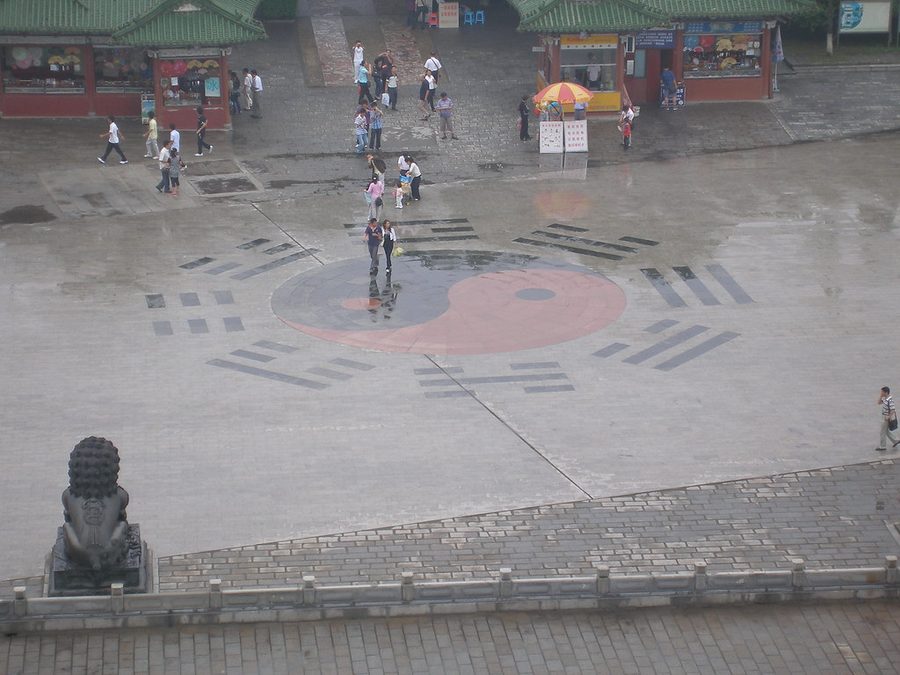
The eight trigrams give these ideas a shape: each is a set of three lines, broken or unbroken, standing for heaven, earth, thunder, wind, water, fire, mountain and lake. Together they form the bagua, a map of the world drawn on the ground and carved into the rings of the compass. The Book of Changes (Yijing, 易经), the ancient classic from which the trigrams come, is the art’s deepest root — feng shui is the Book of Changes applied to the land. The plaza in the photograph shows the idea made solid: a taiji (太极), the yin-yang symbol, ringed by the eight trigrams.
The Two Schools
Over the Tang and Song dynasties, the art divided into two schools. The Form school, associated with mountainous Jiangxi (江西), reads the shape of the land. Its masters trace the dragon veins, the ridges along which qi is believed to flow from distant peaks, and judge a place by what the eye can see. It is traditionally traced to Yang Yunsong (杨筠松), a master of the Tang dynasty, honoured as a teacher who used his knowledge to help ordinary people rather than only the powerful — though, as with Guo Pu, much of what is told about him is legend.
The Form school’s ideal site is a kind of armchair: high ground behind, against the north wind; lower hills to the left and right, like the arms of the chair; open ground and curving water in front, to the south, where the sun falls. The four sides are named for four animals: the Azure Dragon (青龙) on the left, the White Tiger (白虎) on the right, the Vermilion Bird (朱雀) in front, and the Black Tortoise (玄武) behind. The dragon veins (longmai, 龙脉) are the key: follow the ridge, find where it stops, and there, the masters say, the qi gathers.
The Compass school, associated with Fujian (福建), works differently: it reads direction and time rather than shape, using the compass, the trigrams, the stems and branches, and calculation. It rose with the magnetic compass, and by the Song dynasty it had become the second great branch of the art. The two schools were never rigidly separate — most practitioners used both — but the two emphases gave the tradition its structure.
The Luopan
The tool of the Compass school is the luopan, a compass unlike any other: at its centre is the Heaven Pool (天池), a small well holding a magnetic needle that points to magnetic south. Around it run ring after ring of characters: the twenty-four directions, known as the 24 Mountains (二十四山), each covering fifteen degrees of the circle; the eight trigrams; the stems and branches; and the cycles of time. The rings are crowded with characters, and reading one takes years to learn.
The Compass school’s best-known methods are Eight Mansions and Flying Stars. Eight Mansions (bazhai, 八宅) divides a house into eight directional sectors and matches them with a person’s birth year, read from the Chinese zodiac: four favourable directions, four unfavourable. Flying Stars (xuankong feixing, 玄空飞星) adds time: the fortune of each sector is believed to change in cycles of twenty years, and in shorter cycles too, so a house lucky in one period may not be lucky in the next.
Royal Feng Shui
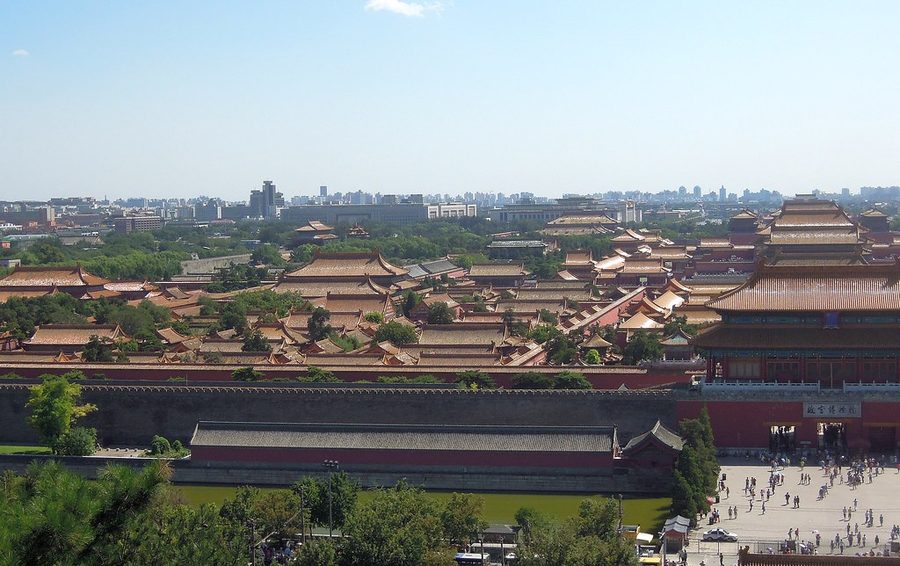
No one used feng shui on a grander scale than the emperors. The Forbidden City in Beijing, built between 1406 and 1420, runs on a precise north–south axis, with the emperor’s throne at its heart. Behind it to the north stands Jingshan (景山), an artificial hill of earth from the palace moat, as the Black Tortoise. In front, to the south, flows the Jinshui River (金水河), and the great halls stand in the ming tang (明堂), “bright hall”, plan, facing the sun. The whole city of Beijing was laid out on the same axis, nearly eight kilometres from the southern gate to the Bell and Drum Towers; the axis itself became a UNESCO World Heritage Site in 2024. Court feng shui was a matter of state, run by the Qintianjian (钦天监), the Imperial Astronomical Bureau, whose officials chose sites for palaces, tombs and capitals and advised the emperor on the timing of ceremonies.
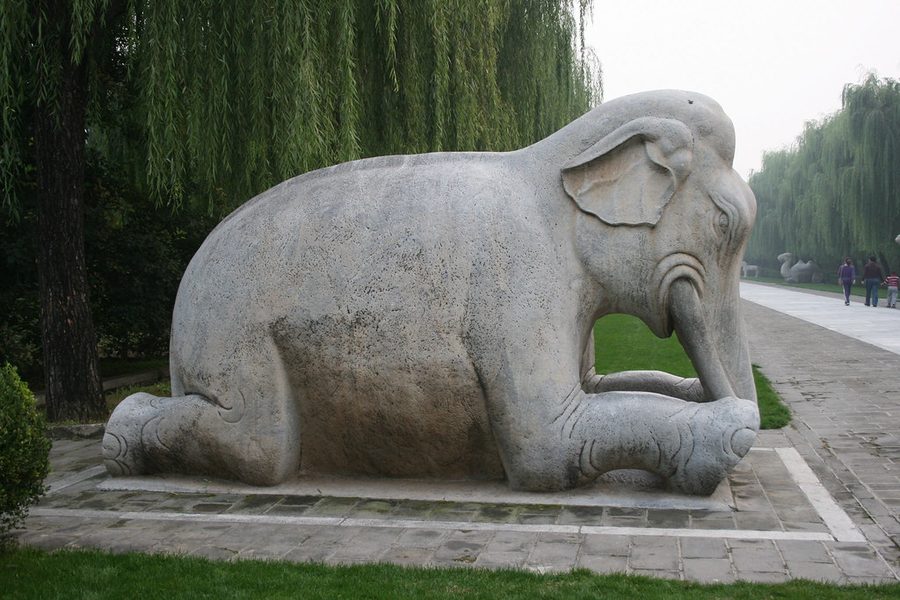
The Ming Tombs show the art at its most complete. In 1409 the Yongle Emperor chose a basin at the foot of Tianshou Mountain (天寿山), about fifty kilometres north of Beijing, as the burial ground of his dynasty. Mountains shelter the valley on three sides, it opens to the south towards the capital, and streams flow in front — the armchair ideal, written large. Thirteen Ming emperors are buried there. A long Sacred Way, lined with stone animals and officials, runs through the valley’s southern entrance.
Feng Shui at Home
For most people, feng shui is not about palaces but about the house. A practitioner called to a home looks first at the door: in the practitioner’s view it should open onto a clear space, not face a straight road or a sharp corner, which is said to send rushing energy, sha qi (煞气), straight at the house. Inside, the advice is practical as much as mystical: keep the entrance clear, let light and air move, and avoid clutter, which practitioners say blocks the flow of qi. The bed should stand against a solid wall, with a clear view of the door but not in line with it. The same ideas shaped the Chinese garden, where rock, water and pavilion are arranged as a small landscape.
None of this is presented as physics: the art describes a belief system, and its claims are its practitioners’ claims — a well-placed door brings opportunity, a bedroom facing the wrong way brings restless sleep, a house on a good site keeps its family healthy and prosperous. Many people in China consult a master before moving house or opening a shop; others follow the same rules out of habit. Before the Spring Festival, many households clean the house from top to bottom, sweeping out the old year.
Feng Shui Today
In Hong Kong, feng shui never went away: it is part of the property market, where buyers ask about a flat’s facing, developers consult masters before breaking ground, and the skyline carries the art’s most famous modern story. The HSBC headquarters, completed in 1985 to the design of Norman Foster, is described by feng shui experts as a model of the old ideal: an open garden in front, the harbour beyond it, flanking buildings like the Azure Dragon and the White Tiger, and the hills behind. On its roof sit two cannon-shaped objects, which the bank says are window-cleaning rigs — and which, the story goes, were aimed at the Bank of China Tower across the square.
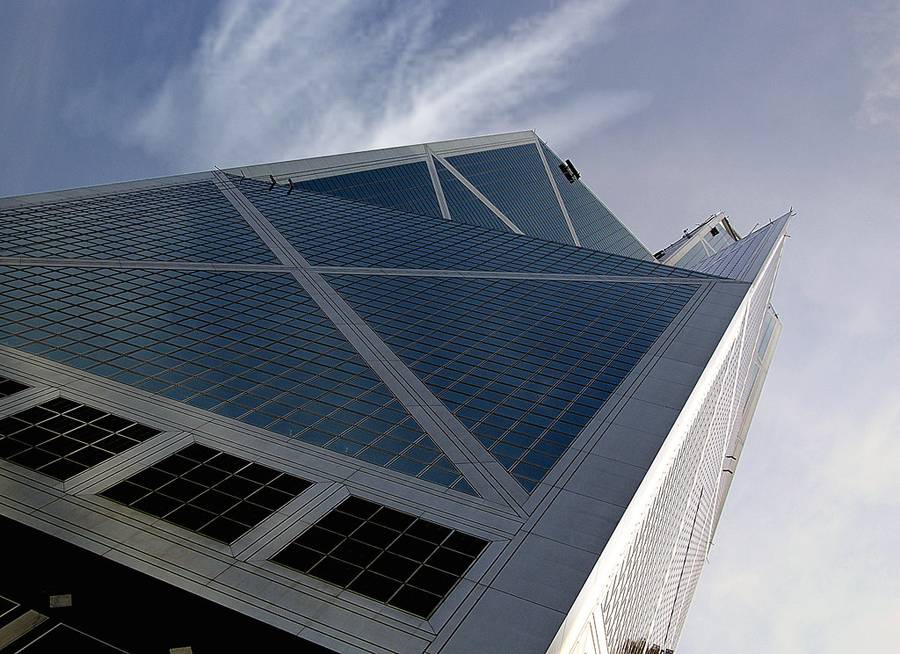
The Bank of China Tower, designed by I. M. Pei as a bamboo shoot rising in sections, is the other half of the story. Its sharp, triangular faces are read by feng shui masters as blades, sending out sha qi, “killing energy”, that cuts the fortune of the buildings around it. The story goes that months after the tower was completed, HSBC’s share price fell to a historic low of £3.74, and the cannons went up in reply. Whether the cannons caused anything is beside the point.
The art has also put down roots in the countryside: across the villages of southern China, groves of old trees stand protected behind the houses, known as fengshui forests (fengshui lin, 风水林). Villagers have guarded them for generations, believing they shelter the village and keep its fortune safe. The first records of such woods go back to the Three Kingdoms period, and they still stand — at Lai Chi Wo (荔枝窝), a Hakka village in Hong Kong more than three hundred years old, a wood of five to seven hectares arcs over the hillside behind the houses, planted, the villagers say, on a master’s advice.
Feng shui reached the West through a different door: in the early 1970s, Lin Yun, a teacher born in Beijing, brought his Black Sect Tantric Buddhist school to the United States, and in 1983 his student Sarah Rossbach’s book Feng Shui: The Chinese Art of Placement carried it to a wide public. His school differs from the classical ones: it needs no compass, and reads a home from its front door. From there the art spread into magazines, design shops and estate agents’ brochures, until “good feng shui” became a phrase in English. Not everyone is convinced: in China, feng shui is defined in dictionaries as superstition, and it has never been recognised as heritage — a Shanghai scholar’s 2006 application to list it as a local intangible heritage was withdrawn under pressure, and in 2010 the Vice Culture Minister said no decision had been made. It is on no UNESCO list, and on no national list in China. Its supporters call it a science of living with the land; its critics call it a belief, and say it should be described as one. This article has described it as one.
Summary
Feng shui began, if its own books are to be believed, with a line about wind and water, and it became an art of graves, houses, palaces and cities: three ideas, two schools, one ideal — a sheltered place, open to the sun, with a hill behind and water in front. It has chosen the sites of emperors and the corners of bank towers. Whether wisdom or superstition, it has lasted more than two thousand years, and it is still practised today — in the villages of the south, in the tower blocks of Hong Kong, and in living rooms a long way from China.