
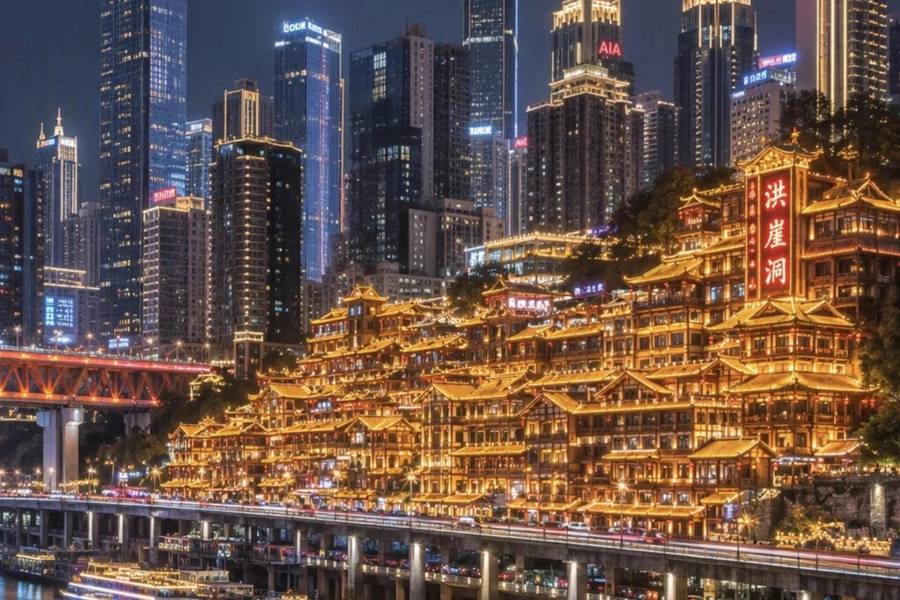
The first time I came to Chongqing, I tried to walk everywhere. That was my first mistake, and I made it within an hour of arriving.
On the map, my hotel looked close to everything. Six hundred metres to the metro, a short stroll to the river, a quick hop to dinner. In Chongqing, six hundred metres can take half an hour. You go up three flights of stairs, down a slope, round a dead end, up another flight, and you are somehow back where you started, only higher up and out of breath. A local laughed when I told her. She said the navigation apps give up here too.
I have been back many times since, and I have learned the city’s real secret: it rewards you for going downhill. Start high, walk down, take the metro for the long distances and a taxi for the short ones, and save your legs for the things that are actually worth climbing for. Three days is the right amount. Two will cover the big sights if you are willing to rush and climb a lot. Three lets you see the city properly, eat properly, and still have an evening free for the night view, which is the whole point of coming here.
Chongqing sits where the Yangtze meets the Jialing (嘉陵), built on steep hills in the southwest of China. It is the youngest of China’s four municipalities, made a municipality in its own right in 1997, but the city itself is far older. It was the capital of the Ba (巴)state long before the Qin, a river port for centuries, and the wartime capital of China from 1937 to 1946, when the government moved here during the war with Japan. That history is still in the streets: the old guild halls by the river, the air-raid shelters turned into hotpot restaurants, the stone steps that were once the only way up and down.
People call it the mountain city, the fog city, and one of China’s furnace cities, because the summers are famously hot and humid. The fog is part of the charm and part of the problem. On a clear day the two rivers shine and the whole peninsula looks like a model. On a foggy day the bridges disappear and Hongyadong glows through the mist, which is beautiful in its own way and useless for photographs. You cannot control the weather here. You can control the order you do things in, and that matters more in Chongqing than in almost any other Chinese city I know.
For a first visit, the sights cluster helpfully, once you understand the shape. The Yuzhong (渝中) peninsula holds the monorail, the park on the ridge, the cableway, and the night view. The west side holds the old town and the museum. The old streets run downhill. The day trips run in opposite directions. That is the plan below.
At a Glance
- How many days: Three. That is what I tell friends. Two will do it at a rush, but you will miss the slow afternoons, which are the point.
- Where to stay: I usually stay near Jiefangbei (解放碑) for a first visit, for the metro and the food, or near Guanyinqiao (观音桥) for better value and flatter streets. Nanbin Road (南滨路) suits couples and families who want a quiet river view. Being close to a metro station matters more than anything else, and a short walk on the map is not a short walk in Chongqing.
- The shape of the trip: Day one on the peninsula, from the monorail through the building to the cableway and Hongyadong at night. Day two in the old town and on the downhill trail. Day three out of the city, to the karst or the stone carvings, pick one.
- Book ahead: The Yangtze cableway needs advance booking through the official channels, and the day trips need planning. Most of the city sights do not need booking at all. I sort the cableway out before I arrive, not after.
- Getting around: I use the metro for long distances and taxis for short ones. For two or three people, a taxi often costs about the same as metro fares, and it saves your knees. The centre is not walkable in the normal sense. It is climbable, which is different.
- When to go: Spring and autumn are the most comfortable, in my experience. Summer is hot, humid and crowded. Winter is foggy and quieter, and the night view in fog has its own mood.
- My verdict: Chongqing is the most three-dimensional city in China, and the most fun to get wrong and then get right. The food is honest, the views are enormous, and everything worth seeing is close together, if you go downhill.
Day One: The Monorail, the Park on the Ridge, and the Night View
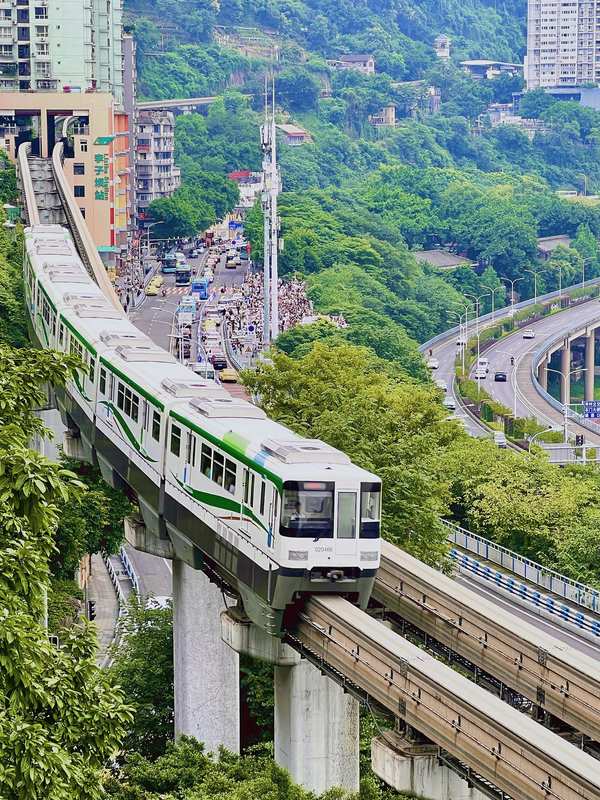
Start with the monorail, and start early. Liziba (李子坝) is the station where Line 2 passes straight through a residential building, and it is the photograph that launched a thousand trips to Chongqing. I go early in the morning, when the light is good and the platform is not yet packed. The official viewing platform is at street level below the station, reached from Liziba Station Exit 2. Go left for the overhead view, or right and down for the low angle. Trains pass every few minutes, so twenty to forty minutes is enough. Do not wait a long time for one train, and do not stand in the road to photograph it.
There is a quieter spot I like better, in the community across the road, at a small pavilion. You cross the zebra crossing, walk into the community and walk for a couple of minutes. It is head-on, it is quieter, and in cherry-blossom season it is lovely. One blogger warned that a residential spot she used had started charging a fee, while another said hers was free, so treat that angle as possibly charged and do not argue about it. The platform is free and it is fine.
Riding Line 2 is the other half of the experience. I board at Jiaochangkou (较场口), towards Yudong (鱼洞), and sit at the front, behind the driver’s glass. You are not allowed in the driver’s cab, and you do not need to be. The train runs along the river, through the building at Liziba, and on through the city. Stay on for a re-ride without exiting if you want the view again. The direction that matters is towards Liziba, for the through-building view.
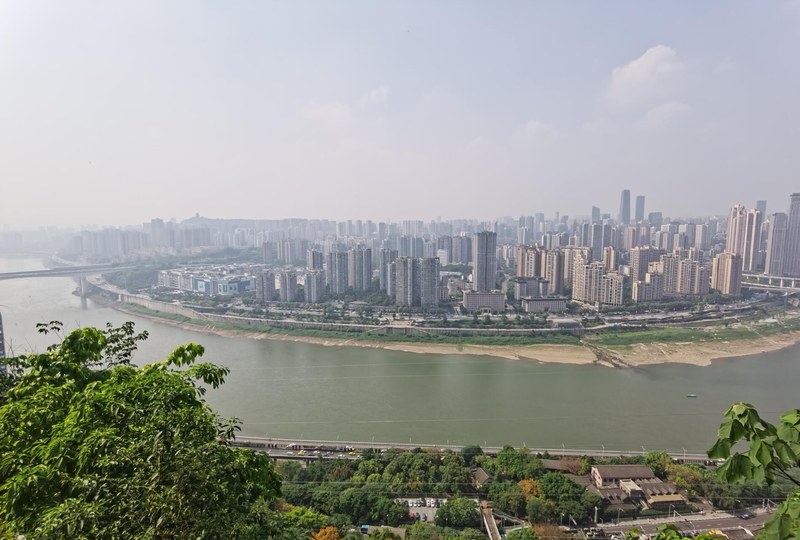
From Liziba, walk uphill to Eling Park (鹅岭公园), or take a short taxi up and walk down from there, which is my rule for the whole trip. Eling Park is free, and it is the quiet high point of the peninsula, on the ridge that gives the park its name. The Lansheng Tower (瞰胜楼) at the top gives a view over both the Yangtze and the Jialing, and sunset there is superb. Inside, it is a garden more than a sight: old banyan trees, a lotus pond, a stone rope bridge, a Suzhou-style villa, and a lot of Republican-era buildings from when this was the diplomatic quarter. It was built in 1909 as a private garden, and it still feels like one.
My route is to enter at the main gate, wander through the garden, and finish at the tower last, to catch the light, then exit at the south gate. There is no backtracking that way, and no re-climbing. The villa closes in the early evening, so visit it early if you want to go in. From the south gate, Eling Erchang (鹅岭二厂), the old printing factory turned into a creative park, is ten minutes downhill, and Liziba is fifteen to twenty minutes further down, or a short shuttle ride. That downhill chain, park to factory to monorail, is one of the best half-days in the city, and it costs you almost no climbing.
There is a plank road here too, the Eling plank road, which runs along the cliff below the park. The entrance is outside the park and the exit is inside it, so do not enter the park first, because you cannot get onto the plank road from inside. It needs a reservation through the official mini-program and it is one-way, so check whether it is open on the day you go. I missed it once and used the viewing platform at the south gate instead, which was fine. It is good at night, and it is a popular spot for hanfu photographs.
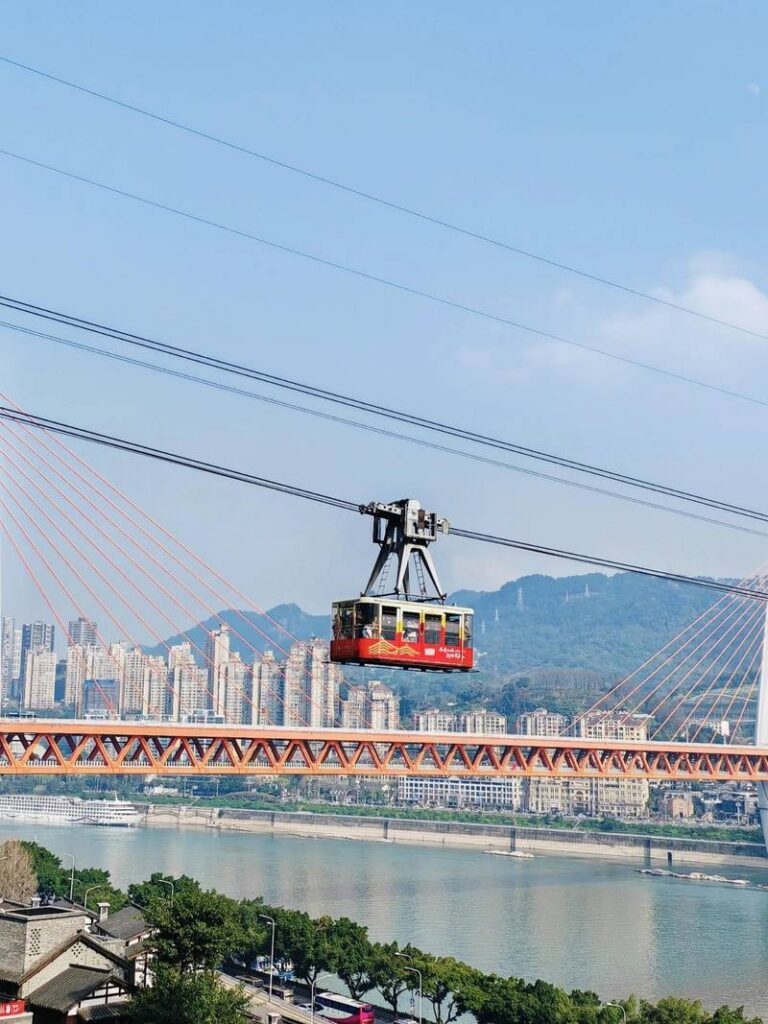
In the late afternoon, go to the Yangtze River Cableway (长江索道). This is the part of the trip that causes the most trouble, so I will be blunt about it. The cableway is worth it once, for a four or five minute ride across the Yangtze and the night view. It is not worth a long queue. If the queue is over forty minutes, walk away. The bridges are free, and the view from them is good.
Direction matters more than anything else. The north station, at Xiaoshizi (小什字) on the Yuzhong side, is the tourist queue. On holidays it can be an hour or more. The south station, at Shangxinjie (上新街) on the Nan’an (南岸) side, is usually under twenty minutes. So ride south to north, from Shangxinjie to Xiaoshizi, and walk to Hongyadong when you get out. I have ridden the first car from the south station at opening with almost no one else in it. Book in advance through the official WeChat account, check the official account for the real-time queue before you go, and do not just join the tour-group queue. There is a separate channel for pre-booked visitors. Show your code to the staff at the front.
There is no official fast lane. Do not trust scalpers selling no-queue or VIP access. Buy a single ticket only, not a return, because you will not want to queue again for the way back. On the south to north car, stand on the right-hand side by the window, facing Yuzhong, for Raffles City and the two-river confluence. The car has no seats, it shakes, and it is packed at peak times. In fog or rain there is almost no view. Go early in the morning, or late at night, or at dusk, which is best. A good evening plan is Longmenhao Old Street (龙门浩老街) on the Nan’an side first, then the cableway south to north.
When you get out at the north station, you are at Xiaoshizi, a short walk from Hongyadong. This is where the night begins, and where most first-timers go wrong.
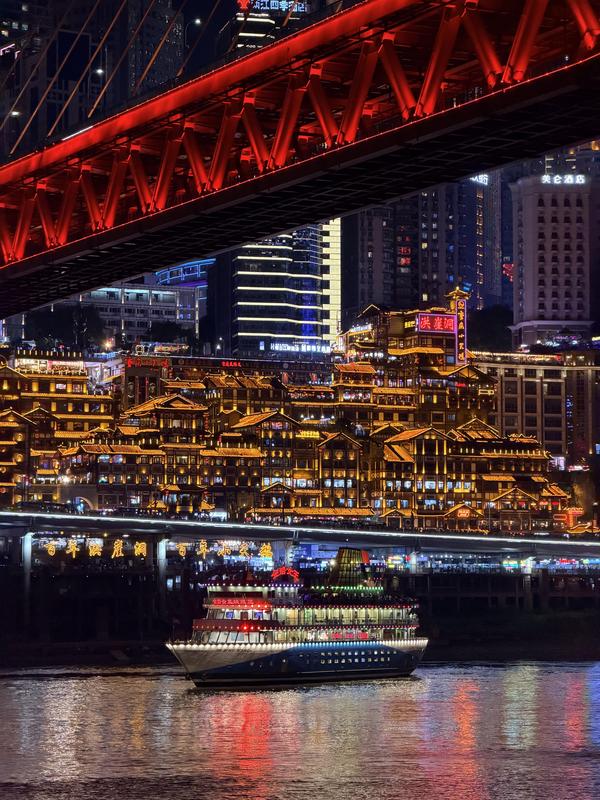
Hongyadong (洪崖洞) is the eleven-storey stilt-house complex built into the cliff above the Jialing River. It is free to enter, and it is the most photographed sight in Chongqing. I am honest with friends about it: the value is the outside, at night, not a long visit inside. Inside, expect souvenir and food floors and queues. Outside, with the lights on and the bridge in the same frame, it looks like something from a film.
Do not enter from the first floor and walk up through the crowds. That is the worst way in. Take a taxi straight to the eleventh floor, the top, and walk down. Or enter at the first floor and take the lift to the twenty-second floor of the building next door to reach Kuixinglou (魁星楼). Either way, you are going down, not up. The lift down from the top floor has a very long queue, so allow extra time if you want close-up photographs.
Arrive before the lights come on, in the early evening, and do not arrive on the dot. The lights go on around sunset and off late in the evening, and the times shift with the season, so check on the day and treat everything else as a rough guess. On holidays the area is described as a hundred thousand people, and I believe it. The crowd peak is in the first couple of hours after the lights come on.
For the photograph, walk the Qiansimen Bridge (千厮门大桥), but walk it backwards. Most guides say walk from Hongyadong onto the bridge. On holidays that is impassable. The roads are closed and taxis cannot get through. My tested route, which I learned from a blogger who had tried it the hard way, is to take Metro Line 6 to Grand Theatre Station (大剧院站), Exit 4, turn left from the exit onto the bridge. There are far fewer people, and you arrive before the lights come on. For people with children or elderly parents who do not want to walk, turn right from Exit 4 instead, watch from there, and take the metro straight back.
The other viewpoints are worth knowing. Downstairs at Hongyadong, by the river, is the immersive close-up, better than a river-view hotel room, in my experience. Jiangtan Park (江滩公园), across the river, is the full panorama, with the stilt-house block and the bridge together. Nanbin Road is the drone-show and Raffles City far view. For one night, Jiangtan Park and the Qiansimen Bridge give you the postcard shot. Do all three only if you have time.
A few warnings from that first night, learned the hard way. Do not book a river-view hotel at Hongyadong expecting a better view. The downstairs close-up is better. By contrast, a high-floor hotel on Nanbin Road is recommended if you want the drone show — check the schedule on the day, as show days change. Do not pay the follow-photographers at Jiangtan Park unless you want to. They are optional. And watch the roadside power-bank sellers near the bridge. One was seen charging a startling amount for a charge.
I end the night on the bridge, looking back at the lights. It is the moment Chongqing makes sense: a city stacked in layers, lit up floor by floor, with two rivers running underneath it.
Day Two: The Old Town, the Museum, and the Trail Downhill
The second day goes west, to the old town, and then downhill, which is the theme of the whole trip.
Start at Ciqikou (磁器口), the old town on the Jialing River. Go in the morning, before the tour groups, or in the late afternoon, when the light slants and it is cooler. Do not go at noon. It is hot and packed. Allow an hour and a half to two hours.
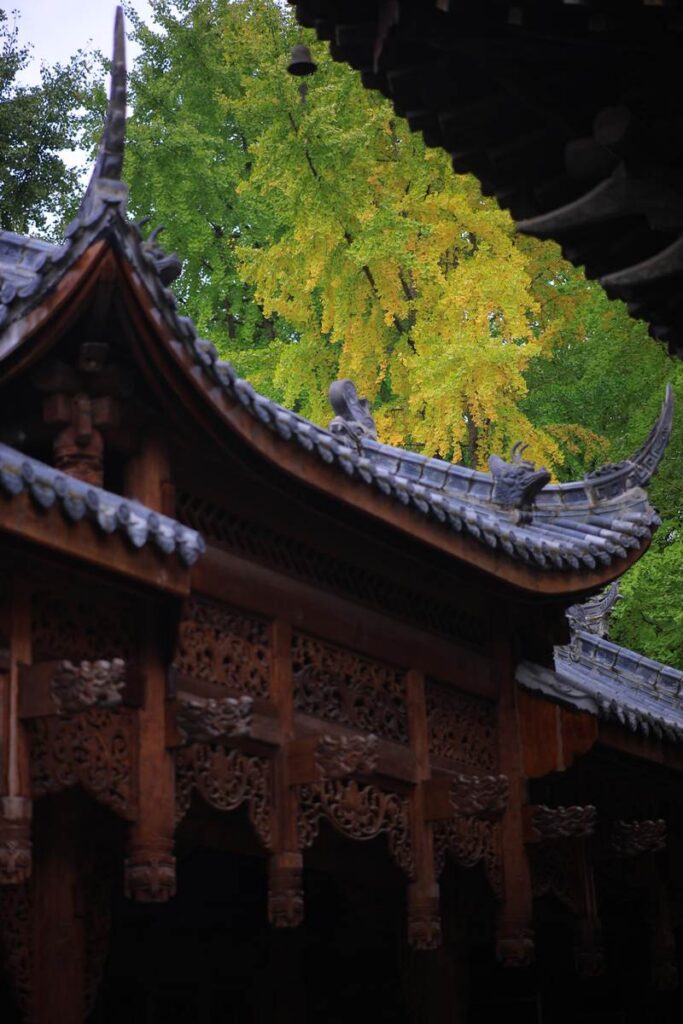
Be clear about what Ciqikou is. The main street is largely rebuilt, in Ming and Qing style, but mostly new shops selling the same snacks and souvenirs you will find all over Chongqing. The main street is worth ten minutes. The real old town is in the side lanes, Hengjie (横街), Houjie (后街), Jinrongjie (金蓉街), and in Baolun Temple (宝轮寺), a Ming-dynasty temple that is free, and Zhongjia Courtyard (钟家院). That is where the old town survives, narrow, lived-in, full of small workshops.
Try Chen Mahua (陈麻花), a sweet fried twist, and Maoxuewang (毛血旺), a bowl of duck blood and offal in spicy broth. Order Chongqing xiaomian (小面), the bowl of wheat noodles the city runs on, and liangfen (凉粉), the cold jelly noodles that make sense on a hot day. Eat standing up in a corner shop, queue if you have to, and keep it cheap and small, because you will eat again in an hour.
And watch for the traps. A free tea tasting in a teahouse that turns into a steep charge. Free photo-studio shots that are charged per print. A porcelain master who asks you to pay for a piece you broke. People offering to take you to a hidden old street for a fee, and local guide touts at the metro exit. I have seen all of these, and I walk past all of them. Ciqikou Station is on Metro Line 1, Exit 1 — follow the signs there, as the original staircase is closed for construction and the routing can change.
From Ciqikou, go to the Three Gorges Museum (三峡博物馆), across People’s Square from the People’s Assembly Hall (人民大礼堂). The museum is free, and it is a good half-day on its own. Book in advance through the official WeChat account, because tickets sell out on weekends and holidays.
Take the lift straight to the top floor and work your way down. The highlights are the Three Gorges panorama, a giant scroll with a short film, and the dam model on the ground floor, which shows you the scale of the Three Gorges Dam in a way no photograph can. The Ba-Yu (巴渝) bronze ware and the Han-dynasty pictorial bricks are my other picks. The Dazu rock carvings hall and the ancient porcelain hall are skippable if you are short on time.
One warning: different guides give different floor-by-floor layouts, and the museum may have changed its displays, so I will not give you a floor list to follow. Follow the signs, and ask at the desk. There is a free guided tour in the morning and the afternoon, and free audio guides through the museum’s WeChat account. Allow two to three hours for a proper visit. An hour is only enough for a quick pass.
Most bloggers say it is worth it, especially as a free half-day that pairs with the Assembly Hall across the square. One dissenting post called it the worst museum the author had visited, and the commenters pushed back, which tells you something about how seriously Chongqing people take their museum. I am with the majority. Go if you like museums. Skip it if you do not, and go to the trail earlier.
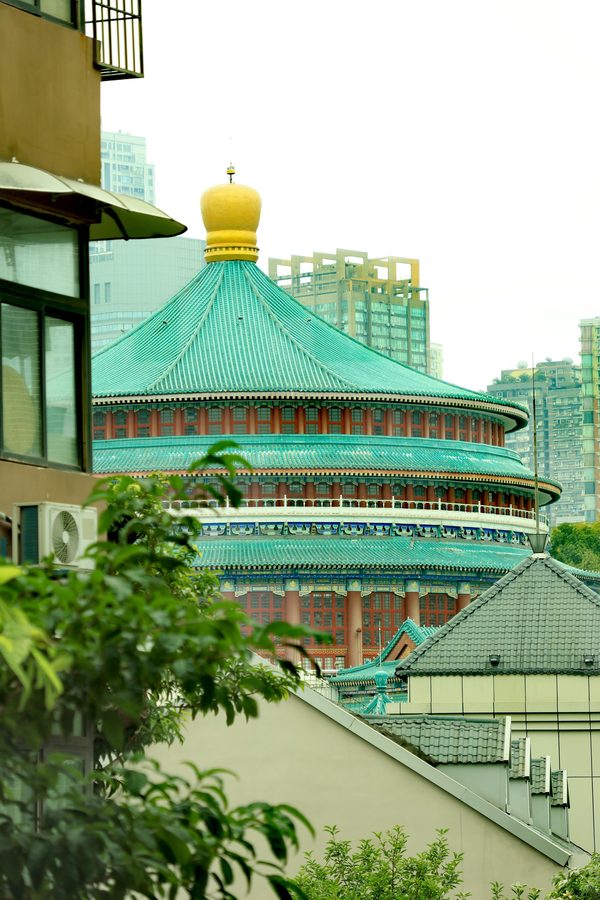
The Assembly Hall itself is a photo stop only. Do not pay to go inside. Inside is rows of old red chairs, an ordinary meeting hall, with no air conditioning, hot in summer. The exterior is free and photogenic from People’s Square: a golden, flying-eaves roof with peacock-blue glazed tiles, best in morning light. A smaller post argues the interior dome is worth seeing, and architecture lovers may disagree with me, but the consensus is exterior only.
In the late afternoon, do the Shancheng Trail (山城步道), also called Shancheng Lane (山城巷). This is the city’s best walk, and the one most visitors miss. It is a downhill cliffside trail through the old city, and it is free.
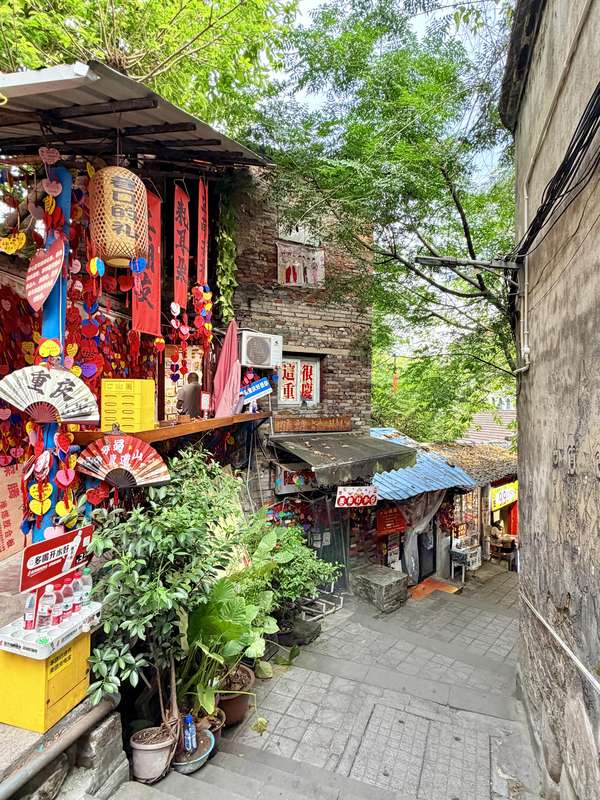
Do not start at the bottom and climb up. Start at the top and walk down. The top entrance is at Metro Line 1, Qixinggang Station (七星岗站), Exit 1, an eight-minute walk, navigating to Jiashi Nursing Home (佳实养老院). That is the hilltop entrance, in Lingshi Lane (领事巷). Then walk downhill all the way to the bottom exit at Jiaochangkou, which comes out directly at Shibati and Jiefangbei. The walk takes about two and a half hours, unhurried, with photo stops.
The route runs through the old city on the hillside: the wildflower garden at Ren’ai Church (仁爱堂), a small church with a garden and a view, and Houlu (厚庐), a large old house with a terrace and a view of the river. Walk slowly, look at the houses, and keep an eye out for the small details.
Go in in the late afternoon, and you get daylight on the old street, a riverside sunset, and blue-hour night views in one walk. For the fewest people, go early in the morning, when the trail has only locals on it. Avoid the middle of the day at weekends, the busiest window. Wear non-slip sports shoes. There are many steps, and no high heels. Bring mosquito repellent in summer. You do not need to buy water. Local stalls sell liangxia (凉虾) and ice jelly along the way. Skip the cliffside walkway in rain — it is slippery when wet.
There is no shortcut back up. Once you walk down, you either climb back up or exit at the bottom and take the metro from Jiaochangkou or Xiaoshizi. That is the point. You started high, you walked down, and you are done.
Shibati (十八梯), at the bottom, is the downhill end of the walk. It is a rebuilt commercial street, from the eighteenth step of the old city wall to the river, and it is busy at night. Walk it once, have a look, and go on to dinner.
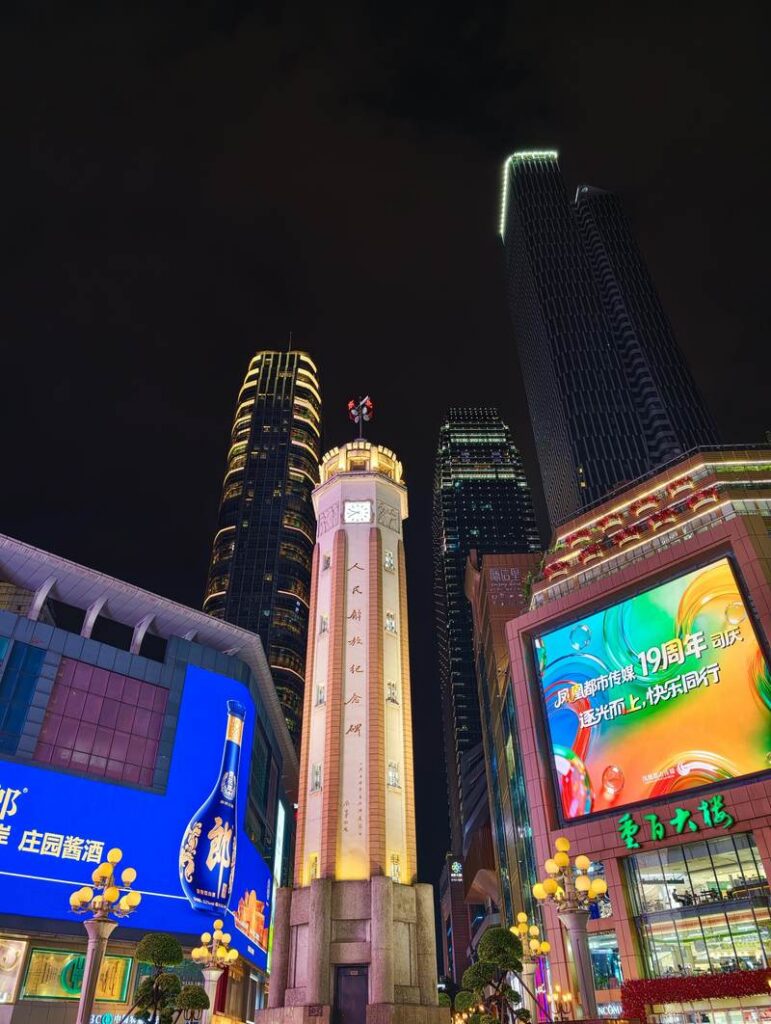
For dinner, walk to Jiefangbei. It is a central landmark and shopping area, not a long attraction in itself, but it is a good meeting point and a good place to eat if you pick the right streets. I eat on the side streets, not in the pedestrian area, and I will tell you why in the food section below.
If you have energy left, Chaotianmen (朝天门) is a short photo stop on the way. It is the tip of the peninsula, where the two rivers meet, and it is a good place to see the city from the water’s edge. Go at sunset, if you can.
Huguang Guild Hall (湖广会馆), near Xiaoshizi, is a niche stop for history lovers. It is a group of Ming and Qing dynasty guild halls, built by migrants from Hubei and Hunan, and it is a good place to see how the city was built. The Yuwang Palace (禹王宫) next door is a smaller, quieter temple, and it is worth a look.
Day Three: A Day in the Karst, or a Day with the Carvings — Pick One
Day three is a choice, and I mean it as a choice. Wulong (武隆) and Dazu (大足) lie in opposite directions, and you cannot do both in a day. Pick one, and pick it for the right reason.
Wulong is the karst. The core is the Three Natural Bridges (天生三桥), three giant natural stone bridges over a sinkhole, with a cliff elevator down into the valley floor. It is the Transformers filming location, and the scale is hard to take in until you are standing underneath the bridges looking up. Walk the valley floor past the old Tianfu Inn (天福客栈), then go to the Longshui Gorge fissure (龙水峡地缝) in the afternoon, a narrow gorge with waterfalls and hanging walkways.
One day is doable but full. The bridges take two and a half to three hours, the fissure takes an hour and a half to two hours, and you need to start early. Get there by high-speed rail to Wulong station, then a tourist shuttle to the visitor centre, or by direct scenic shuttle from Chongqing. Self-drive is two and a half to three hours.
Go in the morning. Afternoon fog hides the sinkhole. The gorge floor is damp and cold, and the steps are slippery, so wear non-slip shoes and bring a thin jacket. Holiday shuttle queues are long. The evening show, Impression Wulong, is outdoors in a cold valley, so bring a thick jacket if you go.
Fairy Mountain (仙女山), the alpine grassland with a small train, is best in summer, when it is cool, and in snowy winter. Bloggers say skip it if time is short or outside snow season. Two days in Wulong lets you add Fairy Mountain. Three days lets you add Furong Cave (芙蓉洞) and the Furong River (芙蓉江). October is peak, with rain and fog and poor visibility. November and December are colder and foggier, with wet trails, but clear days give you karst cliffs and a sea of clouds and far fewer people. Best visibility is on a clear, dry day. Do not count on shoulder-season fog lifting.
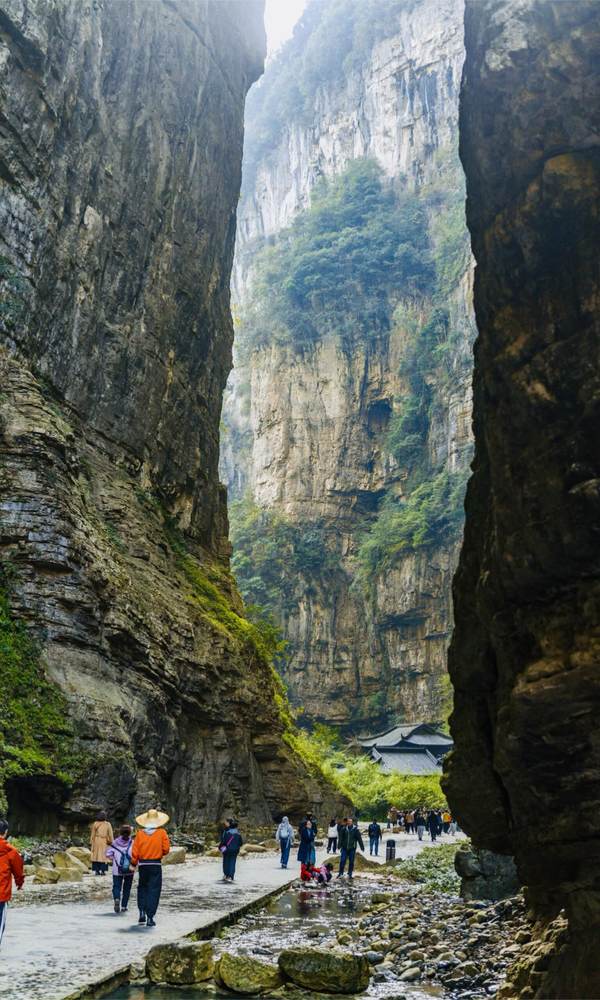
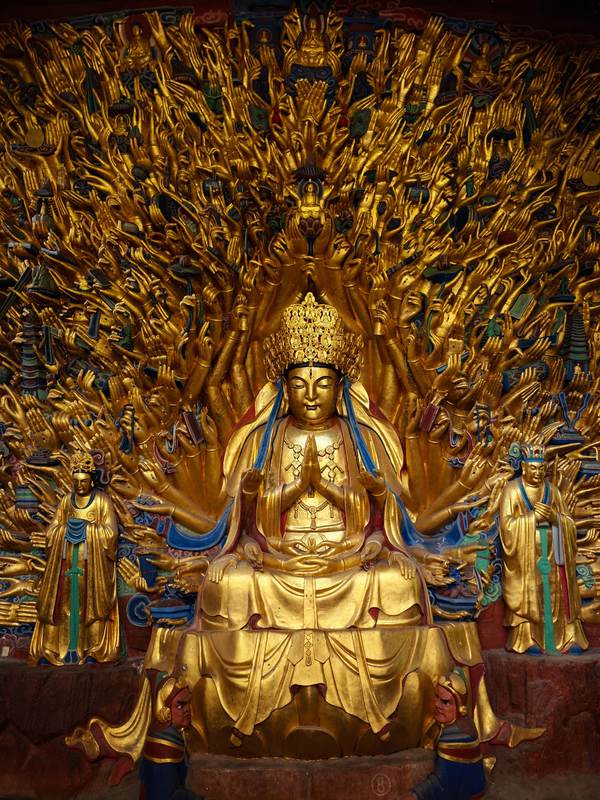
Dazu is the carvings. The Dazu Rock Carvings are a UNESCO World Heritage site, and they are the finest cliff carvings I have seen in China. Baoding (宝顶山) is the core, from the Southern Song dynasty, with carvings on three cliff faces, a thirty-one metre reclining Buddha, and the Thousand-Hand Guanyin, with a thousand and seven hands. Beishan (北山) is finer and more delicate, from the late Tang to the Song, with folk Buddhism and many steles and inscriptions. If you only have time for one, pick Baoding. If you have time for both, do Baoding in the morning and Beishan in the afternoon. They are about twenty minutes apart by taxi.
Allow three to four hours for both, five to six if you add Changzhou Ancient City (昌州古城), which is optional. Skip it if time is tight. Hire a guide. Without understanding the statues, it is a wasted trip, and every blogger I read agreed on that. Watch the films at Baoding first, if you can. The Dazu Museum has a weekly closing day, so check before you go. For food, try the Youting crucian carp (邮亭鲫鱼) and the Dazu sausage.
Get there by high-speed rail to Dazu South, then a taxi, or by bus to Dazu bus station and then a local bus or taxi to the visitor centre. A small group with Chongqing pickup is the most convenient option if you do not want to navigate it yourself.
My rule is simple. Nature, outdoors, photographs and families, pick Wulong. History, art and culture, pick Dazu. Both are worth it if you have time. Wulong needs a full day, ideally two. Dazu is a comfortable day trip.
What to Eat
Chongqing was not built for delicate eating. It was built for dock workers, and it still eats like it. The food is hot, oily, salty, and generous, and after a day of stairs it is exactly what you want. The eating is half the reason I keep coming back.
Hotpot
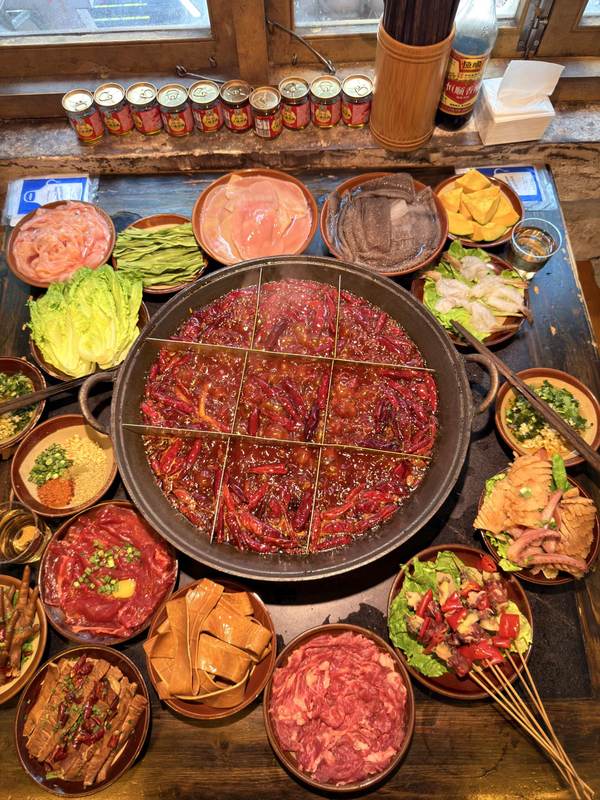
Hotpot is the meal I plan my evenings around. A pot of broth bubbles in the middle of the table, you cook raw ingredients in it yourself, and the meal stretches out for hours. Chongqing hotpot is different from the hotpot you will find in Chengdu. The broth is beef-tallow based, oilier, and more aggressively seasoned. The dip is not sesame paste. It is sesame oil and garlic, with coriander, and, if you are doing it properly, houttuynia, the herb locals call zhe’ergen (折耳根). The commenters insist that is the real thing, and I agree.
Start with mild spice, wei la (微辣). The broth gets hotter as it cooks, and medium spice, zhong la (中辣), is my usual order. Then, if you are feeling brave, te la (特辣) is the hottest, but be warned, it is really hot. I advise ordering a mild and a medium pot and tasting as you go.
What locals order first: tripe (毛肚), duck intestines (鸭肠), tender beef, gongcai (贡菜), lotus root slices, and potato. Cook tripe for fifteen seconds, lifting it when the edge curls and the colour darkens. Duck intestines take ten seconds, lifted when they curl tight. Yellow throat (黄喉) takes fifteen to twenty seconds, until it turns from pinkish-white to milky white. Waist slices (腰片) take ten to twelve seconds, eaten with a dry dip. Overcooking makes everything tough and old. That is the beginner’s mistake.
Do not eat hotpot in or around Jiefangbei or the Guanyinqiao pedestrian streets, or right by Hongyadong. The tourist premium is real, the same dishes cost far more, and the quality is worse. Do not follow taxi drivers’ recommendations. Drivers get commission and steer tourists to bad shops. Eat where locals eat, within a short walk of metro stations like Shiyoulu (石油路), Daping (大坪), Qixinggang, Huangnibang (黄泥磅), and Ranjiaba (冉家坝). Look for a shop full of locals, with a clear menu and no one outside trying to pull you in.
Check the set meal before you order. The pot base, the oil dip, and the tea are often charged separately, and a free pickle or side dish is a good sign. Avoid free hotpot deals that are actually a card top-up promotion. If a shop’s name is full of words like air-raid shelter, community, nine-grid, city gate, or granny, be careful. Locals do not say nine-grid hotpot. That is largely a tourist framing.
For drinks, I order Wanglaoji (王老吉), Tianfu Cola, soy milk, or a local beer. Milk beats water for cooling the burn, and Wanglaoji is a sweet herbal tea that works better than beer, in my opinion.
Xiaomian
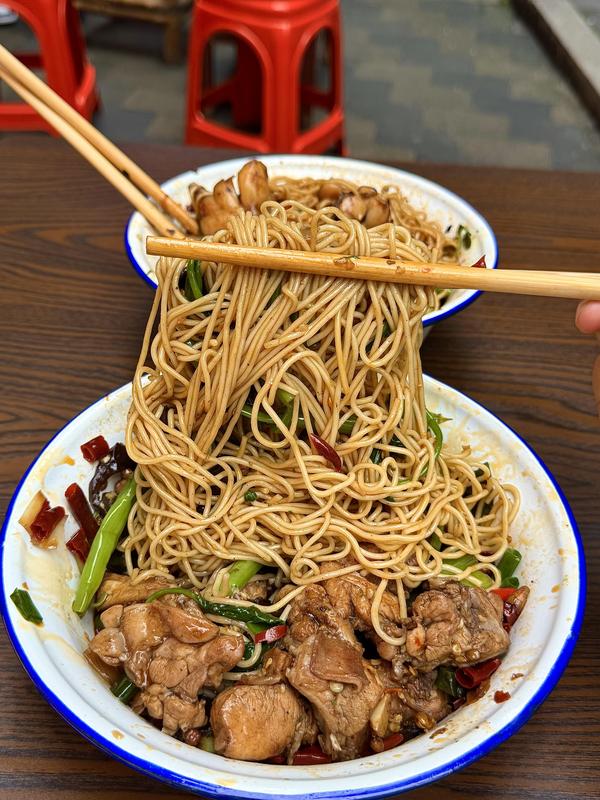
If hotpot is what Chongqing shows the outside world, xiaomian (小面) is what Chongqing actually eats. It is a small bowl of noodles, made to order in a minute, and I eat it almost every morning I am in Chongqing.
Do not say, give me a bowl of noodles. That marks you as a tourist. Say er liang (二两). That is the standard size. San liang (三两) is a bigger bowl, but er liang is the best size to start, unless you are very hungry.
Eat it for breakfast or lunch, sitting on a low stool, or squatting on the kerb. That is normal here. Walk in, call out two liang of xiaomian, and sit down. The default is plain mala, with chilli oil, Sichuan pepper, ginger-garlic water, crushed peanuts, and preserved mustard greens, ten or more seasonings in the bowl first.
The style most reviewed is wanza mian (豌杂面), with soft peas and minced pork. Beef noodles and pork noodles are also available, as are ganliu mian (干溜面), dry mixed noodles, and qingtang mian (清汤面), clear soup noodles. For a famous shop, go to Li Hulake (李糊辣壳面馆), but be prepared for a long wait, up to an hour, on a busy morning.
Jianghu Cai
Jianghu cai (江湖菜), rivers-and-lakes cooking, is Chongqing’s own version of Sichuan cooking, on big plates, with big flavours. It started in the dock workers’ canteens, then spread everywhere. If you only try one restaurant cuisine in Chongqing, make it this one.
Near Hongyadong, in an alley with no signboard, is Fanshi Jianghu Cai (樊氏江湖菜), an eighteen-year-old institution, still run by the same family. It serves an old-style jianghu feast, with a big table, a big pot, and a big appetite. Come with friends, because the portions are enormous.
In Guanyinqiao, opposite North City Tianjie (北城天街), is Leige Jianghu Cai (磊哥江湖菜), an old jianghu restaurant, founded by a man who used to cook for the docks. The food is rich, salty, and deeply satisfying, and the service is friendly and fast.
Near the Great Hall is Minjian Liangcang (民间粮仓), where I order the cured-pork rice pot, the addictive spicy chicken, and the dried radish with cured pork. It pairs well with a gaiwan tea and a face-changing show afterwards, if you want the full evening.
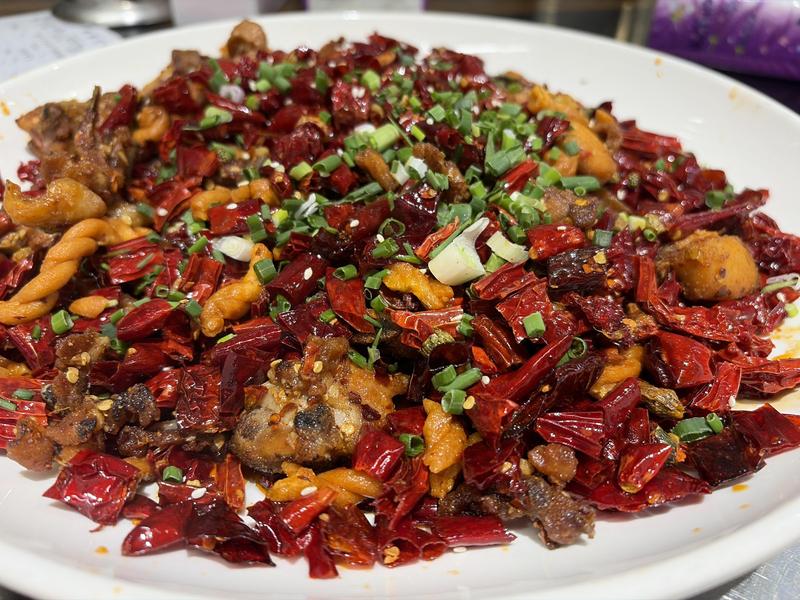
The classic dishes you will see everywhere are laziji (辣子鸡), spicy chicken excavated from a mountain of dried chillies, maoxuewang (毛血旺), a bowl of duck blood, offal and bean sprouts in a fiery broth, and shuizhu yu (水煮鱼), fish poached in chilli oil. Ask for them by name, and the waitress will know you are not a first-timer.
Snacks and Food Streets
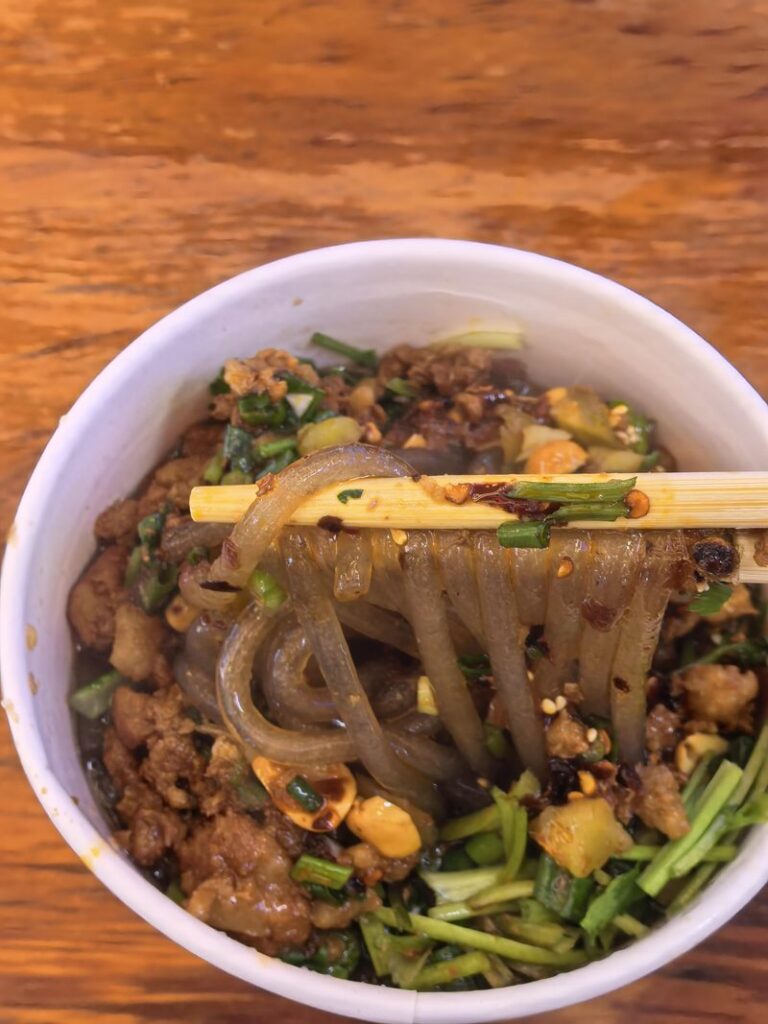
Chongqing’s snacks are a whole cuisine of their own, and I hunt them down street by street. Suanlafen (酸辣粉), hot and sour sweet-potato noodles, is my two-minute lunch. Liangfen (凉粉), cold jelly noodles with vinegar and chilli, is my afternoon stop. Bingfen (冰粉), ice jelly, is what I order at the end of any spicy meal, by default. Liangxia (凉虾), the rice-flour jelly in sweet syrup, is the summer sweet I look for on the street. It has no shrimp in it, despite the name. That confuses everyone the first time.
Bayi Food Street (八一好吃街), by Jiefangbei, is where most visitors go for snacks, and it is where most visitors go wrong. Twenty years ago, locals ate there cheaply. Now the prices are high, worse than Guanyinqiao food street, and the stalls are duplicated everywhere: bobochicken (钵钵鸡) every two steps, colourful liangxia every three steps. Net-red stalls deliberately serve slowly to fake queues. You pay first, then queue, and refunds are troublesome. One blogger queued an hour for a potato-mash fried chicken leg and found it dry and mediocre. These are not traditional Chongqing snacks. They are mostly one-off tourist items.
The old shops still worth trying are Mailisi (麦丽丝) meat skewers, Pangzima (胖子妈) salted duck, which sells out late in the day, and Haoyoulai (好又来) suanlafen. Order less chilli at Haoyoulai. Normal chilli made one blogger’s nose run. For the rest, go to Guanyinqiao food street, where the prices are friendly and the taste is good, or to the community old shops around Qixinggang and Jiaochangkou, where locals go, the prices are clear, and there is no long queue. The food in Chongqing is very good. It is just not on the tourist snack street.
One more warning: many shops selling hotpot base on the food streets are a pure tourist trap. Locals buy it cheaper in supermarkets. Do not buy it there.
Booking, Honestly
Chongqing is easier than Xi’an for booking, but the cableway and the day trips need planning. The cableway needs advance booking through the official channels, with tickets released the day before. Check the official account for the real-time queue before you go, rather than trusting any guide, including this one. There is no official fast lane, and scalpers selling one are not official.
Hongyadong is free to enter, and there is no booking. The museum is free, and you walk in with your passport or ID. The trail is free. Ciqikou is free. The Assembly Hall exterior is free. That is most of the city, and it is why Chongqing is such good value.
For the day trips, sort out the transport first. Buy your return train tickets as soon as your plans are fixed, because the evening trains back to the city sell out. At Wulong, start early, because the gorge and the bridges take a full day. At Dazu, hire a guide, and check the museum is open before you go, because it has a weekly closing day. Book hotels ahead for weekends and holidays, and check the total price after tax, not the from price.
And the usual warnings apply: ignore the touts at stations and outside sights, including the ones selling day tours and fast-track tickets, and ask the price before you buy anything on a snack street. If someone on the street offers you a tour, a boat, or a bargain, walk on. Every one of those offers has a shop at the end of it.
What I’d Skip
Not everything in Chongqing is worth your time, and three days is short enough that the skips matter as much as the picks.
Hongyadong is the first one. The night view from outside, from the bridge and the river, is the whole point. A long wander through the souvenir floors inside is not. Same with the People’s Assembly Hall across the square. The golden roof from People’s Square is the photograph. The inside is just rows of red chairs, so I don’t pay to go in.
Food is where people waste the most money. Hotpot in Jiefangbei or right by Hongyadong costs more for worse food than the same dishes a few minutes away, near a metro station where locals actually eat. Bayi Food Street is the same trap in a different form. The old shops are still worth a stop, but queuing blindly for the net-red stalls is not, and the best food in the city isn’t on that street at all. And don’t buy hotpot base from the tourist shops there. It’s the same stuff, cheaper, in a supermarket.
Then there are the two mistakes that cost you a whole day, not just a meal. Wulong and Dazu lie in opposite directions, so trying to squeeze both into one day means a day on the road and neither place properly seen. And the Shancheng Trail only works one way. Start at the top and walk down. Climb it from the bottom and you’ll spend your legs before you’ve seen anything.
Walking everywhere is the other one I learned the hard way. The map says six hundred metres and means half an hour of stairs, so I take the metro for the long distances and a taxi for the short ones now.
And finally, the offers that sound too good. The low-price day tours and the cheap fast-track tickets at stations and scenic-area entrances are scams, with forced shopping, hidden fees, and a route that barely stops anywhere. Book the cableway and the trains yourself, through the official channels, and walk past the rest.
Summary
Three days, three layers, and a plan that goes downhill: that is the whole secret to Chongqing. The monorail and the park on the ridge on day one, the cableway south to north and Hongyadong at night, the old town and the trail downhill on day two, and the karst or the carvings on day three, with hotpot and xiaomian in between at every opportunity. It is a city that rewards a bit of preparation and punishes none of it.
Chongqing is not an easy city. It is steep, it is foggy, it is crowded at night, and it will make you climb stairs you did not expect. It is also the most alive city I know in China. A train through a building, a cable car across a river, a bowl of noodles on a low stool, a night view that looks like a film set, and a hotpot shared with strangers who become friends by the end of the meal. That is Chongqing.
I have been coming here for years, and I still find something new each time. Start with this plan, and then go and find your own version of it. And if you only remember one thing from this guide, make it the direction: start high,
walk down, ride the cableway south to north, and eat where the locals eat. The rest of the trip takes care of itself.