

Zhuge Liang (诸葛亮, 181–234) is the most admired statesman of the Three Kingdoms age, and the hardest to see clearly. In an age when the Han dynasty was collapsing into civil war, he rose from a young recluse to Chancellor of the state of Shu Han (蜀汉), and held that small kingdom together for more than a decade against the much stronger state of Wei (魏) in the north, while keeping the alliance with Wu (吴) in the south-east alive. He never won the war he fought, and is remembered instead for how he fought it: with honest government, careful planning, and unwavering loyalty.
The Zhuge Liang most people know is a figure of legend. In the later novel that retells his age, he can call up the wind, borrow arrows with straw boats, and foresee every plot. He is often paired with Cao Cao (曹操), the great warlord of the north, as the wise hero to Cao Cao’s villain. The history written closest to his lifetime tells a quieter story: a man whose real strength was governing, running an army, and managing officials — and who lost more battles than the legend admits.
What follows keeps the two apart. The campaigns, the reforms, and the memorial are history, recorded by writers close to the events. The cleverest stories mostly come from the novel, written more than a thousand years after his death. Where this article retells them, it says so. The real Zhuge Liang needs no magic: holding a weak state together against the odds was achievement enough.
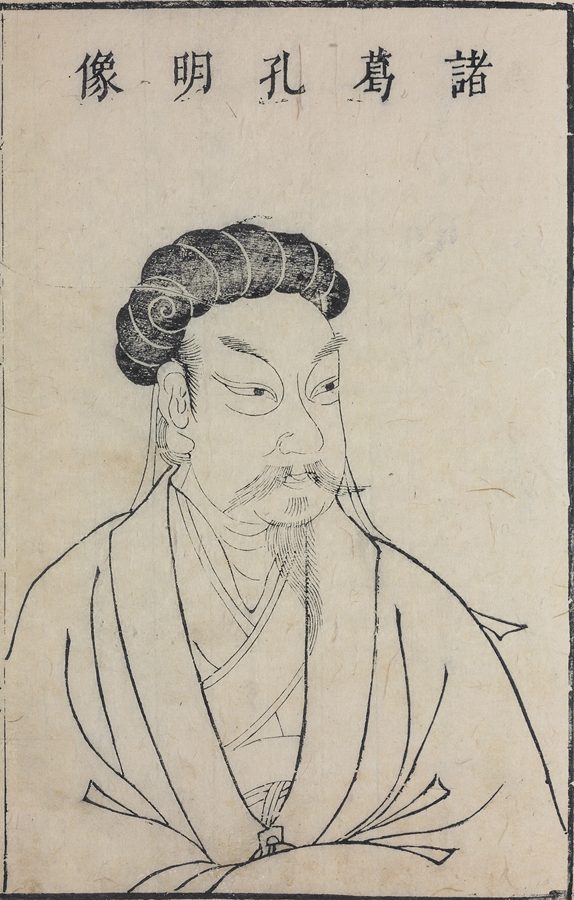
Key Facts
- Lived: 181–234, dying at the age of 53
- Courtesy name: Kongming (孔明)
- Known as: the Sleeping Dragon (Wolong, 卧龙)
- Office: Chancellor of Shu Han from 221; in effect regent after 223
- Titles: Marquis of Wuxiang (武乡); posthumous name Zhongwu (忠武), meaning “loyal and martial”
- Famous plan: the plan of 207 for dividing China three ways
- Famous writing: the Chu Shi Biao (出师表), his memorial of 227
- Campaigns: the southern campaign of 225; five northern expeditions, 228–234
- Death: 234, of illness on campaign at Wuzhangyuan (五丈原); buried at Mount Dingjun (定军山)
The Sleeping Dragon
Zhuge Liang was born in 181 in Yangdu (阳都), in Langya (琅琊), in what is now Shandong (山东). Orphaned young, he was raised by an uncle, with whom he moved south. After his uncle’s death, he settled at Longzhong (隆中), near Xiangyang (襄阳) in what is now Hubei (湖北), in Jing Province (Jingzhou, 荆州). There he lived quietly, farming and reading, while the empire around him fell apart.
His friends already knew him as the Sleeping Dragon, a young man of unusual promise who had taken no part in public life. The Han dynasty, founded nearly four centuries earlier by Liu Bang, was falling apart. One of the warlords dividing the empire was Liu Bei (刘备), who claimed descent from the Han emperors but held no land, and he was looking for a strategist.
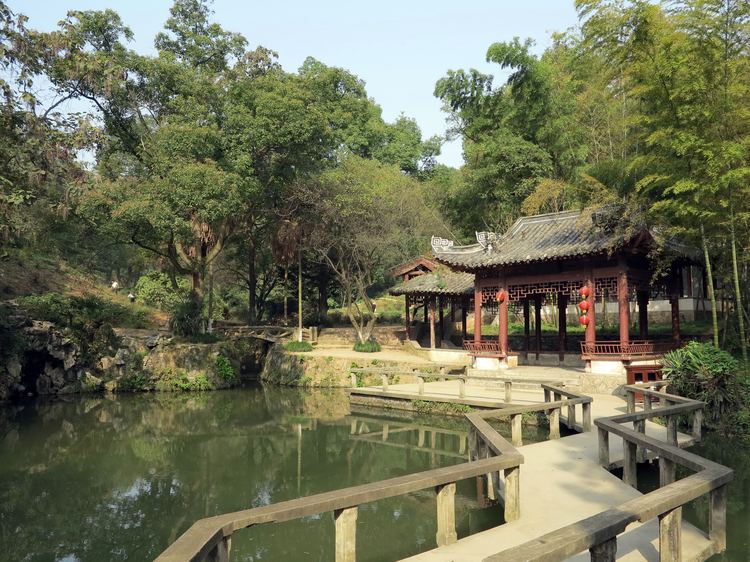
In 207 Liu Bei visited Longzhong three times to ask Zhuge Liang to join him — the famous Three Visits (San Gu Maolu, 三顾茅庐), the story of a lord humbling himself three times before a recluse. The history records them in a single sentence: Liu Bei went three times, and at last met him. The famous details — the snow, the long waits at the gate — come from later retelling.
What passed between them became the Longzhong Plan. Zhuge Liang told Liu Bei that the empire would divide three ways: Cao Cao held the north and could not be challenged directly; Sun Quan (孙权) held the south-east and should be an ally; Liu Bei should take Jing Province and Yi Province (Yizhou, 益州), build a secure base, and advance north on two routes to restore the Han. The account comes from the Records of the Three Kingdoms (Sanguozhi, 三国志), written by Chen Shou (陈寿) in the third century — the history closest to the events, and the source this article follows wherever the later novel disagrees with it.
Red Cliffs and Yi Province
The plan was tested within a year. In the autumn of 208 Cao Cao marched south with a great army. Liu Bei fled towards the Yangtze, and sent Zhuge Liang to Sun Quan to seek an alliance. Zhuge Liang argued that the two weaker sides must stand together or fall separately, and Sun Quan agreed. The two sides met Cao Cao’s fleet at Red Cliffs (Chibi, 赤壁) in the winter of 208–209.
Sun Quan’s commander, Zhou Yu (周瑜), led the allied fleet. The allies destroyed Cao Cao’s fleet with a fire attack, driving burning ships into his anchored vessels, and disease was already spreading through Cao Cao’s northern troops, unused to the southern climate. Cao Cao claimed to have led 800,000 men; historians put the real figure far lower, at roughly 220,000 including non-combatants and recently surrendered troops, against about 50,000 allies. The victory fixed the division of China into the Three Kingdoms. Zhuge Liang’s part in it was the alliance, not the battle: the history gives him no command at Red Cliffs, and the novel’s famous tricks belong to the novel alone.
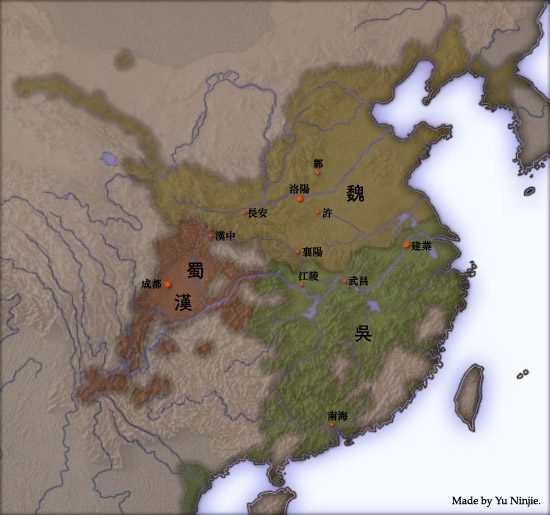
Red Cliffs gave Liu Bei his chance in the west. In 212 he entered Yi Province, and in 213 he turned against its governor, Liu Zhang (刘璋). Zhuge Liang joined the campaign later, travelling up the Yangtze with Zhang Fei (张飞) and Zhao Yun (赵云). Chengdu (成都), the capital of Yi Province, surrendered in 214. Pang Tong (庞统), one of Liu Bei’s best advisers, was killed in the fighting. Zhuge Liang’s role in the conquest itself was second to Liu Bei’s; his work began once the province was won.
In 219 Liu Bei took Hanzhong (汉中) from Cao Cao, and in the same year his general Guan Yu (关羽) lost Jing Province to a surprise attack from Wu; he was captured and executed soon after. In 221, after Cao Cao’s son had forced the last Han emperor to abdicate, Liu Bei declared himself emperor of Shu Han. A year later his attack on Wu ended in defeat at Yiling (夷陵), also called Xiaoting (猇亭), at the hands of the Wu commander Lu Xun (陆逊). Liu Bei never recovered from the defeat.
The Entrusted Minister
Liu Bei died at Baidi City (白帝城) in 223, where he had retreated after the defeat. On his deathbed he entrusted his son and heir, Liu Shan (刘禅), who would reign until 263, to Zhuge Liang. The history records him as saying that if Liu Shan proved unfit to rule, Zhuge Liang might take the throne himself. Historians still debate what the words meant — a test of loyalty, or a frank judgement of his son. Whatever they meant, Zhuge Liang never acted on them, and never took the throne.
In 227, before his first northern expedition, Zhuge Liang sent Liu Shan the memorial for which he is best remembered, the Chu Shi Biao, his “Memorial on Sending Out the Troops”. It is plain, earnest advice to a young emperor on governing well, trusting honest officials, and keeping the purpose of the state in mind while its army was away. It contains a promise that has become one of the most quoted lines in Chinese: Ju gong jin cui, si er hou yi (鞠躬尽瘁,死而后已) — “to give everything I have until my dying day”. It is still read in China today as a statement of what a public servant owes his state.
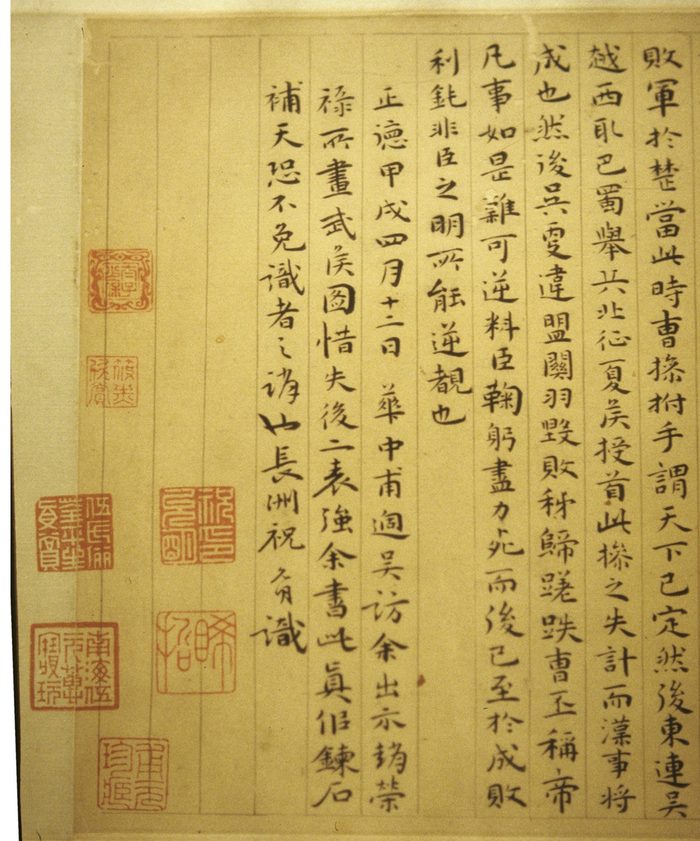
From 223 Zhuge Liang governed Shu Han in Liu Shan’s name, as Chancellor and governor of Yi Province, deciding questions of law, taxation, and war. Liu Shan remained emperor, but the decisions were Zhuge Liang’s. The arrangement depended entirely on trust, and it held for eleven years.
Governing Shu
Shu Han was the smallest of the three states, with the fewest people and the least farmland. Zhuge Liang governed it with strict, even-handed laws, applied to high and low alike. Rewards and punishments, he insisted, must be kept trustworthy: a promised reward must be paid, and a stated punishment must follow. He promoted able officials on merit, including Jiang Wan (蒋琬) and Fei Yi (费祎), who carried on the government after his death, and he lived frugally himself.
To pay for the state, he built on what Shu Han had. Workshops in Chengdu made Shu brocade, the state’s most famous product, and its sale brought in revenue. The state also controlled salt and iron, a policy going back to Emperor Wu of Han. Together they gave a small state the means to keep an army in the field year after year — the material basis for everything Zhuge Liang attempted in the north.
In 225 Zhuge Liang led an army in person to the south, to Nanzhong (南中), the far south-west in what is now Yunnan (云南), Guizhou (贵州), and southern Sichuan (四川). The region had risen under a local leader, Meng Huo (孟获). The history records that Meng Huo was captured. The famous story that he was captured seven times and released seven times is legend, not history. What the histories do record is a policy of winning hearts rather than holding the region with garrisons, and the south stayed quiet for the rest of his lifetime.
The Northern Expeditions
Between 228 and 234 Zhuge Liang led five expeditions north against Wei, through the mountain passes. His aim was that of the Longzhong Plan: to advance on Chang’an and Luoyang and restore the Han. Every expedition faced the same problems: long supply lines, a stronger enemy, and a small state that could not afford a long war. None of them reached its goal.
The first, in the spring of 228, began well and ended in defeat at Jieting (街亭), where his general Ma Su (马谡) disobeyed orders and lost the position guarding the army’s route. Zhuge Liang had Ma Su executed and accepted demotion for his own error in choosing him. A second expedition followed in the winter of 228, and a third in 229, when the fortress town of Chencang (陈仓) held out under its defender, Hao Zhao (郝昭). Each time, the Shu army withdrew in good order, having gained little.
The fourth, in 231, fought around Mount Qi (Qishan, 祁山). When supplies ran low, Zhuge Liang withdrew, and the pursuing Wei general Zhang He (张郃) was killed in an ambush. The fifth and last, in 234, ended in stalemate on the Wuzhangyuan plain, where Sima Yi (司马懿) refused to give battle. Zhuge Liang fell ill in camp and died there, in the autumn of 234, at the age of fifty-three. His army withdrew in secret, carrying his body home.
The wooden ox and the flowing horse, said to be transport devices that carried grain through the mountains, are best read as legend, not engineering: no reliable design survives. The Eight Arrays (Bazhen, 八阵), a battle formation attributed to him, belongs to the same world of later legend, not to any proven system of war. Five expeditions, then, not six: the popular saying “six outings from Qishan” is a storyteller’s count, not a historical one. The famous tale that a dead Zhuge Liang frightened away the living Sima Yi is a story, not a report — though it shows what his enemies thought of him.
The Novel and the History
The history closest to Zhuge Liang’s life is the Records of the Three Kingdoms, written by Chen Shou in the third century, with the detailed annotations added by Pei Songzhi (裴松之) in the fifth century. Together they portray a hard-working, careful, and sometimes unsuccessful statesman. The novel that most people know is the Romance of the Three Kingdoms (Sanguo Yanyi, 三国演义), written by Luo Guanzhong (罗贯中) in the fourteenth century. The novel takes Liu Bei’s side and turns Zhuge Liang into something close to a sage: a man who never miscalculates and never doubts.
Three of the novel’s most famous scenes about him have no record in the history at all. In the novel, he borrows 100,000 arrows from Cao Cao’s army with straw boats in the fog; he borrows the east wind for the fire attack at Red Cliffs; and he saves a city with the Empty City Stratagem, sitting alone on the walls playing music while Sima Yi’s army turns away. None of these appears in Chen Shou’s history: the fire attack was Zhou Yu’s, the wind was the season’s, and the empty city is a storyteller’s invention.
The seven captures of Meng Huo belong to the same world: legend, not history. So does the saying that he was “wise almost to the point of sorcery”, a product of the novel and the opera stage rather than of the historical record. By the Tang dynasty, poets were writing verses about the loyal minister who gave everything and died on campaign, and by the Song dynasty, storytellers were performing tales of the Three Kingdoms in the cities. The legend grew because the history deserved it — but the two are not the same.
Death and the Shrine
Zhuge Liang died at Wuzhangyuan in 234 and was buried at Mount Dingjun, in present-day Shaanxi (陕西). Shu Han itself fell in 263, less than thirty years after his death, when Wei armies took Chengdu. In 266 the Sima family replaced Wei with the Jin dynasty. The division he had planned, and the state he had held together, were gone within a generation.
In Chengdu, the Wuhou Shrine (Wuhou Ci, 武侯祠) keeps his memory alive. Wuhou, “Marquis Wu”, comes from his posthumous title. It was later joined to the temple and tomb of Liu Bei, so lord and minister are honoured together. The buildings standing today are mostly Ming and Qing rebuilds, but people have honoured his memory there for many centuries.

Summary
Zhuge Liang was not the magician of the novel. He was a Chancellor who governed a small state honestly, kept its laws firm and its promises trustworthy, and led its armies north five times against the odds. He failed to restore the Han, and the state he served fell within thirty years of his death. What lasted was the example: the minister who gave everything until his dying day, and never took the throne he could have seized. The legend made him a sage. The history made him something rarer — a good servant of a lost cause, remembered for it ever since.
Read more: Chinese Dynasty Timeline