

Every Chinese history book begins its list of dynasties with the Xia (about 2070 – 1600 BC). According to the traditional account, the Xia was founded by Yu (禹), called Yu the Great, the hero who tamed China’s floods, and it ended some 470 years later when its last king, the tyrant Jie (桀), was overthrown by Tang (汤), founder of the Shang dynasty. It is a complete, satisfying story – and not one word of it can be confirmed by anything written at the time.
That is what makes the Xia unique. For the Shang and every dynasty after it, we have evidence from the age itself: inscriptions, tombs, ruins. For the Xia we have only histories written many centuries later, above all Sima Qian’s (司马迁) account, and archaeology. Twentieth-century scholars even concluded that the Xia was pure legend – until archaeologists uncovered Erlitou (二里头), a great Bronze Age city in exactly the region where tradition placed the Xia, flourishing at roughly the right time. Many Chinese scholars identify Erlitou with the Xia; many others reply that, without writing, this can never be proved. This article tells both stories – what the histories say, and what the ground says – and keeps them apart.
The Xia also stands at a border: behind it, the legendary sage-kings – the world of the Yellow Emperor and of Yao (尧) and Shun (舜); ahead of it, documented history. It is where China’s story of itself begins.
Key Facts
- Traditional dates: about 2070 – 1600 BC. These dates rest on later texts and modern chronology projects, not on contemporary records.
- Preceding period: the legendary age of the sage-kings Yao and Shun.
- Subsequent dynasty: Shang, c. 1600 – c. 1046 BC – the first Chinese dynasty confirmed by writing from its own time.
- Founder, in the traditional account: Yu the Great, the tamer of the floods.
- Kings, in the traditional account: 17, from Yu to Jie – a list recorded many centuries later.
- Final king, in the traditional account: Jie, remembered as a cruel tyrant, overthrown by Tang of Shang at the Battle of Mingtiao (鸣条), about 1600 BC.
- The evidence position: no writing from the Xia period has ever been found; the case rests on later texts and on archaeology, above all Erlitou.
The Legend of Yu the Great
In the traditional account, China was ruled before the dynasties by sage-kings who chose their successors by merit. Yao passed over his own unworthy son and gave the throne to Shun, the most virtuous man in the realm; Shun in turn would pass it to Yu. This custom is called shanrang (禅让) – abdication in favour of the worthiest – later mourned as a lost golden age.
In Shun’s time, the histories say, the land was drowning. Great floods covered the fields, and Shun ordered Yu’s father, Gun (鲧), to control the waters. Gun worked for nine years, building dams and dykes to hold the rivers back – and failed; the histories say he was executed or banished. The task passed to his son.
Yu, the story goes, succeeded by doing the opposite: instead of blocking the waters, he dredged channels to lead them to the sea. For thirteen years he travelled the flooded lands, guiding rivers and cutting through hills, with such single-mindedness that he passed the door of his own home three times without going in. When the waters drained away, a grateful people accepted Yu as their leader, and Shun yielded the throne to him.
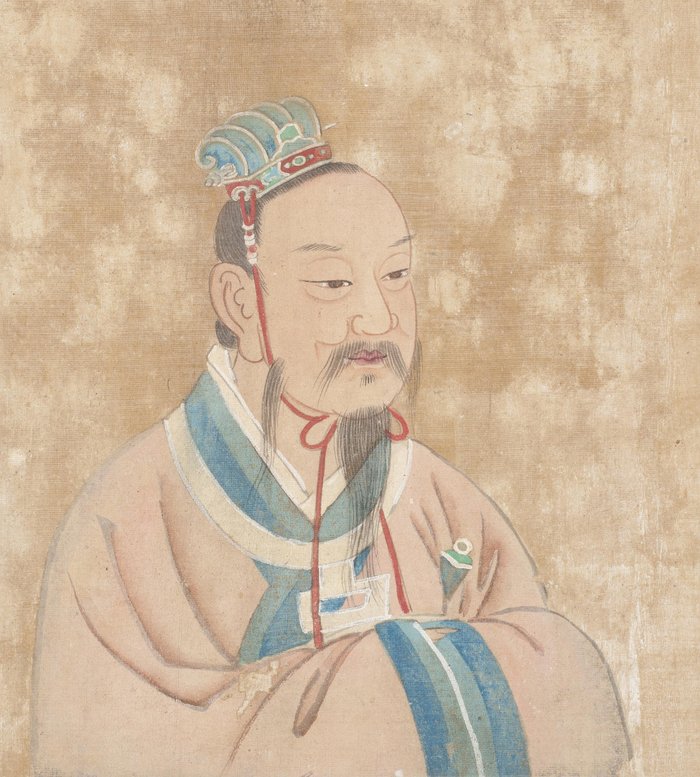
The decisive moment came after Yu’s death. By the old custom, the throne should have gone to the worthiest minister. Instead it went to Yu’s own son, Qi (启) – whether by Yu’s design or Qi’s strength, the histories differ in emphasis but agree on the result. Rule now stayed inside one family, passing from father to son: later ages saw this as the invention of dynastic government itself. And Yu’s reputation only grew; Confucius, more than a thousand years later, said that in Yu he could find no flaw – for Confucius and Confucianism, Yu was already an ancient and perfect hero.
The Xia Kings in the Traditional Account
Sima Qian’s Records of the Grand Historian (Shiji, 史记), written under the Han dynasty around 90 BC, gives the Xia a full royal genealogy: 17 kings across some 470 years. For most of them the histories preserve little more than names – a warning in itself, since a bare list is both what a later age could construct and what genuine old records might shrink to.
The first crisis, the histories say, came under Qi’s son Taikang (太康), a king who loved hunting more than governing. Whilst he was away hunting, the archer Hou Yi (后羿) seized the capital – ‘Taikang losing his state’. Hou Yi was himself overthrown by his minister Han Zhuo (寒浊), and for a generation the Xia line survived only in exile, until a Xia prince, Shao Kang (少康), destroyed Han Zhuo and restored the dynasty: the dynasty lost and won back, like a rehearsal for later Chinese history.
Of the middle centuries the traditional account says almost nothing: the capital moved among the valleys of western Henan and southern Shanxi, and king succeeded king without recorded incident. Then comes Jie, the final king, portrayed as a monster of cruelty and extravagance – the precise mirror image of the selfless Yu. Such portraits should be read with care: later ages told the same stories, in almost the same words, about Di Xin (帝辛), the last king of Shang, and modern historians suspect both tyrants were blackened by the dynasties that replaced them.
Jie’s nemesis, in the traditional account, was Tang, lord of the Shang people, who defeated him at the Battle of Mingtiao, in about 1600 BC. Jie fled into exile, and the Xia was finished. Later ages treated this as the first case of a great principle: misrule forfeits Heaven’s approval. That principle – the Mandate of Heaven – was only worked out by the Zhou dynasty after its own conquest of Shang, and then read back onto Jie’s fall: the Xia did not hold the doctrine; later ages used the Xia to illustrate it.
Did the Xia Really Exist?
The problem can be stated in one sentence: nothing written during the Xia period has ever been found. The earliest Chinese writing known is the oracle bone script of the late Shang, from about 1250 BC, centuries after the Xia supposedly ended. No excavated inscription names the Xia, a Xia king, or a Xia capital. Everything said about the Xia above comes from texts written down in the Zhou and Han dynasties, centuries or more after the events. How such traditions were preserved is a story in itself: the long history of how history was recorded in ancient China.
There is a strong argument that the late texts deserve trust. When the oracle bones of the Shang were deciphered in the early twentieth century, the kings they named matched Sima Qian’s Shang king list almost exactly – proof that the historian, writing under the Han dynasty long after the Shang fell, had access to genuinely ancient records. If his Shang list was real, why not his Xia list too? Against this stands a simple difference: the Shang list could be tested against the bones, and passed. The Xia list cannot be tested at all – the oracle bone script is silent about anything before the Shang itself.
In the 1920s a group of Chinese scholars known as the Doubting Antiquity school went further. Their leader, Gu Jiegang (顾颉刚), argued that China’s ancient history had been built up layer by layer, each age pushing its invented origins further into the past – and he suggested that Yu himself might originally have been not a man but a creature pictured on ancient ritual vessels. The argument caused outrage, but it posed a fair challenge: if the texts could not settle the question, perhaps the spade could.
Erlitou – The City Archaeologists Found
In 1959 the historian Xu Xusheng (徐旭升) led an expedition into the valleys west of Luoyang, in Henan, deliberately hunting for the ‘ruins of Xia’ that old texts placed in that region. Near the village of Erlitou his team found a large Bronze Age city: archaeology setting out to test a legend, and finding something worth sixty years of argument.
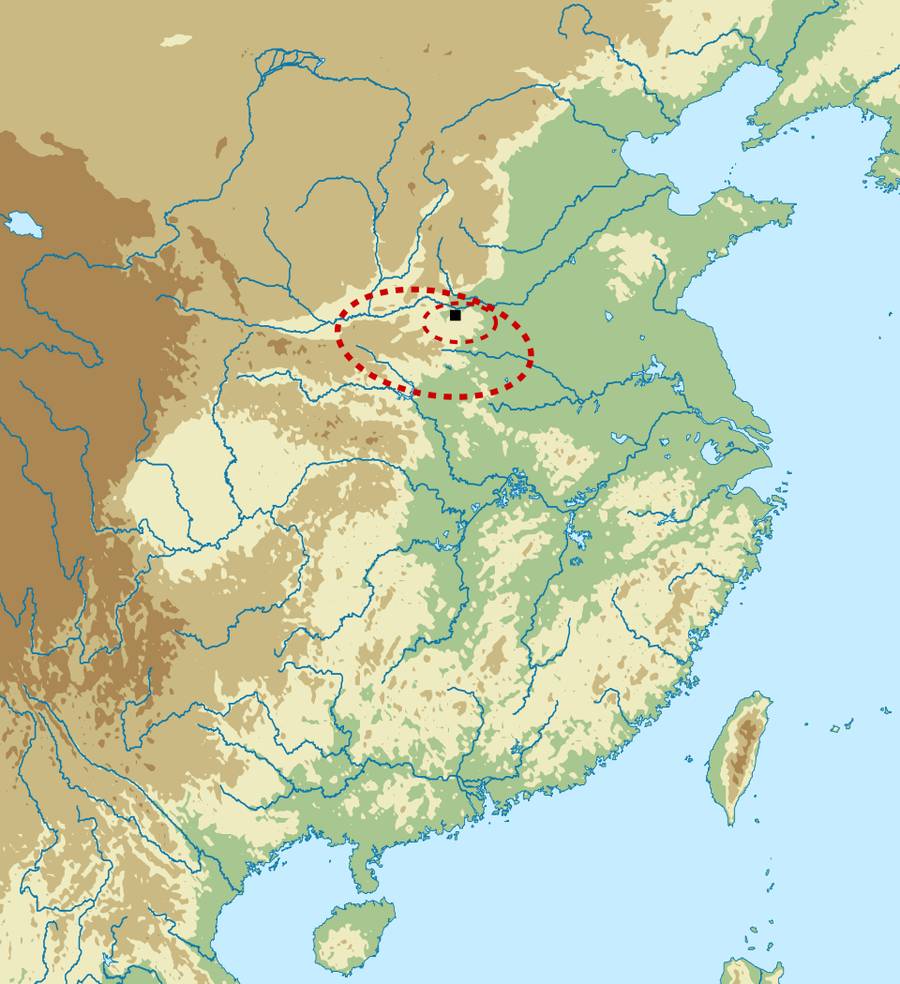
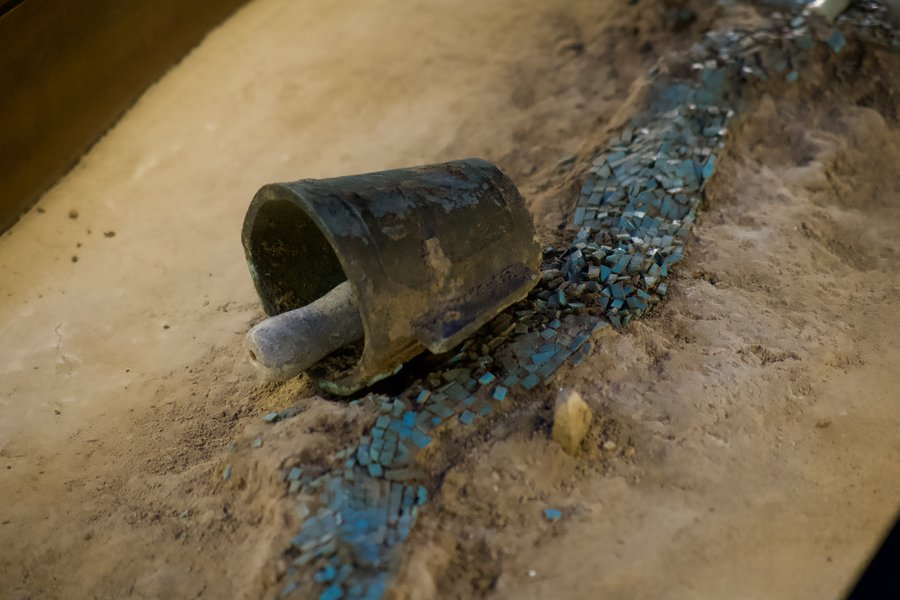
At its height it covered about 300 hectares – China’s largest settlement of its time – on the plains of the loess country south of the Yellow River. It had a grid of roads, workshop quarters, and a palace district of two great walled compounds, their halls on rammed-earth platforms, the largest about a hectare. South of the palaces stood a bronze-casting foundry and a turquoise workshop. This was no village culture; it was a royal capital of some kind.
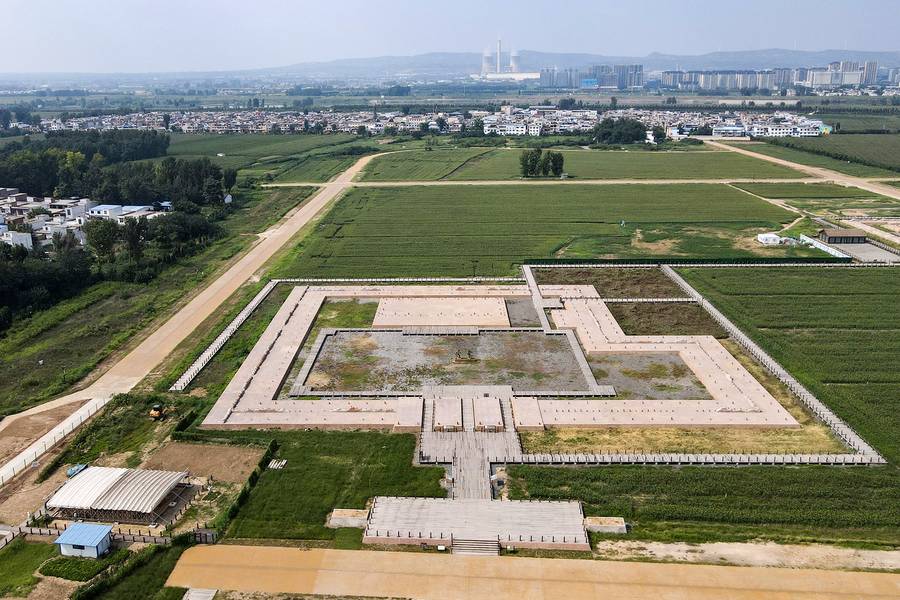
The dating fits – roughly. Erlitou is usually dated to about 1900 – 1500 BC, though recent radiocarbon studies argue for a tighter span of about 1750 – 1530 BC; the dates are still debated. Either range overlaps the traditional dates of the later Xia, and the location matches the region of the Xia capitals in later texts – one, Zhenxun (斟鄩), was traditionally placed near Erlitou itself. On this basis, most Chinese archaeologists identify Erlitou as a Xia capital.
Many scholars outside China are more cautious: everything at Erlitou proves a powerful, bronze-using state existed in the right place at roughly the right time, but nothing there says what it was called. Without a single written word, ‘Xia’ is a name supplied by texts written a thousand years later, not recovered from the ground. These scholars prefer to speak of the ‘Erlitou culture’, which may or may not be the Xia of tradition. Both sides agree that before 1500 BC this valley held China’s largest, most organised society yet.
Read more: Top 10 Capital Cities of Ancient China
Art and Culture in the Xia Age
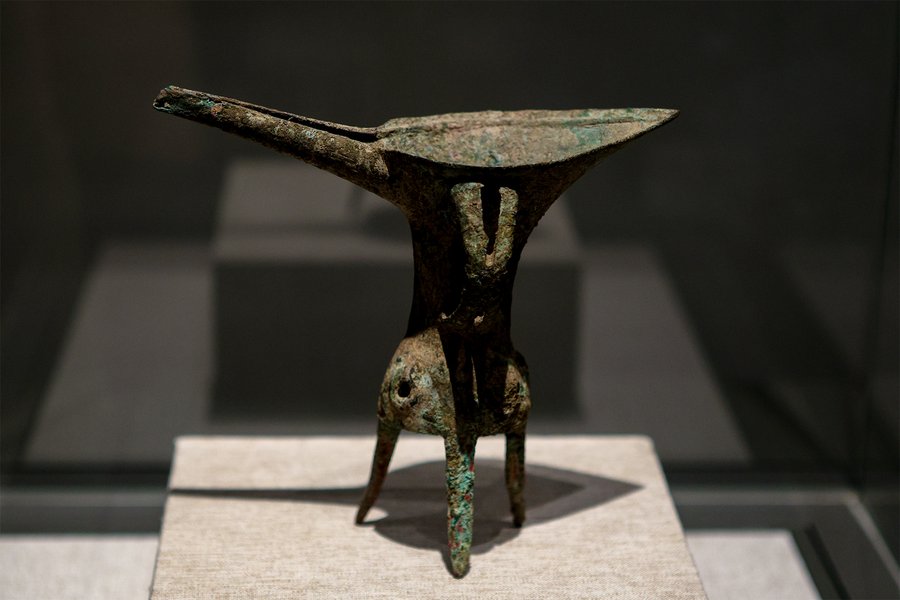
Because nothing written survives, the culture of this age has to be read from its objects – which means, in practice, the culture of Erlitou and its world. Its greatest achievement was bronze. In the Erlitou foundry, craftsmen cast some of the earliest bronze ritual vessels in China: thin-walled wine cups called jue (爵), together with bells, mirrors and weapons. The casting was simpler than the great Shang bronzes that followed, but the idea was already there – bronze served ceremony first, not tools or war. China’s Bronze Age begins in workshops like this one.
The elite of this world prized jade and turquoise as much as bronze. Great ceremonial jade blades, called zhang (璋), were cut to a size far beyond any practical use; turquoise was inlaid into bronze plaques shaped as animal masks, a first sketch of designs the Shang would make famous. Beneath the palaces lay the ordinary economy: millet on the loess, rice in the wetter lowlands, herds of pigs, cattle and sheep. Later tradition also credited the Xia with a calendar of its own, whose year was said to begin in a different month from those of Shang and Zhou – a claim that, like everything else about the Xia, comes from later texts.
Religion and Belief in the Xia Age
Of religion in this age almost nothing can be said directly, because religion leaves its clearest evidence in words, and there are no words. What archaeology allows is this: the rulers of Erlitou buried their elite dead with rich grave goods – bronzes, jades, turquoise ornaments – implying belief in an afterlife; and they cast vessels whose whole purpose was ceremony, most plausibly offerings of food and wine to ancestors or spirits. Something like the ancestor-centred religion of the Shang was probably taking shape. But the developed Shang system – named royal ancestors, oracle bone divinations, the supreme god Shangdi (上帝) – is documented only for the Shang, and it would be a mistake to read it back into the Xia age as fact.
Whatever the Xia age itself believed, later China turned its supposed founder into an object of worship. Yu was honoured for three thousand years as the patron of flood control – the worker-hero who saved the world from the waters and asked nothing for himself. Tradition says he was buried near Shaoxing (绍兴), where his mausoleum is still a place of pilgrimage. The cult is real, and ancient; what it proves is not the flood, but the power of the story.
The Fall of the Xia
As a story, the fall of the Xia has already been told above: Jie the tyrant, Tang the virtuous rebel, the defeat at Mingtiao in about 1600 BC. It is the pattern Chinese history would repeat for three and a half thousand years, and precisely this neatness makes historians cautious: real endings are rarely so tidy.
What the ground shows is slower and less theatrical, but recognisably a changing of the guard. Around 1600 – 1500 BC Erlitou shrank: the palaces were abandoned, the foundry fell silent, and the site dwindled into an ordinary settlement. In the same centuries, just a few kilometres east, a new power was rising: the walled city at Yanshi (偃师), which archaeologists identify as an early Shang capital. Power passed from one centre to another at almost exactly the time, and in exactly the place, where tradition says Tang overthrew the Xia. That is not proof of the Battle of Mingtiao – but behind the tidy story stands a real event: an old capital fading, and a new one rising.
Summary
The Xia is the first dynasty in every Chinese history book and the only one that may not have existed – at least, not in the form the books describe. Its kings, dates and dramas all come from texts written centuries later; no written word from its own age tests them. Against the scepticism stands Erlitou: a genuine Bronze Age capital, in the right place, at roughly the right time – claimed by Chinese archaeology for the Xia, and left unconfirmed by much of world scholarship.
In a sense, the argument misses what the Xia has already done. The template of Chinese kingship – the selfless founder, the hereditary line he establishes, the tyrant who loses the realm to a worthier man – was fixed in the Xia story before any other dynasty existed to copy it, and every later dynasty told its own story in that shape. The search for the Xia also helped create Chinese archaeology: scholars hunted a legend and came back with knowledge of the Bronze Age. Whether or not Yu ever dredged a river, the first dynasty remains the point where China’s memory of itself begins.
Read more: Ancient Chinese Dynasty Timeline