
In the middle of the nineteenth century, Britain and China fought two wars over trade, law and a drug. The first began in 1839, when the Qing official Lin Zexu (林则徐) seized and destroyed the opium held by British merchants on the China coast. The First Opium War lasted from 1839 to 1842, and the Second Opium War from 1856 to 1860. They are known in English as the Opium Wars because opium stood at the centre of the dispute, but the wars were about more than a drug. They were about how China would deal with the outside world, and on whose terms. The settlements that ended them, the Treaty of Nanjing in 1842 and the Convention of Beijing in 1860, set the terms of China’s dealings with the outside world for the next hundred years.
The two sides saw the conflict in very different ways. The British government argued that it was defending free trade, the rights of its merchants and the principle that nations should deal with each other as equals. The Qing court held that it was enforcing its own laws, defending its sovereignty and protecting its people from a harmful drug. Both views shaped what happened, and this article keeps both in view.
When the wars began, China was ruled by the Qing dynasty, and its goods — silk, porcelain and above all tea — were wanted all over the world. For centuries Chinese goods had travelled west along the routes of the Silk Road, and by the eighteenth century European ships carried them home by sea. Yet foreign trade was kept under strict control, and that control was the background to everything that followed.
Key Facts
- First Opium War: 1839–1842
- Second Opium War: 1856–1860
- The two sides: Qing China against Britain; France joined the second war
- Spark of the first war: the seizure and destruction of smuggled opium in 1839
- Spark of the second war: the Arrow incident of October 1856
- First settlement: the Treaty of Nanjing, signed on 29 August 1842
- Second settlement: the treaties of 1858 and the Convention of Beijing, 1860
- Territory ceded: Hong Kong Island in 1842; Kowloon in 1860
- Outcome: treaty ports opened to foreign trade; the opium trade legalised; Hong Kong under British rule until 1997
A Trade Out of Balance
By the early nineteenth century, Britain had developed a great thirst for Chinese tea. Tea, silk and porcelain flowed out of China, and silver flowed in to pay for them. The trade was confined to a single port, Guangzhou (广州), known to Europeans as Canton. Foreign merchants were not allowed into the city itself: they lived and worked in a small factory quarter outside the walls, and all their dealings passed through the Cohong (公行), the guild of licensed Chinese merchants known as the Thirteen Hongs (十三行). Foreign relations, meanwhile, were handled through the tribute system, in which foreign rulers sent missions bearing gifts and were received as lesser partners of the Chinese emperor.
The system worked, but it troubled the British. Their merchants chafed at being confined to one port and at having no direct contact with Chinese officials. The British government, for its part, wanted diplomatic relations between equals, with an ambassador living in Beijing. The Qing court saw no reason to change arrangements that had served China well. To the court, the foreigners were traders who should follow Chinese rules while they were in China. British merchants also disliked the ceremonies of the system, which received foreign envoys as tribute-bearers rather than as equals.
The balance of the trade itself was changing. British traders found a product that Chinese buyers wanted in large quantities: opium, grown in British India and sold at auction in Calcutta. Private traders carried it to the China coast, where it was smuggled ashore in defiance of imperial edicts that had banned the drug from 1729 onward. By the late 1830s the imports ran to tens of thousands of chests a year, and the flow of silver had turned around: silver now drained out of China to pay for the drug. Addiction spread widely, and the trade in opium became the largest single branch of the commerce between the two countries.
Lin Zexu and the Crackdown
In March 1839 the Daoguang (道光) Emperor sent a new official to Guangzhou with orders to end the opium trade. He was Lin Zexu, a respected scholar-official known for his honesty and his hard line against the drug. Lin demanded that the foreign merchants hand over all the opium in their hands. The British superintendent of trade, Charles Elliot, ordered the merchants to surrender it, promising that the British government would compensate them. The merchants gave up their stocks.
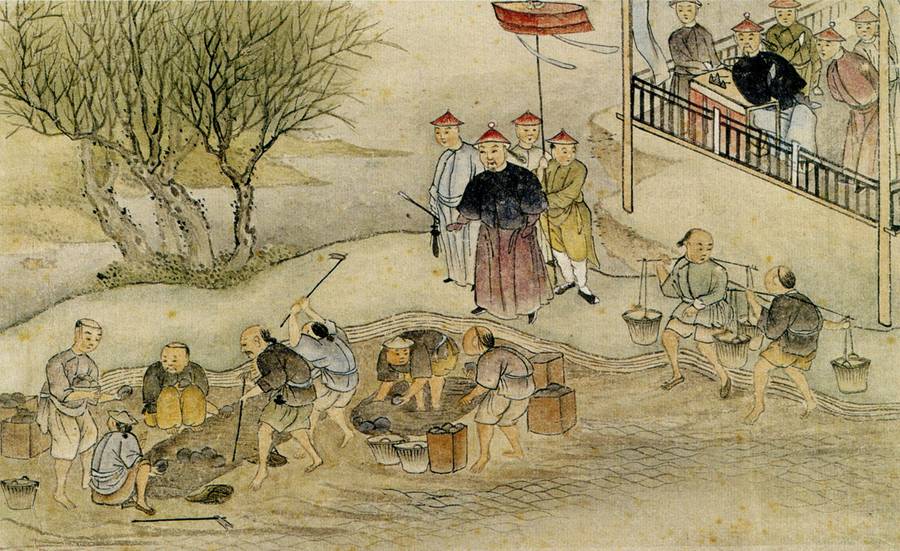
In June 1839 the seized opium — more than 20,000 chests — was destroyed at Humen (虎门), at the mouth of the Pearl River, mixed with salt and lime in trenches and washed out to sea, watched by Lin and his officials. It was a public act of law enforcement, and Lin meant it to be seen as one. He also wrote a letter to Queen Victoria setting out the Chinese case against the trade; whether it ever reached her is uncertain.
The seizure settled nothing. The British merchants demanded compensation for their losses, and the British government, which had promised to pay them, now had a claim against China. Tensions rose further in July 1839, when a Chinese villager, Lin Weixi (林维喜), was killed in a brawl with British sailors, after which Elliot refused to hand over the men suspected of the killing. Both sides were now locked in a dispute that neither knew how to settle without losing face.
The First Opium War
The first shots were fired in November 1839, when British warships clashed with Chinese forces at Chuenpi (穿鼻), at the mouth of the Pearl River. The British Foreign Secretary, Lord Palmerston, decided that China must pay for the seized opium and open its ports, and in 1840 he sent an expeditionary force. In July 1840 the force took Dinghai (定海) on the island of Zhoushan (舟山), off the east coast. A draft settlement, the Convention of Chuenpi, was agreed in January 1841, but it was repudiated by both governments, and the fighting went on.
In May 1841 British forces threatened Guangzhou, and the city paid a ransom of 6 million silver dollars to avoid an attack. The expedition then moved up the coast, taking Xiamen (厦门) and Ningbo (宁波), and then Shanghai. In July 1842 it fought a hard battle at Zhenjiang (镇江), on the Yangtze, and then moved against Nanjing, the great city on the river’s southern bank. The Qing court, faced with a force it could not stop, agreed to negotiate.
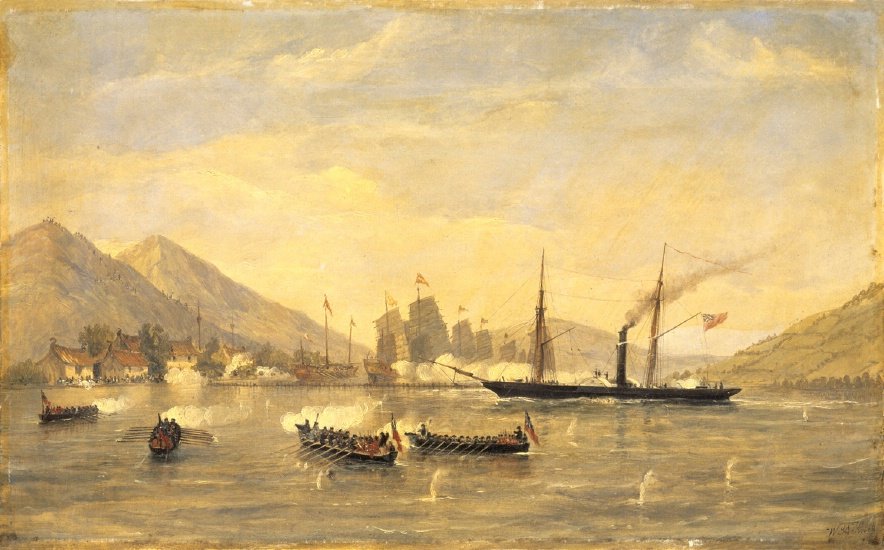
The war showed a wide gap in military technology. The clearest example was the iron paddle-steamer Nemesis, which arrived in 1841. With her shallow draft she could enter rivers and creeks that no sailing warship could reach, and her guns outmatched the Chinese war junks and shore batteries. Chinese soldiers fought bravely in several battles, but their weapons and ships belonged to an earlier age, and the British fleet could strike almost anywhere along the coast.
The Treaty of Nanjing
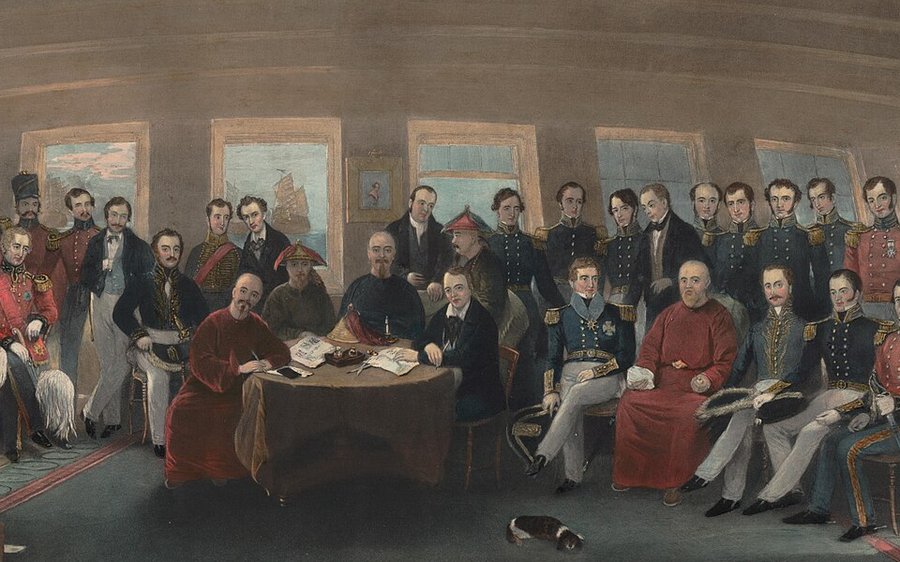
The Treaty of Nanjing was signed on 29 August 1842, aboard the British warship HMS Cornwallis anchored off Nanjing. Under its terms, the island of Hong Kong was ceded to Britain “in perpetuity”. Five ports were opened to British trade and residence: Guangzhou, Xiamen, Fuzhou (福州), Ningbo and Shanghai. China agreed to pay an indemnity of 21 million silver dollars, and tariffs were to be fixed by agreement between the two sides. The treaty said nothing about opium, and the trade went on.
A supplementary treaty, signed at the Bogue (Humen) in October 1843, added two provisions that mattered greatly. The first was extraterritoriality: British subjects in China would be tried under British law, not Chinese law. The second was the most-favoured-nation clause: any privilege China granted to another country would automatically extend to Britain. Other Western powers soon signed treaties on similar terms.
In later years these agreements came to be known in China as the “unequal treaties” (bupingdeng tiaoyue, 不平等条约). The label came into common use later, and it was not a term used at the time; but it captures how the treaties were afterwards seen in China, as agreements imposed by force, which China had not freely chosen. For Britain, the treaties were the legal foundation of a new trading relationship. The two readings have lived side by side ever since.
An Uneasy Peace
The settlement satisfied neither side. The British wanted more: above all, they wanted their merchants and officials admitted to the city of Canton itself, which the treaty had left closed to them. The Qing authorities in Guangzhou resisted, and through the 1840s British demands for entry were put off again and again. British traders complained that the treaties were not being honoured; Chinese officials complained that the foreigners kept pressing for more than the treaties allowed. Trade, meanwhile, went on growing, and the open ports grew into busy centres of foreign commerce.
At the same time, the Qing state was under strain from within. The Taiping Rebellion, which broke out in 1850 and lasted until 1864, shook the empire and absorbed the energies of the court. By the mid-1850s both Britain and France wanted the treaties revised in their favour, and the incident that gave them an opening came in the autumn of 1856.
The Second Opium War
On 8 October 1856 Chinese officials boarded a small trading vessel, the lorcha Arrow, in Guangzhou harbour and arrested 12 Chinese crew members as suspected pirates. The British consul, Harry Parkes, demanded an apology and the men’s release, arguing that the Arrow was a British-registered ship and that the boarding had insulted the British flag. The facts were disputed: the ship’s British registration had expired days earlier, a detail that only emerged later, and the two sides never agreed on what the boarding had meant. When the Qing authorities refused to apologise, British warships bombarded Canton.
In London, Parliament criticised the bombardment, but Palmerston, now Prime Minister, defended the action and won a general election in 1857 fought largely on the issue. France joined the war, giving as its stated reason the murder of the French missionary Auguste Chapdelaine in Guangxi (广西) in February 1856. In December 1857 Anglo-French forces occupied Guangzhou, and the Governor-General, Ye Mingchen (叶名琛), was captured and exiled to Calcutta, where he died in 1859.
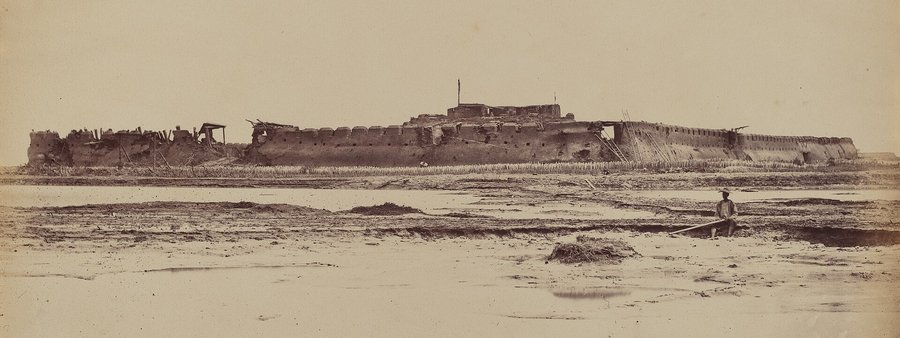
In June 1858 the Treaties of Tianjin (天津) were signed. They opened more ports to foreign trade, allowed foreign envoys to live in Beijing, opened the Yangtze to foreign trade, and legalised and taxed the opium trade. But the settlement did not hold. In June 1859 an allied fleet on its way to Beijing was repulsed at the Dagu (大沽) forts, at the mouth of the river leading to the capital, with heavy losses.
In 1860 a larger Anglo-French force returned, took the Dagu forts in August and advanced on Beijing. During negotiations at Tongzhou (通州), allied envoys were seized, and several died in captivity. The Xianfeng (咸丰) Emperor fled to Chengde (承德), leaving his brother Prince Gong (Yixin, 奕訢) to negotiate with the allies.
The Burning of the Summer Palace
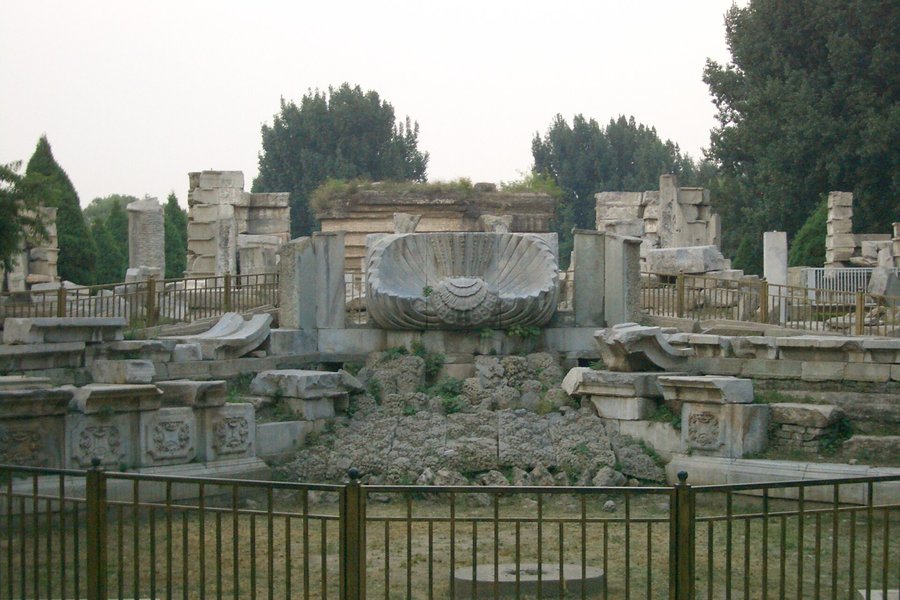
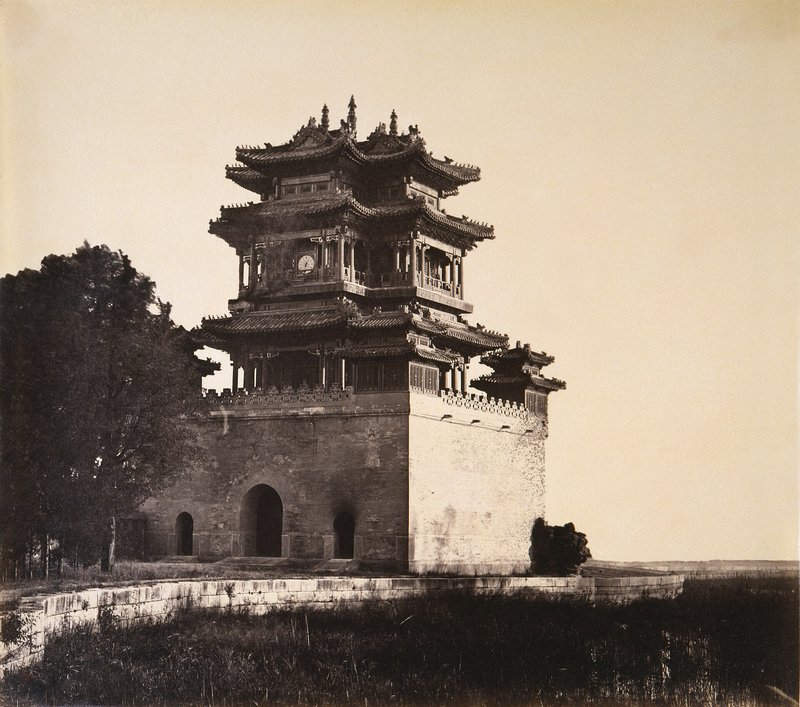
Before the negotiations were finished, the allies turned to the Old Summer Palace (Yuanmingyuan, 圆明园), the vast garden-palace of lakes, pavilions and halls north-west of Beijing, built up over 150 years under the Kangxi (康熙) and Qianlong (乾隆) emperors. French troops had already looted the palace, carrying off treasures, many of which are now in museums and private collections outside China.
On 18–19 October 1860 Lord Elgin, the British plenipotentiary, ordered the palace to be destroyed by fire, as punishment for the treatment of the allied envoys. French forces declined to take part in the burning. The decision was controversial even in Britain, where it was criticised in Parliament. The fire burned for days, and the palace was left in ruins.
The Convention of Beijing, signed in October 1860, closed the war. The Kowloon Peninsula south of Boundary Street was ceded to Britain, and Tianjin was opened as a treaty port. China agreed to pay indemnities of 8 million taels of silver to each of Britain and France. Foreign legations were permitted in Beijing, the legal status of the opium trade was confirmed, and the emigration of Chinese labourers was permitted.
Consequences
The two wars changed China’s place in the world. The treaty-port system spread along the coast and up the Yangtze, and foreign merchants, missionaries and officials settled in the open ports. The Maritime Customs, which collected the tariffs agreed in the treaties, came under a foreign inspectorate, headed from 1863 by the Irishman Robert Hart.
The wars also changed China from within. The Qing court, shocked by defeat, began the Self-Strengthening Movement of the 1860s to 1890s, an attempt to learn Western military and industrial techniques while keeping Chinese institutions intact. Hong Kong remained under British rule until 1997. The opium trade, now legal and taxed, continued, and addiction continued to spread.
In later years the Opium Wars came to be remembered in China as the start of a “century of humiliation”, a later framing that looks back on the period from 1839 to 1949 as one of foreign intrusion and national weakness. Whatever the framing, the facts of the settlement are plain: the wars ended China’s long seclusion and began a new and unequal relationship with the outside world, in which the terms of trade and diplomacy were set by treaty rather than by the Chinese court alone. Their memory still shapes Chinese views today.
Summary
For twenty years, from 1839 to 1860, the question of how China would trade and deal with the outside world was settled by force. The opium trade lit the fuse, but the wars were fought over the terms on which two very different systems would meet. The treaties that ended them opened China’s ports, ceded Hong Kong and Kowloon, legalised the opium trade and brought foreign envoys to Beijing. China did not become a colony, but it lost control of its own tariffs and of the rules under which foreigners lived on its soil. The effects of those twenty years shaped the century that followed.
Read more: Chinese Dynasty Timeline