

For some three hundred years, China was not one country but several. While the Song dynasty ruled the centre and the south, the north was held by three states founded by peoples from beyond the old frontiers: the Liao (辽, 907–1125), founded by the Khitan (契丹); Western Xia (西夏, 1038–1227), founded by the Tangut, called the Dangxiang (党项) in Chinese sources; and the Jin (金, 1115–1234), founded by the Jurchen (女真). Each had its own emperor, its own capital and its own written language. Each claimed to rule as a rightful dynasty. Together they are the reason the history of this period cannot be told as the story of one empire alone.
One confusion must be cleared up at the start. The Jin of this article is the Jurchen Jin, the state founded by the Jurchen people in the north-east. It is not the Sima Jin (晋, 266–420), the dynasty founded by the Sima family after the fall of the Han, which has its own article on this site: the Jin dynasty. The two states share a name in English and nothing else — different peoples, different centuries, and different Chinese characters.
The three northern states were rivals of the Song, but they were not strangers to Chinese civilisation. They collected taxes, held examinations, built Buddhist temples and kept court records in Chinese as well as in their own languages. The Song fought them, paid them and traded with them, but never conquered them. In the end, all three were gone within a little over a century: Liao fell to the Jin, and Western Xia and Jin fell to the Mongols. This article tells their stories side by side — who each people were, how each state was ruled, and how each one ended.
Key Facts
- The three states: Liao, 907–1125; Western Xia, 1038–1227; Jin, 1115–1234
- The three peoples: the Khitan, the Tangut and the Jurchen
- Liao founder: Yelü Abaoji (耶律阿保机), Khitan khan in 907, emperor in 916
- Western Xia founder: Li Yuanhao (李元昊), proclaimed emperor in 1038
- Jin founder: Wanyan Aguda (完颜阿骨打), proclaimed emperor in 1115
- Capitals: Linhuang (临潢) for Liao; Xingqing (兴庆) for Western Xia; Zhongdu (中都) for Jin from 1153
- Treaties with the Song: Chanyuan (澶渊) in 1005, the settlement of 1044, Shaoxing (绍兴) in 1141
- Scripts created: Khitan, Tangut and Jurchen — each state had its own
- How they ended: Liao fell to the Jin in 1125; Western Xia fell to the Mongols in 1227; Jin fell to the Mongols in 1234
Three Peoples, Three States
China had been united before. The Sui dynasty reunified the country in 589, and the Tang dynasty ruled a great empire for nearly three centuries. But the Tang collapsed in 907, and for the next half-century China was divided among rival states. In the north, new powers took shape among peoples who had lived on the borders of the Tang world. By the time the Song dynasty, founded in 960, had reunified central and southern China, the north already had rulers of its own.
The Khitan were a people of the northern steppe, herders and horsemen who lived north of the old Tang frontier. The Tangut farmed and herded in the dry lands of the north-west, along the routes that led west to Central Asia. The Jurchen lived in the forests and river valleys of the far north-east, hunting, fishing and farming. The names Khitan, Tangut and Jurchen are the names by which these peoples are known to history.
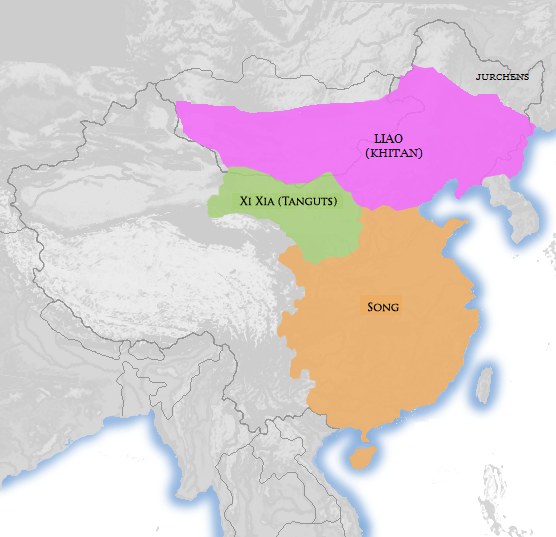
What the three peoples had in common was ambition. Each built a state on the Chinese model — with an emperor, a court, a capital and a bureaucracy — while keeping its own language, customs and ruling family. Each created its own script, so that its own language could be written down. Each claimed to be a rightful dynasty, with its own emperor and its own calendar of reign eras. The Song court had to deal with all three as neighbours that would not go away.
Liao: The Khitan Empire
The first of the three states was the Liao. Its founder, Yelü Abaoji (872–926), was chosen as khan of the Khitan in 907. In 916 he took the imperial title, and the state he built took the dynastic name Liao in 947, under Emperor Taizong (太宗). The year 907, when Abaoji became khan, is used here as the founding year of the dynasty.
Abaoji built his Supreme Capital at Linhuang, also called Shangjing (上京), on the northern steppe. To rule two peoples, the Liao court ran two administrations side by side: a Northern Administration, which governed Khitan affairs and followed steppe custom, and a Southern Administration, which governed the Han Chinese population through offices and laws on the Chinese model. The arrangement let the Khitan keep their own way of life.
The turning point in Liao history came in 938. In that year Shi Jingtang (石敬瑭), the ruler of the Later Jin (后晋), one of the short-lived states of the Five Dynasties period, ceded the Sixteen Prefectures of Yanyun (燕云) to the Liao in return for help in seizing the throne. The cession gave the Liao the mountain passes north of the plain — and the city that is now Beijing. From that time on, the Song faced a rival that held the gates of the north.
The long war between Liao and Song ended with the Chanyuan Treaty of 1005. Under its terms, the Song paid the Liao 100,000 taels of silver and 200,000 bolts of silk every year, and the two courts addressed each other as equals — “brotherly states”. The agreement held, with later adjustments, for the rest of the Liao dynasty’s life.
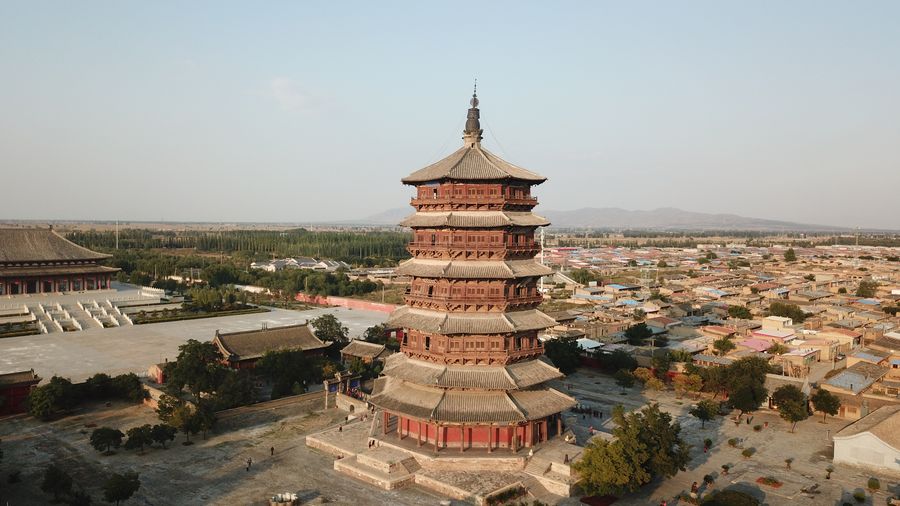
Liao rule left great monuments. Buddhism flourished under Liao patronage, and the Wooden Pagoda at Yingxian (应县) in present-day Shanxi (山西), built in 1056, is the tallest surviving wooden pagoda in China.
The Liao fell not to the Song but to a new power from the north-east. The Jurchen rose under Wanyan Aguda, and in 1125 they captured the last Liao emperor, Tianzuo (天祚), and ended the dynasty. A member of the Liao imperial family, Yelü Dashi (耶律大石), fled west and founded the Western Liao (西辽), also known as Qara Khitai, in Central Asia.
Western Xia: The Tangut Kingdom
The second state, Western Xia, grew out of the north-west. Its people were the Tangut, and its founder was Li Yuanhao (1003–1048), who proclaimed himself emperor in 1038. His capital was Xingqing, modern Yinchuan (银川).
Two years before taking the imperial title, Li Yuanhao had ordered the creation of a script for the Tangut language. The Tangut script, created in 1036 and traditionally credited to his minister Yeli Renrong (野利仁荣), used thousands of complex characters modelled on Chinese writing but entirely distinct from it. A state with its own script was a state with its own identity, and Li Yuanhao wanted both.
Western Xia’s wealth came from its position. It controlled the Hexi (河西) Corridor, the narrow passage between the mountains and the desert through which the Silk Road ran west from China. Trade passing through the corridor paid tolls to the Xia court, and the corridor cities grew rich on the traffic between China and Central Asia.
Li Yuanhao fought a series of wars against the Song between 1040 and 1044. Neither side could win a lasting victory, and in 1044 the two courts reached a settlement: the Song made annual payments of silver, silk and tea to Western Xia, and Western Xia accepted a subordinate status in name while ruling itself in practice. The settlement gave Western Xia the recognition and the income it needed, and the Song a quieter western border.
Western Xia was a Buddhist kingdom. Its cities held great temples, and its monks translated Buddhist texts into Tangut. At Khara-Khoto, known in Chinese as Heicheng (黑城), the “Black City”, a desert city in the far west of the state, thousands of Tangut books and paintings survived in the ruins, buried in the sand until explorers found them in the early twentieth century.

Western Xia was the first of the three states to face the Mongols. Mongol campaigns against Xia began in 1209, and after years of war the Mongols destroyed the state in 1227. Genghis Khan died in August 1227, during this last campaign. The cause of his death is unknown, and the accounts differ; no single explanation can be trusted. The last Xia emperor was killed, and the state was never restored.
Jin: The Jurchen Conquerors
The third state rose last and fastest. The Jurchen lived in the far north-east, and in 1115 their leader, Wanyan Aguda (1068–1123), proclaimed himself emperor and gave his state the dynastic name Jin. His capital was Huining (会宁), also called Shangjing, in the north-east.
Aguda’s first target was the Liao. In 1120 the Jin made an agreement with the Song, known as the Alliance on the Sea, under which the two states would attack the Liao together. The alliance worked: in 1125 the Jin destroyed the Liao. But the victory left the Jin as the strongest power in the north.
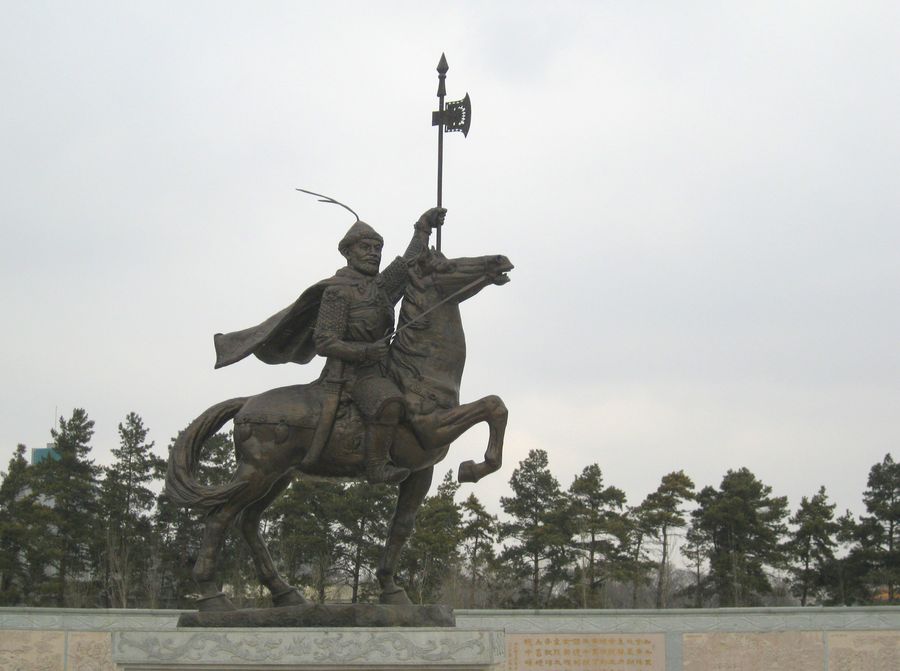
Then the Jin turned on their former ally. In early 1127 Jin armies took Kaifeng (开封), the Song capital, in the Jingkang (靖康) Incident. The retired emperor Huizong (徽宗) and the reigning emperor Qinzong (钦宗) were taken captive and carried north, and the Northern Song came to an end. The Song court fled south and regrouped, and the dynasty continued in the south as the Southern Song.
War between Jin and the Southern Song continued for years. It ended, for a time, with the Shaoxing Treaty of 1141, which fixed the Huai (淮) River as the boundary between the two states and required the Song to pay the Jin 250,000 taels of silver and 250,000 bolts of silk each year. The Song general Yue Fei (岳飞) was executed in early 1142.
In 1153 the Jin moved their capital south to Zhongdu, modern Beijing, under the emperor Wanyan Liang (完颜亮), known to history as the Prince of Hailing (海陵). The move marked a change: the Jin court now ruled a largely Chinese population from a Chinese city, and it adopted Chinese-style administration, law and examinations.
Living with the Song
For the Song, the northern states were the central problem of foreign policy for three centuries. The Song was the richest state in the region, with the largest population and the most advanced economy, yet it never managed to conquer the north. Its armies fought all three in turn, and each time the result was a settlement, not a victory.
Instead, the Song bought peace. The payments to Liao, Western Xia and Jin — silver, silk and tea, year after year — were the price of keeping the borders quiet. Song statesmen argued bitterly over whether the payments were a wise bargain or a humiliation, but the money kept flowing, and trade flowed with it. Border markets grew up where merchants from both sides met, and goods, ideas and people crossed the frontiers in both directions.
The northern courts, for their part, needed the Song as much as they threatened it. They used Chinese officials, Chinese titles and Chinese court ritual, and their rulers studied Chinese books. The frontier was not a wall but a meeting place: the Song and its rivals shared a political language even when they were at war. The Song never won back the Sixteen Prefectures, and the north remained outside Song rule until the Mongols changed everything.
Scripts, Faith and Culture
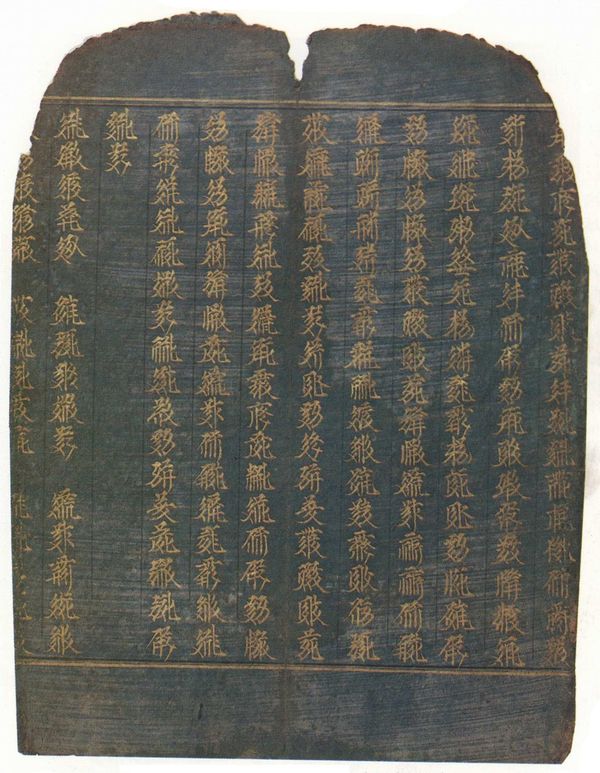
Each of the three states invented a script of its own — a declaration that it was a civilisation in its own right, not a copy of China. The Khitan created two: the large script in 920 and the small script in 925, the small script traditionally credited to Yelü Diela (耶律迭剌), the younger brother of Abaoji. The Tangut script followed in 1036. The Jurchen created their large script in 1119, traditionally credited to Wanyan Xiyin (完颜希尹), and a small script in 1138. All three scripts borrowed the idea of Chinese characters — square blocks of strokes — while writing entirely different languages.
Buddhism was the common faith of the three states. Khitan, Tangut and Jurchen rulers built temples, funded monasteries and had Buddhist texts translated into their own languages. The finest surviving monuments of the period are Buddhist, from the Wooden Pagoda of the Liao to the Tangut sutras recovered from Khara-Khoto.
The Jin went furthest in adopting Chinese ways. After the move to Zhongdu, the Jin court ran its government through Chinese-style ministries, held examinations to recruit officials, and used Chinese as the language of administration. The Jurchen language declined among the elite, and later Jin emperors tried, without much success, to keep it alive. The conquerors ended up governed in the language of the conquered.
Read more: Confucius, Confucianism and Confucian Classics
Fall: The Mongol Storm
The power that ended the last two states came from further north. The Mongols, united under Genghis Khan, destroyed Western Xia in 1227, in the campaign in which he himself died. The Jin were next. Weakened by years of war with the Mongols, they held out for seven more years.
In 1234 the Mongols, allied with the Southern Song, took Caizhou (蔡州), the Jin dynasty’s last refuge, and the dynasty ended. The campaign was fought under Genghis Khan’s successor, Ögedei. The Song, which had allied with the Mongols to destroy the Jin, had removed the last buffer between itself and the steppe.
In 1271 Kublai Khan proclaimed the Yuan dynasty, and in 1279 the Mongols conquered the Southern Song. The age of rival states was finally over, and China was once again united under a single ruler — this time a Mongol one.
Summary
For three centuries, the north of China belonged to three peoples who built states of their own: the Khitan Liao, the Tangut Western Xia and the Jurchen Jin. They fought the Song, made treaties with the Song, and took payment from the Song, but they were never ruled by the Song. They invented scripts, built pagodas and temples, and ran empires that mixed steppe traditions with Chinese statecraft. All three were gone by 1234, destroyed by the Jin and the Mongols in turn. What remains is their art, their writing and their monuments — and the reminder that China was not always one empire, and that some of its most remarkable centuries were shared among rivals.
Read more: Chinese Dynasty Timeline