
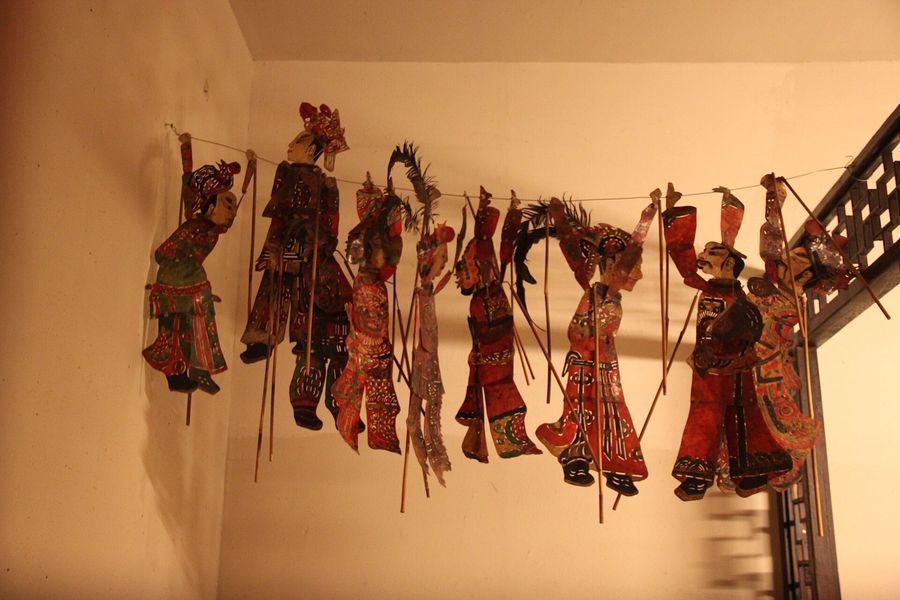
The room goes dark, and a white screen begins to glow. On it, coloured figures walk, ride, fight and dance: a general with a painted face, a monkey somersaulting through the air, a lady with long sleeves, all moving to music and song. Behind the screen, out of sight, a handful of people work the figures with thin rods, sing every part and play a dozen instruments between them. The whole play — the actors, the scenery, the orchestra — is made of flat pieces of leather and a lamp. This is Chinese shadow puppetry, called píyǐngxì (皮影戏), “leather-shadow theatre”. It is one of the oldest folk arts in China, performed for more than two thousand years, and it is still played in villages, theatres and museums today.
It is theatre, craft and music in a single art. The figures are carved from animal hide and painted in bright colours; the stories are the great tales of China, told in shadow; and the performance is sung, not spoken, to the sound of drums, gongs and strings. In 2011 UNESCO placed Chinese shadow puppetry on the Representative List of the Intangible Cultural Heritage of Humanity.
Key Facts
- Chinese name: píyǐngxì, “leather-shadow theatre”
- Born: traced to the Western Han dynasty; reliable records from the Song dynasty
- Material: animal hide — donkey hide or cowhide — carved and painted
- Screen: white cloth, lit from behind; an oil lamp once, an electric bulb now
- Troupe: about five people in Huaxian (华县), called “the busy five”
- Main stories: Journey to the West, Three Kingdoms, Water Margin
- Regional schools: north, led by Luanzhou (滦州), and south, led by Sichuan (四川)
- National listing: 2006, first batch of China’s intangible heritage
- UNESCO: 2011, Representative List of the Intangible Cultural Heritage of Humanity
Origins
The art’s origin is a love story, and it is a legend, not history. Emperor Wu of Han (汉武帝, r. 141–87 BC) lost his favourite concubine, Lady Li (李夫人), who died young. The emperor could not stop grieving, and a man from Qi named Li Shaoweng (李少翁), who claimed he could summon spirits, offered to bring her back. According to the Book of Han, he set lamps in a tent, laid out wine and food, and asked the emperor to watch from another tent. There, behind the curtain, the emperor saw a figure that looked like Lady Li, and wrote a short poem asking, “Is it she? Or is it not?” It was a séance, not a play: the Book of Han says nothing about puppets, and it was a Song-dynasty writer, Gao Cheng (高承), who first read the story as the beginning of shadow puppetry, reasoning that since the emperor could not see the figure at close quarters, it must have been a shadow. Later retellings add that Li Shaoweng was inspired by a child playing with a doll whose shadow fell on the ground, but that detail is not in the Book of Han. To make matters less certain still, the Records of the Grand Historian tells a similar story about a different consort, Lady Wang, in 121 BC. The origin, in short, is a tale with two versions, and neither can be proved.
Reliable evidence begins later. As a form of entertainment, shadow plays are documented from the Tang dynasty onwards, and by the Song dynasty they were a proper trade. In the entertainment quarters of Bianliang (汴梁), the Northern Song capital — modern Kaifeng — shadow players worked alongside singers, storytellers and acrobats. A memoir of the city, the Dongjing Meng Hua Lu (东京梦华录) by Meng Yuanlao (孟元老), preface dated 1147, names them: Dong Shiwu, Zhao Qi and Cao Baoyi are among the shadow players listed. Puppeteers say the art began in the Han dynasty, became popular in the Tang and reached its height in the Song; other sources put the peak later, in the Qing dynasty (1644–1912). Either way, by the Song dynasty the shadow play was no longer a court trick but a living trade in the streets.
Huaxian, a county in Shaanxi about ninety kilometres from Xi’an, is widely called the art’s birthplace, and its troupes are the most famous. Scholars, however, note that the origins were probably many rather than one, with different regions developing their own shadow traditions. The art did not spread from a single village: it grew up wherever people had hide, a lamp and a story to tell.
How a Show Works
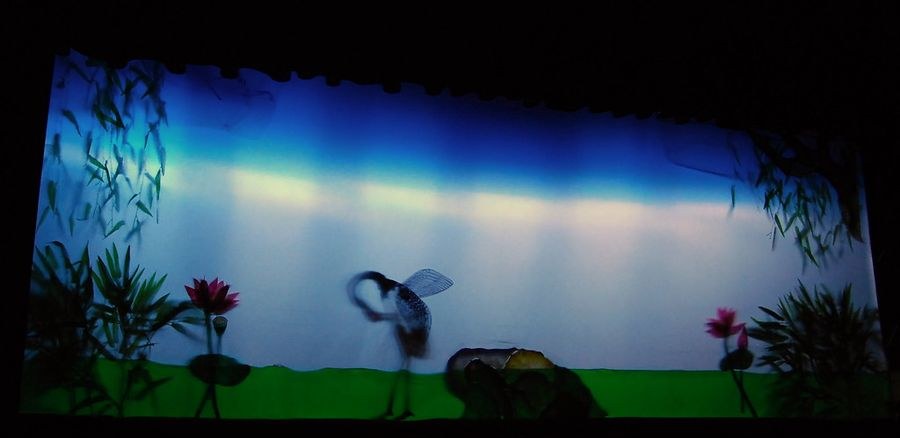
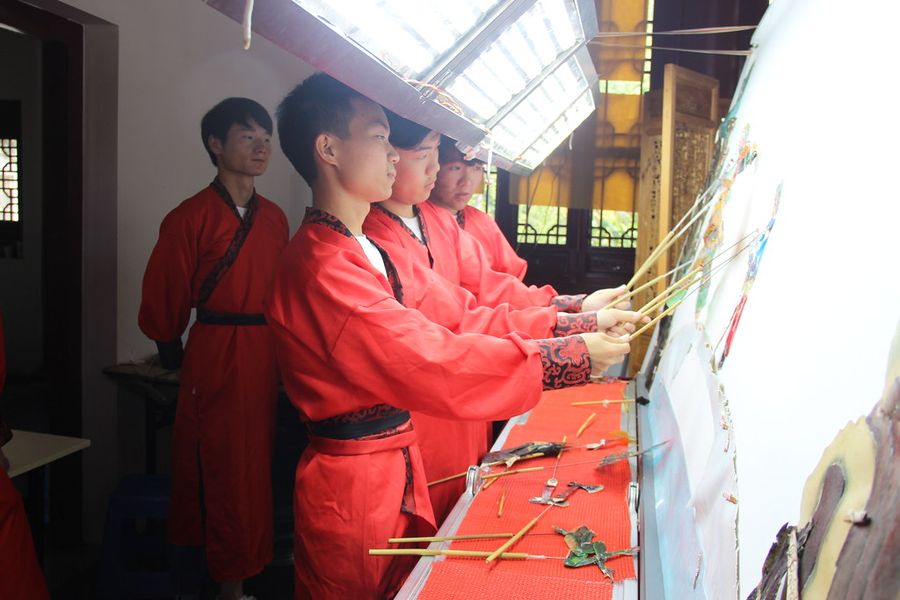
A shadow play needs little: a white cloth screen, a light behind it, and the puppets. In the old days the light was an oil lamp; today it is usually a single electric bulb. The puppeteers stand behind the screen, out of sight, and press their flat, coloured figures against the cloth. The audience sees only the shadows — but coloured shadows, because the light passes through the painted hide and the colours glow from within. The figures walk, ride, fight, fly and dance, all moved by thin bamboo rods held in the puppeteers’ hands.
The music is as important as the pictures. The singing follows the local opera tradition: one singer delivers the songs for every character in the play, changing voice from hero to villain, from old man to young lady; when the scene calls for crowds or armies, the others join in the chorus. The lead singer also plays the yueqin (月琴), a short-necked lute, and the drum, and works a foot pedal for the percussion. Around him sit the other musicians, with drums and gongs, wooden clappers, and stringed instruments such as the banhu (板胡) and the erhu; in some regions the suona joins in. In Huaxian the singing style is Wanwan Qiang (碗碗腔), a high-pitched, delicate style with long trailing notes, famous for its pathos.
A Huaxian troupe is small — about five people, known as wǔrénmáng (五人忙), “the busy five”. Between them they handle everything: stage, singing, puppets, a dozen instruments, and keeping the right figures ready. One performer may operate dozens of puppets in a single evening, and a full-length play can call for more than sixty figures. The shows are long — a village performance can run for four hours — and they are played at night, outdoors in a courtyard or a field, with the whole village watching. Children sit at the front, close enough to touch the screen.
How the Puppets Are Made
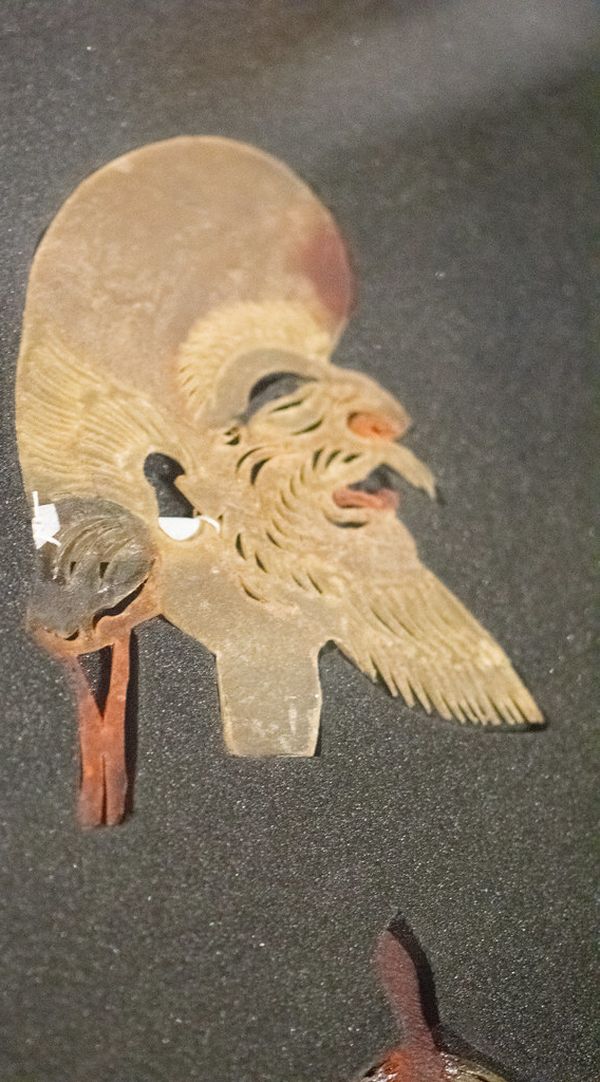
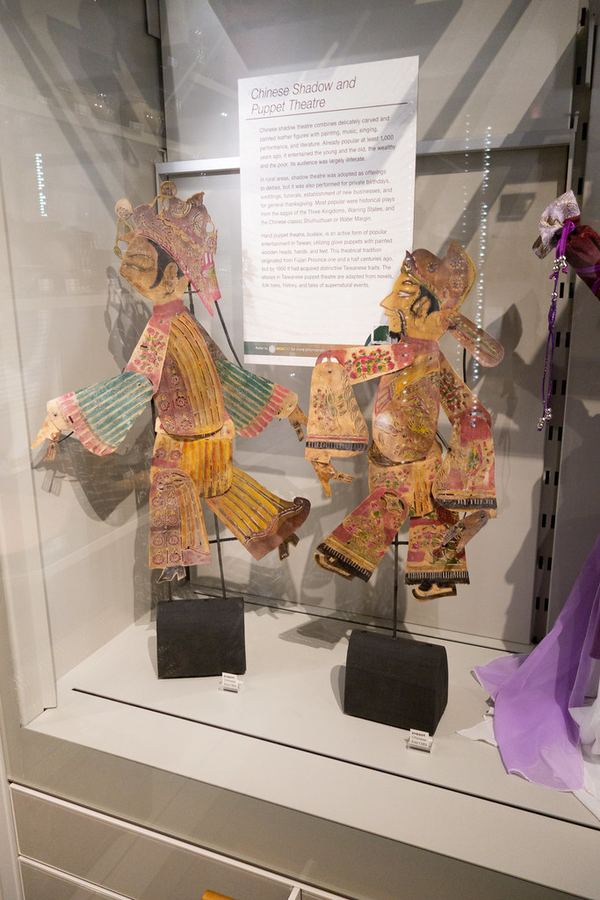
A shadow puppet begins as animal hide, usually donkey hide or cowhide. The hide is soaked, scraped and dried until it turns thin and translucent — the hide of a young donkey, three or four years old, is prized in some traditions for its fineness. Then the design is drawn on it, and the carving begins. Making one figure takes more than twenty steps, from selecting the hide to dyeing and assembly, and the carving is the hardest part: a detailed face can need more than a thousand knife cuts. Huaxian carvers use two knife techniques, one of them unique to Huaxian — the knife stays still while the carver turns the hide against the blade, which makes exceptionally smooth, rounded lines.
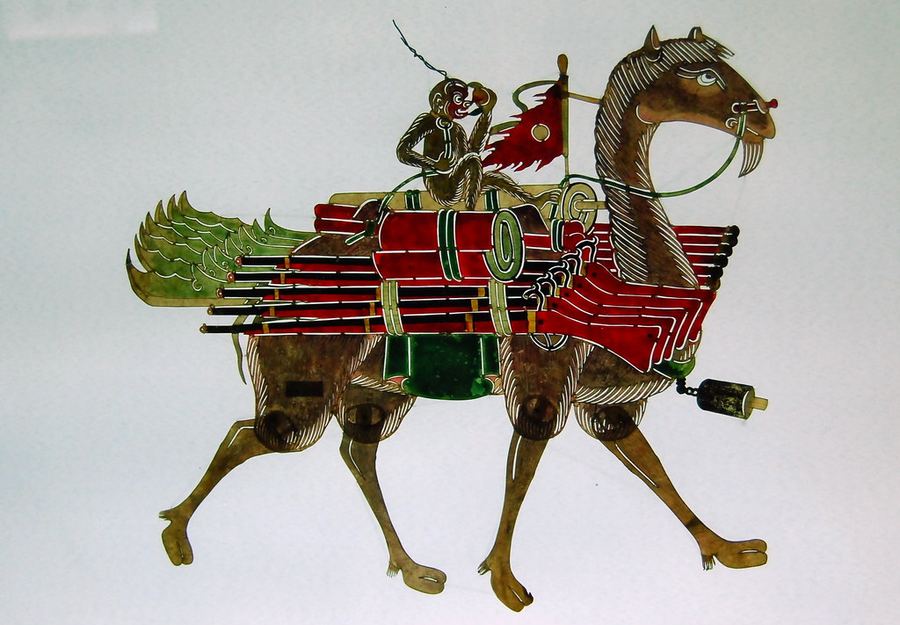
The figure is made in pieces: head, body, arms and legs, jointed at the neck, shoulders, waist, knees and elbows with thread, so that it can bend and gesture. A Huaxian figure stands more than thirty centimetres tall and has ten joints; a Luanzhou figure is smaller, about twenty-three centimetres, and is made of eleven parts. Thin bamboo rods fixed to the head and hands let the puppeteer work the figure on the screen. The pieces are painted with mineral pigments in five colours — red, green, black, yellow and white — the five colours of Chinese tradition, with yellow the colour of the hide itself and white the colour of the hollowed-out parts. Painting a puppet’s face calls for the same fine brushwork as Chinese calligraphy, and the colours are a code: they mark a character’s nature at a glance, so heroes, villains, beauties and clowns are recognisable before they speak. The costumes follow Ming-dynasty court dress, patterned with dragons, phoenixes, peonies and clouds.
Regional Schools
Shadow puppetry is usually divided into two great schools, north and south. The northern school is led by Luanzhou, in Hebei. The Luanzhou style — also called the Tangshan style, after the city of Tangshan (唐山) — took shape in the Wanli reign of the Ming dynasty (1573–1620). Its figures are small and finely carved from donkey skin, its singing is called the “Shadow Tune”, and its singers use a “pinching-throat” technique, pressing thumb and forefinger to the throat to make the voice finer. A Luanzhou troupe is bigger than a Huaxian one: at least nine people, four of them singers, two working the puppets and three playing music. More than five hundred play manuscripts survive from this tradition.
The southern school is led by Sichuan. Its figures are larger than northern ones, made for big village audiences, and bolder in colour and line. Within Sichuan there are two styles: northern Sichuan and Chengdu. Beyond these two great schools, every region has its own flavour: in Gansu the shows are sung to Daoqing (道情) music. The art spread to more than twenty provinces, and each county has its own puppets, tunes and stories. Every part of China plays with shadows, but no two regions play quite the same way.
The Stories
The shadow stage lives on stories. The great novels supply the most popular plays: Journey to the West, with the Monkey King Sun Wukong (孙悟空) at its centre — his seventy-two transformations, his staff that grows and shrinks, and his somersaults through the clouds are made for shadows; the Romance of the Three Kingdoms; and Water Margin. The same stage also plays the White Snake, Hua Mulan, the Generals of the Yang Family, and the tale of the folk hero Zhu Yuanzhang (朱元璋), the peasant who overthrew the Mongol Yuan dynasty and founded the Ming. The twelve animals of the Chinese zodiac appear too, as animal heroes, messengers and comic turns. Short comic pieces are played between the long histories — the Song memoir lists comic players too.
These are not only entertainments. Shadow plays have always been part of village life, performed at births, weddings and funerals as well as at New Year and temple fairs. A troupe may be hired for a wedding feast, or to honour the dead — one Huaxian performance on record was a four-hour play for a funeral, the story of Zhu Yuanzhang’s rise told through the night for a dead master singer’s family. The plays carry morals with them: loyalty, filial duty, honesty and courage, told in a form that even a child can follow. UNESCO notes that the art passes on cultural history, social beliefs, oral traditions and local customs — a village’s memory, performed in light and shadow. The stories it tells are the same ones told in Peking opera, and the two arts have borrowed from each other for centuries.
Shadow Puppetry Today
Shadow puppetry was named to China’s own list of intangible cultural heritage in 2006, with Huaxian shadow puppetry in the first batch, and in 2011 UNESCO placed the art on the Representative List of the Intangible Cultural Heritage of Humanity. The listing changed the craft’s fortunes. Troupes that had played only for their own villages began to teach, tour and build museums; heritage departments have collected more than sixty thousand items from a dozen provinces; and shadow plays are now performed for tourists in city theatres as well as in village courtyards.
The craft still faces hard times. Television and film have taken its audiences, young people have left the villages for the cities, and many old troupes have shrunk to a handful of ageing performers. But the listing brought classes, competitions and museum jobs, and schools in the craft’s home regions now teach it to children. In Huaxian, master singers still train apprentices in Wanwan Qiang, and near Xi’an, troupes play for tourists as well as villagers.
The art has also travelled far beyond China. From the thirteenth century onwards, it spread west along the trade routes to Persia, Arabia and Turkey, where local traditions such as the Turkish Karagöz grew from it, and on to Thailand, Burma, the Malay Archipelago and Japan. By the seventeenth century it was popular in France, Italy, Britain and Germany, where in France it was advertised as ombres chinoises. In 1781 the German poet Goethe helped build a shadow-play theatre at Tiefurt, near Weimar, and he is said to have celebrated his thirty-second birthday with a Chinese shadow play. It is often called the ancestor of the cinema — an exaggeration, but an understandable one: a dark room, a glowing screen, moving figures and music. The art that began behind a curtain in a Han-dynasty tent had become a theatre of the world.
Many foreign audiences first met Chinese shadow puppetry through the cinema. In Zhang Yimou’s film To Live (1994), the hero Fugui loses his family home at the gambling table and is given a set of shadow puppets, with which he makes his living, starting a troupe with his friend Chunsheng. It was not in Yu Hua’s novel — Zhang Yimou added it, to give the film its visual thread. The Huaxian master Pan Jingle (潘京乐) dubbed the shadow-play singing in the film, and the puppets follow Fugui through the whole story: performed for soldiers in the civil war, denounced and burned in the Cultural Revolution, and taken out of their chest again at the end, a sign of a fresh start. It is a fitting image for the art itself: like Fugui’s puppets, it has survived one disaster after another, and it is still here.
Summary
Chinese shadow puppetry began, if the legend is true, with a grieving emperor and a figure glimpsed behind a curtain, and it became, by the Song dynasty, a working trade in the streets of the capital. It is made of hide, light and song: figures carved and painted by hand, one singer for every part, and a troupe of five. It has two great schools, a repertoire drawn from China’s greatest stories, and a place on UNESCO’s list. It has travelled from a Han-dynasty tent to the theatres of Europe, and survived television, revolution and the emptying of the villages. Its real home is still the darkened room and the glowing screen, where a piece of painted leather, moved by a rod, becomes a hero, a monkey or a king.