
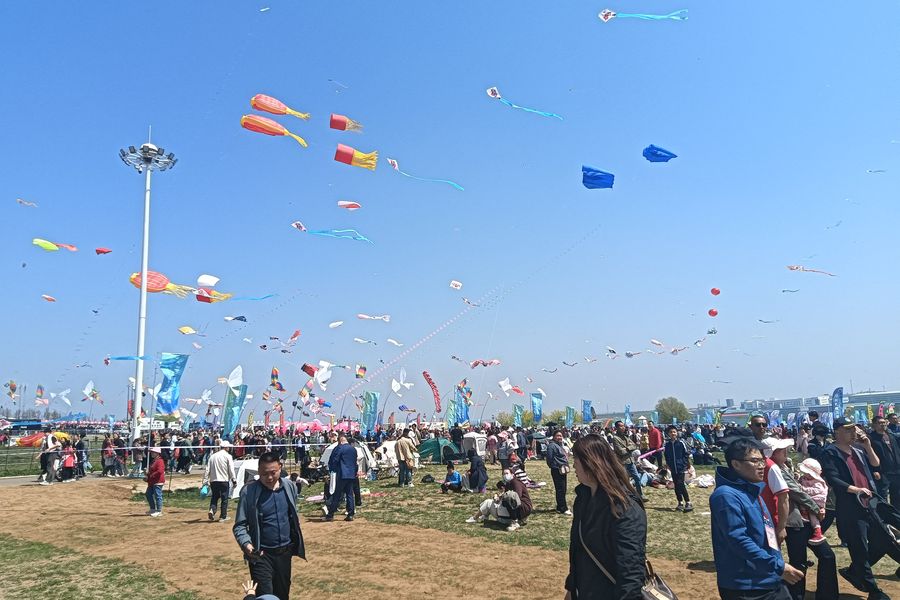
On a spring day in China, look up over almost any open field and you will see them: diamonds and butterflies, dragons and centipedes, all pulling at their strings against the wind. The kite is often called the earliest flying object made by man, and China is its home. For more than two thousand years, the Chinese have flown kites for war, for play, for prayer and for science. What began as a wooden bird became a paper swallow, a whistling dragon, a festival in the sky.
A Chinese kite is easy to recognise. Its frame is bamboo, split into thin strips and bent into shape. Its skin is silk or paper, pasted over the frame and painted by hand. Many carry wishes in their pictures: a fish for plenty, a bat for good fortune, a peach for a long life. And some sing: bamboo whistles fixed to the frame sound like music in the wind.
Key Facts
- Chinese name: feng zheng (风筝), “zheng in the wind”
- Origin: legend credits the philosopher Mozi (Mo Di, 墨子) and his disciple Lu Ban (鲁班), in the 5th–4th century BC
- Earliest written account: c. 200 BC, when the Han general Han Xin (韩信) used a kite to measure a tunnel
- Heartland: Weifang (潍坊), in Shandong (山东), which calls itself the birthplace of kites
- The craft: four arts — zha, hu, hui, fang (扎、糊、绘、放): frame, paste, paint, fly
- Famous types: the centipede kite (wugong fengzheng, 蜈蚣风筝) and dragon kites
- Festival: the Weifang International Kite Festival, first held in April 1984, held every April since
- Custom: at the Qingming Festival (清明), flyers cut the string to send bad luck away
- Heritage status: Weifang kite-making entered China’s national intangible cultural heritage list in 2006; kites are on no UNESCO list
Origins
The kite begins, like many old Chinese things, with a legend. The philosopher Mozi is said to have spent three years building a wooden bird, which flew for a whole day before it broke. His disciple Lu Ban, the master carpenter, is said to have improved on it with bamboo, cutting thin strips, smoothing them and bending them over fire — and his bamboo bird is said to have stayed in the air for three days. Nobody can show us those first kites, and the dates are tradition rather than fact. The earliest kites were made of wood and called muyuan (木鸢), “wooden sparrow hawks”.
The first kites were not toys. They were tools of war. The earliest written account of kite flying, dated to about 200 BC, describes the Han general Han Xin flying a kite over the walls of a city he was besieging, to measure how long a tunnel was needed to pass beneath its defences. It is the oldest firm record of a kite anywhere. Another story from the same wars tells how, at the Battle of Gaixia (垓下), Han Xin ordered a cowhide kite with a bamboo flute fixed to it. When the kite was flown in the wind, the Han army sang songs of Chu (楚) to the sound of the flute, and the homesick Chu soldiers lost heart. The siege gave Chinese the idiom simian chuge (四面楚歌), “Chu songs on all sides” — the songs the trapped Chu soldiers heard all around them.
In 549, during the siege of Taicheng (台城) in Nanjing, kites were flown to carry a message for help out of the besieged city. They were used to measure distances, send signals, and carry messages over walls no runner could pass. Only later, when paper made them light and cheap, did kites become something ordinary people flew for pleasure.
Kites in the Tang and Song Dynasties
Paper changed the kite. After paper-making improved in the Eastern Han dynasty, paper became common in China, and kite-makers were quick to use it: a paper kite was lighter, cheaper and easier to paint than a wooden one, and it could be made in any shape the maker imagined. The early paper kites were called zhi yuan (纸鸢), “paper sparrow hawks”, and by the Tang dynasty (618–907) they had become a popular pastime.
It was in the late Tang dynasty that the kite got the name it still carries. Some makers fixed bamboo whistles to their kites, and when the kite rose, the wind made them sound — a thin, twanging note, very like the zheng (筝), a stringed instrument. From that sound came the name feng zheng, “zheng in the wind”. Feng zheng is the name that stuck, and every Chinese child knows it today.
Under the Song dynasty (960–1279), kite flying became a fashion: the paper-making boom made paper kites cheap, and flying them became a popular outdoor activity, painted and praised in poems and pictures. In Kaifeng (开封), the Song capital, kite flying was a spring pastime, and the city’s street life is recorded in Dongjing Meng Hua Lu (东京梦华录), “Dreams of Splendour of the Eastern Capital”, a Song portrait of life in Kaifeng. By the end of the Song, the kite was no longer a soldier’s tool. It was a toy, a picture and a prayer, all at once.
How a Kite Is Made
A traditional Weifang kite is made by four arts, known as zha, hu, hui, fang: framing, pasting, painting and flying. The work begins with the frame. The maker uses Moso bamboo (maozhu, 毛竹) — the material of Chinese bamboo weaving — split into thin strips, and a good maker insists the strips of one frame all come from the same bamboo, so that they bend alike. The strips are heated over fire, bent into wings, body, head or tail, and tied together with thread. In Yangjiabu (杨家埠), the village outside Weifang where kite-making families have worked for generations, the frame is still tied by hand.
Then comes the pasting: silk or paper is laid over the frame and glued down, pulled tight to catch the wind without tearing. The covering is paper, the same material of Chinese paper cutting, chosen for lightness and strength.
The third art, painting, is where the kite becomes a picture. The painter works on the stretched paper with a brush, and the painting on a fine kite is close to the art of calligraphy: the same brush, the same ink, the same sense of a line. Some kites are painted by hand; cheaper ones use printed paper. The fourth art is flying, a skill in itself: the maker must know where to fix the bridle, how long the tail should be, and how much wind the kite can take. A badly balanced kite will spin and fall; a good one climbs steadily and hangs in the sky as if it belonged there.
Some kites also sing. In Nantong (南通), in Jiangsu (江苏), makers build the banyao (板鹞), a large, flat, whistling kite with a hexagonal frame. Dozens of whistles — sometimes more than a hundred — are fixed to it: large ones made from gourds, small ones from the shells of chestnuts, ginkgo nuts and longan fruit. High in the air, they sound together in different tones, like a small orchestra. Nantong’s banyao craft joined the national intangible cultural heritage list in 2006, the same year as Weifang’s. Modern kites use new materials — nylon for the skin, carbon fibre for the frame — but the four arts have not changed.
The Shapes and What They Mean
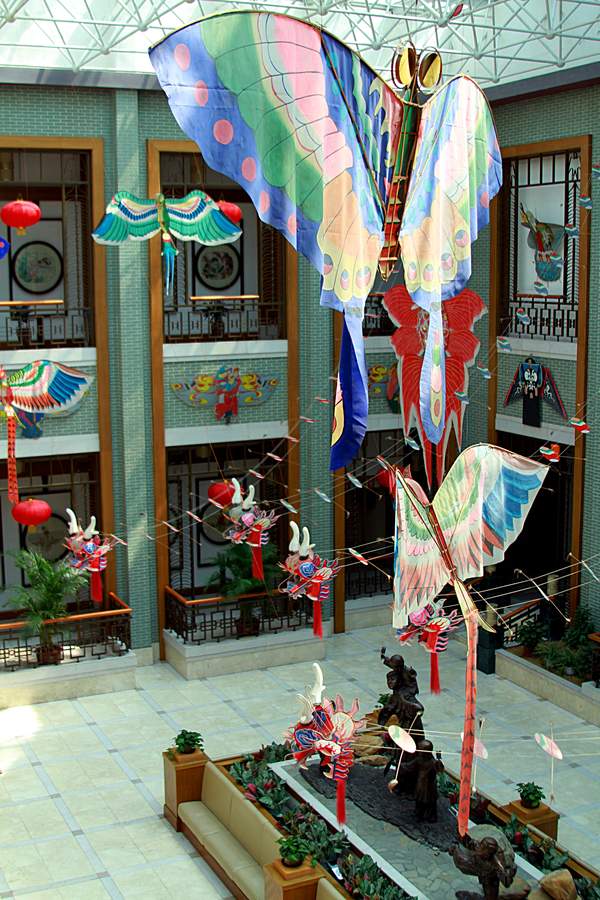
There are said to be more than three hundred varieties of Chinese kite, in shapes that cover almost everything that flies, swims, walks or is imagined: birds and beasts, fish and insects, flowers, figures, masks and written characters. The shape is not decoration; it is the kite’s meaning, and the people who fly it know how to read it.
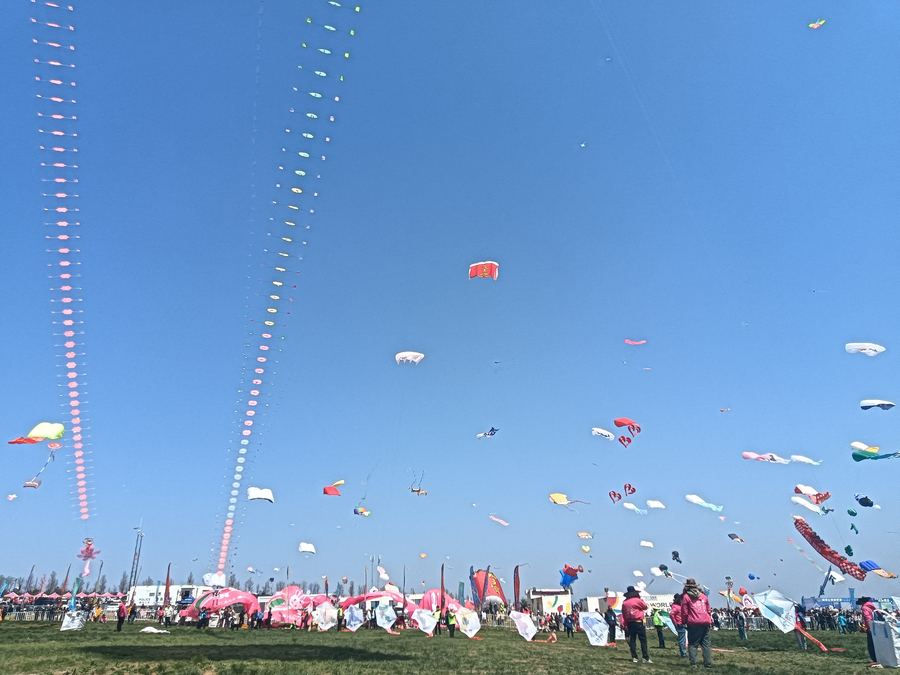
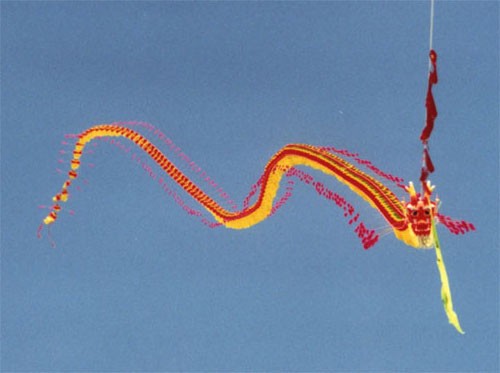
The most famous Weifang type is the centipede kite, a long chain of small, linked sections that ripples through the sky like a crawling insect. Its cousin is the dragon kite, a serpent with a painted head, a body of many sections and a long tail. The best-known dragon kites of Weifang, Longting (龙亭, Dragon Pavilion) and Julong (巨龙, Giant Dragon), take several people to launch. A dragon in the sky is a wish for power and good rain; a centipede, its long body painted with a hundred children, is a wish for family prosperity.
The swallow kite is the classic kite of Beijing: the swallow in flight, with forked tail and outstretched wings. Its making is traced to Cao Xueqin (曹雪芹), the Qing-dynasty author of A Dream of Red Mansions, who designed many styles of swallow kite and wrote a book of rhymes explaining how to make them. The swallow is a bird of spring, and a swallow kite is a spring wish: a real swallow nesting in a house is said to be good fortune, and a painted one carries the same hope.
The painting on a kite is a language of good wishes. A fish drawn on a swallow-shaped kite carries the wish nian nian you yu (年年有余), “surplus every year”, because the word for fish sounds like the word for surplus. Bats, peaches, pine trees and cranes painted on a kite mean fortune, wealth and longevity. A kite-maker will tell you plainly: a bat represents luck, a fish means abundance, and a peach is a symbol of a long life — so a kite is a good gift for an older person.
Kites at Qingming and Other Festivals
Kite flying belongs to spring, and spring in China is festival season. The great day for kites is the Qingming Festival, the tomb-sweeping day in early April, when families visit the graves of their ancestors, then go out to enjoy the spring. Flying a kite at Qingming was never only play: in ancient times people wrote their illnesses and troubles on the kite, and when it was high they cut the string, so that the wind would carry the bad luck away and bring good fortune instead. Folklore also says that on Qingming the gate of the world of the dead stood open, and a kite could carry greetings to loved ones who had passed away — a folk belief, not a fact, but it is why kite and Qingming belong together. Kites were flown in the evening too, with little lanterns tied to the kite or its string, so that they looked like twinkling stars.
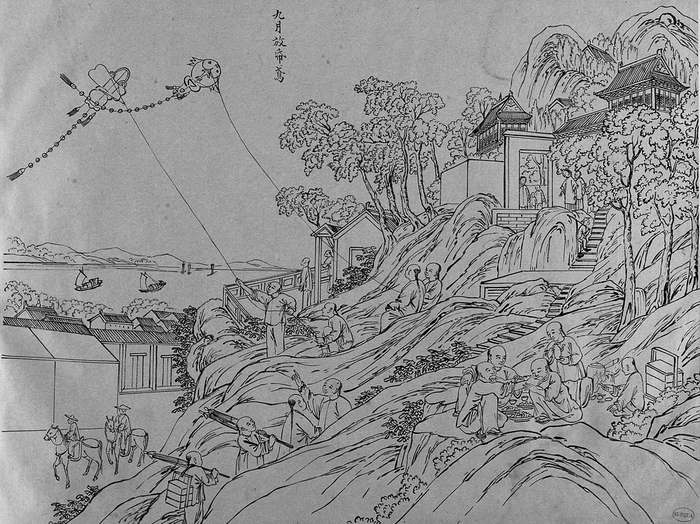
In Kaifeng, an age-old custom is still popular: on Qingming, people fly their kites as high and as far as they can, then deliberately cut the line, letting the kites drift away on the wind. It is a symbol of letting go of the unhappiness and sadness of the past year, and it is believed to keep illness away for the whole year to come. Kites are flown at the Spring Festival too: the New Year holiday opens the year’s flying season, and temple fairs sell painted kites for the spring. Kites are flown in autumn as well: a 19th-century drawing, inscribed “flying kites in the ninth month”, shows people flying kites on a hillside, and the ninth month is the season of the Double Ninth Festival (Chongyang, 重阳), when people climb hills and look to the year ahead.
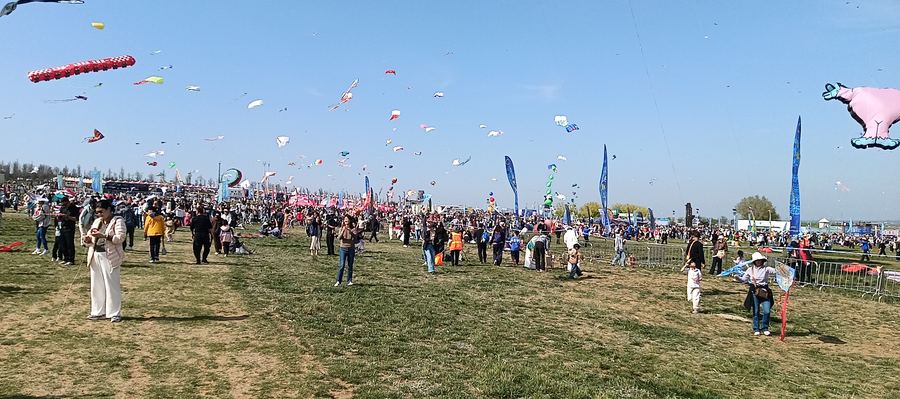
The greatest kite festival of all is in Weifang. The first Weifang International Kite Festival was held in April 1984, after the city’s kites impressed officials of an international kite association in Shanghai. It has been held every April since. In 1988 Weifang was given the title of World Kite Capital (Shijie Fengzheng Du, 世界风筝都); in 1989 the headquarters of the International Kite Federation was set up there. Weifang calls itself the birthplace of kites — a local claim — and its kite-making craft entered the first batch of China’s national intangible cultural heritage list in 2006. Kites are on no UNESCO list, and Weifang’s listing is a national one, but the festival needs no other title: every April, the sky over the city fills with kites from many countries.
Kites Around the World
From China, kite flying spread to Korea and Japan, and through South and Southeast Asia, where it took local forms still flown today: the moon kite, wau bulan, of Malaysia; the rokkaku and edo kites of Japan; the fighting kites of India, Pakistan and Afghanistan, flown in battles with glass-coated lines. The kite’s journey west followed the Silk Road and the sea lanes that joined China to the rest of the world: stories of kites reached Europe with Marco Polo towards the end of the 13th century, and real kites were brought back by sailors from Japan and Malaysia in the 16th and 17th centuries.
In Europe, the kite became an instrument of science. In 1749, Alexander Wilson and Thomas Melville of Glasgow flew a train of kites carrying thermometers, to measure air temperature above the ground, the first recorded use of kites for meteorology. Three years later, in 1752, Benjamin Franklin flew a kite in a thunderstorm in his famous lightning experiment, showing that lightning was electricity. The kite that had once measured a tunnel for a Chinese general was now measuring the sky.
Today the kite is flown everywhere, and the Chinese kite is still the model most makers look to. Modern sport kites of nylon and carbon fibre fly with two or four lines for acrobatics, and giant show kites fill festival skies around the world. But the old shapes are still there: the dragon, the centipede, the swallow, the butterfly. In China, and wherever Chinese communities have settled, the kite is still what it has always been — a small painting, a wish and a toy, held up by the wind.
Summary
The Chinese kite began as a legend — a wooden bird that flew for a day — and became a soldier’s tool, a paper toy, a painted wish and a festival in the sky. It has measured tunnels and temperatures, carried messages out of besieged cities, and taken its name from the wind itself. In Weifang, the craft is still tied, pasted, painted and flown by hand, and every April the sky fills with dragons, centipedes, swallows and butterflies. More than two thousand years after Mozi’s wooden bird, the kite is still flying — still often called the earliest aircraft of all.